



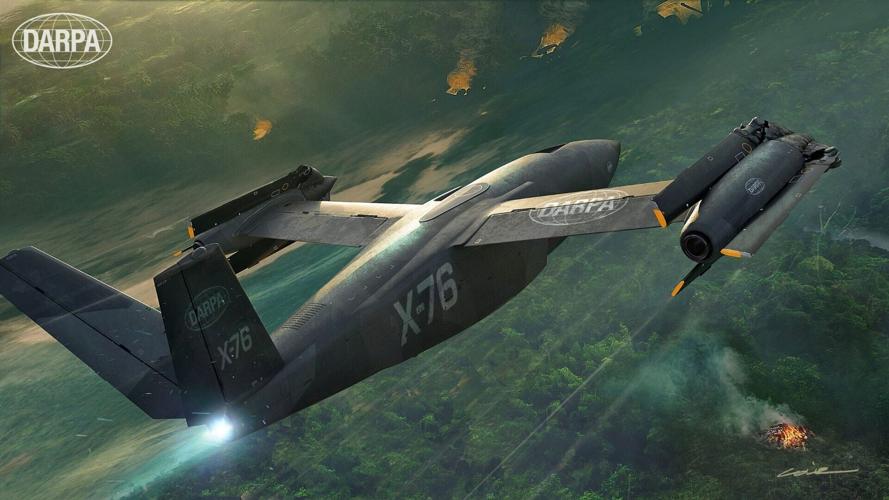

Artist impression of the X-76 aircraft. (DARPA via SWNS)
By Dean Murray
The United States is to unleash a futuristic fleet of nextâgen warplanes.
The new XâPlane, officially revealed as the Xâ76, is able to take off without a runway but still fly at fast speeds like a fighter jet.
DARPA, the research and development agency of the United States Department of Defense, announced Monday (Mar 9) that it has begun building the aircraft.
They said: "Eliminating one of the battlefield's most difficult choices – between the high speed of an aircraft that needs a runway and the go-anywhere flexibility of a slower helicopter – is the goal of DARPA’s SPeed and Runway INdependent Technologies (SPRINT) program."
SPRINT’s experimental aircraft is now being built by Bell Textron, Inc. following a successful Critical Design Review (CDR).
Features include cruise speeds exceeding 400 knots, as well as the ability to hover in austere environments and operate from unprepared surfaces.

Artist impression of the Xâ76 aircraft. (Colie Wertz / DARPA via SWNS)
Cmdr. Ian Higgins, U.S. Navy, serving as the DARPA SPRINT program manager, said: "For too long, the runway has been both an enabler and a tether, granting speed but creating a critical vulnerability."
"With SPRINT, we're not just building an X-plane; we're building options. We're working to deliver the option of surprise, the option of rapid reinforcement, and the option of life-saving speed, anywhere on the globe, without needing any runway."
DARPA said: "The designation places it within the historic lineage of X-planes that have long served to test the boundaries of aviation. Coinciding with the country’s 250th anniversary, the X-76 designation is a deliberate nod to the revolutionary spirit of 1776."
The SPRINT program is a joint effort between DARPA and U.S. Special Operations Command to advance technologies.
A flight test program is planned for early 2028.