


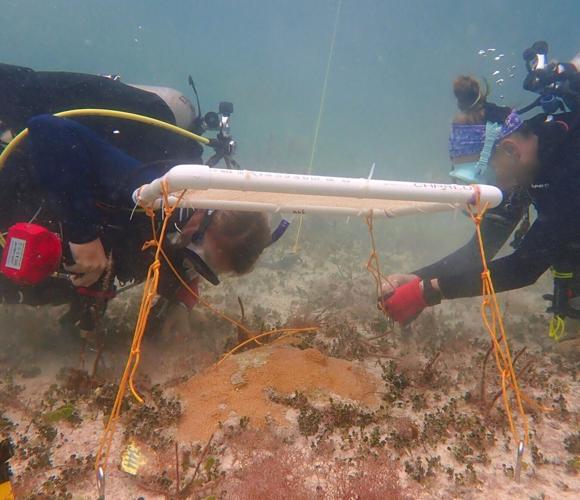
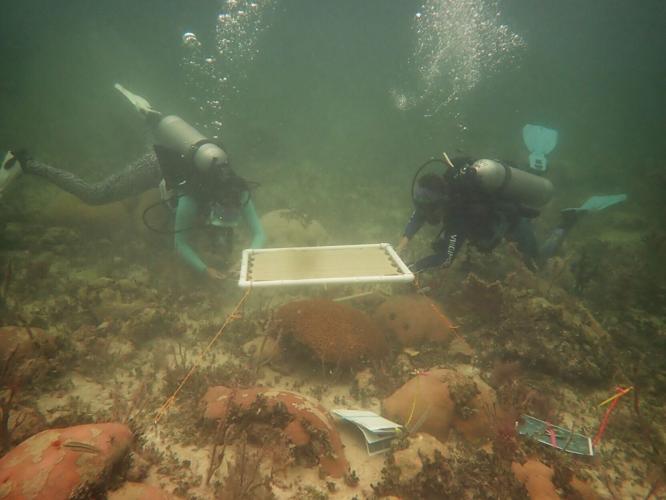

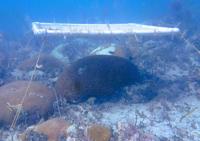

Karen Neely (left) and Kathryn Toth (right) work on a shade. (Arelys Chaparro via SWNS)
By Stephen Beech
Underwater umbrellas could protect coral reefs from heat damage, according to a new study.
Temporary shades placed over particularly vulnerable Caribbean corals mitigate and even partly reverse bleaching driven by marine heat waves, say American scientists.
High sea temperatures driven by global warming damage coral reefs, bleaching them ghostly white and eventually killing them.
Restoring dead reefs is possible, but the process is difficult and expensive, and restored corals are vulnerable to future heat waves.
Ecologists say finding ways to prevent damage to existing reefs is crucial.
Now scientists believe they've found a way to protect some particularly vulnerable Caribbean corals in the shape of umbrella-like shades.
They say shading can't cool the water, but it prevents ultraviolet and irradiance damage, which makes heat damage to corals worse.
Study lead author Karen Neely said: "Heat-related coral bleaching is probably the biggest threat to reefs worldwide, and we absolutely have to address climate change to have any hope of reefs as we know them existing in the future.

Kathryn Toth (left) and Arelys Chaparro (right) at work on a coral shade. (Arelys Chaparro via SWNS)
"Solutions like shading can offer temporary protection on small scales.
"The 2023 coral bleaching event in Florida essentially wiped out branching corals, and at some inshore sites had a devastating impact on brain corals.
"This study stemmed directly from that event: we wanted to provide proof of concept for tools to save targeted corals in similar future events."
In the summer of 2024, Neely and her team set up 20 custom-made shades over 10 different colonies of two species of brain coral, Pseudodiploria clivosa and Colpophyllia natans, at Newfound Harbor, Florida Keys.
They also selected 20 matching corals to act as controls.
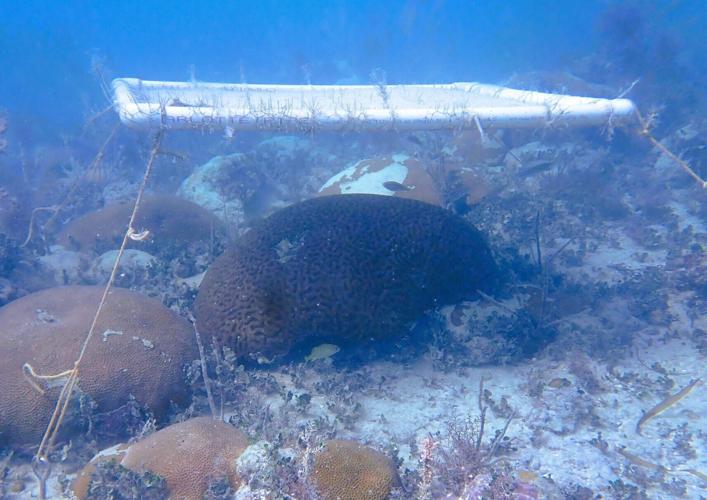
The umbrella-like shades — made of pipes with nylon cloths attached — were temporarily fixed to the seabed with cord and floated 30 centimeters (11.8 inches) over each shaded coral.
They reduced light by 60%, according to the study published in the journal Frontiers in Marine Science.
Divers visited every two weeks to track color changes and take tissue biopsies from the corals, to monitor the algae living inside the corals' tissues.
Neely, of Nova Southeastern University in Florida, explained that corals have a "symbiotic" relationship with the algae: the coral provides the algae with a home and the algae provides the coral with most of its nutritional needs.
She said algae also lend corals their color, so when corals turn white under heat stress, scientists know that the relationship has broken down and the coral is starving.
Although the heat stress measured at Newfound Harbor that summer was the second-highest on record, the shaded corals lost less color than expected.
And the differences were greatest during the most intense periods of thermal stress.
Meely said: "Shaded corals even recovered some of their color after the shades were installed."

A shaded coral. (Arelys Chaparro via SWNS)
However, she and her colleagues also saw less bleaching than they expected overall, and no dead coral.
The researchers said that could have been because 2023's record heat wave meant that most of the corals were occupied by an algae called Durusdinium, which is very heat-tolerant but is associated with lower coral growth and possibly greater susceptibility to disease.
Neely said: "Shades reversed the observed bleaching, but the event wasn't severe enough to cause mortality on control or shaded corals.
"However, we know that even bleaching that doesn't cause mortality can impact corals' future disease susceptibility and reproductive capacity.
"It would be interesting to quantify if and to what extent shade structures benefited these corals after their removal by tracking disease and reproductive output."
The research team found no differences in density of algae occupation or algae species between the control and shaded groups.
They believe that could have been influenced by the sampling location as the team's permits stipulated sampling from the corals' edges, which are less exposed to the light and experience less bleaching.
Similar constraints also meant that the research team couldn't install the shades until well after the water temperature got high enough to bleach coral.
They believe that if they'd been installed earlier, the shades might have been more effective.
However, the study found there was still a "significant" positive impact.
Nelly added: "Scaling is the big limitation of this study.
"Shading is not a cure-all for coral reefs, and its use would require hard decisions about what corals are worth saving.
"We found it was effective on two highly susceptible coral species, so it is likely to be useful for most others, but additional studies would be needed to confirm that.
"It is also likely that thermal stress would reach a point at which no amount of shading could help a coral, but only future experimentation would be able to define the bounds of that."