


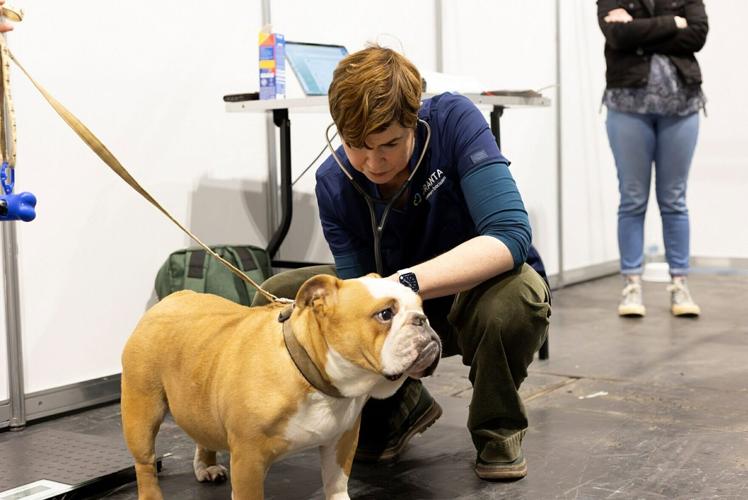








An English bulldog being inspected. (Ellie Smeaton via SWNS)
By Stephen Beech
More selective breeding may help protect pugs and bulldogs from a potentially deadly breathing condition, suggests new research.
They are among several flat-faced dog breeds threatened by Brachycephalic Obstructive Airway Syndrome (BOAS).
The new study involving more than 4,000 pugs, bulldogs and French bulldogs found that respiratory health and nostril size are heritable traits.
Study lead author Joanna Jadwiga Ilska, a geneticist at The Royal Kennel Club, says breeding programs could alter heritable dog characteristics to reduce BOAS rates.
Ilska said: "Dog breeds with flat faces are frequently diagnosed with BOAS, which can cause noisy breathing, difficulty during exercise, an inability to cool off, and, in severe cases, even death.
"Flat-faced obese dogs have a higher risk of developing the disease, and tend to have more severe symptoms.
"But despite the high prevalence of this disorder in many popular dog breeds, the underlying genetic basis of BOAS has been poorly understood."

(Photo by Mladen ŠÄekiÄ via Pexels)
The study, published in the journal PLOS One, estimated the heritability of BOAS in bulldogs, French bulldogs and pugs.
The research team looked at respiratory health — determined by a standardized exercise test — and Royal Kennel Club breeding records of more than 4,000 dogs.
The analysis showed that two characteristics related to respiratory health were moderately heritable: 21% to 49% of variability in dogs' respiratory function and 31% to 39% of variability in nostril size were attributable to genetics.
Poor respiratory function, narrow nostrils and high body weight also tended to occur at the same time, suggesting it may be possible to improve respiratory health by avoiding breeding dogs with those traits.
French bulldogs had the lowest prevalence of BOAS in the study, at 15.6% of tested dogs, compared to 18.9% of bulldogs and 19.8% of pugs.
Ilska said the rates are lower than previous estimates, possibly because few flat-faced dogs are screened for BOAS unless they show symptoms.

(Photo by Teja J via Pexels)
The study also utilized samples that were up to 10 times larger than earlier reference values.
The research team also noted that potential health management improvements may have been made since previous studies.
For owners of the many existing dogs with BOAS, the Royal Kennel Club recommends management of symptoms by keeping dogs lean, giving them frequent breaks during walks and helping them stay cool in the summertime.
Ilska says the new findings provide hope for future prevention of BOAS in flat-faced dogs, through the establishment of more selective breeding programs to help new generations to breathe easier.
But she said better breeding practices will depend on more widespread testing of dogs for respiratory health.

(Photo by Franco Monsalvo via Pexels)
Ilska said: "Together, these efforts may help reduce the prevalence of BOAS population-wide and enhance the welfare of these popular breeds."
She added: "Our findings provide clear evidence that respiratory health in these breeds is influenced by genetic differences between dogs, and importantly, that improvement is achievable through selective breeding.
"By using objective tools like the Respiratory Function Grading Scheme, breeders can make more informed decisions that prioritize health, helping to reduce the prevalence of BOAS over time.
"It is also important to recognize that this research is based on dogs within the Royal Kennel Club's registered population and may not reflect those bred outside of this system.
"This highlights the value of Royal Kennel Club registration, as participation in schemes like the RFGS allows registered dogs to contribute to scientific research that supports the long-term health and welfare of the breed.
"Increasing participation in health screening is also key to achieving progress and ensuring that future generations of these popular breeds can enjoy better quality of life."