


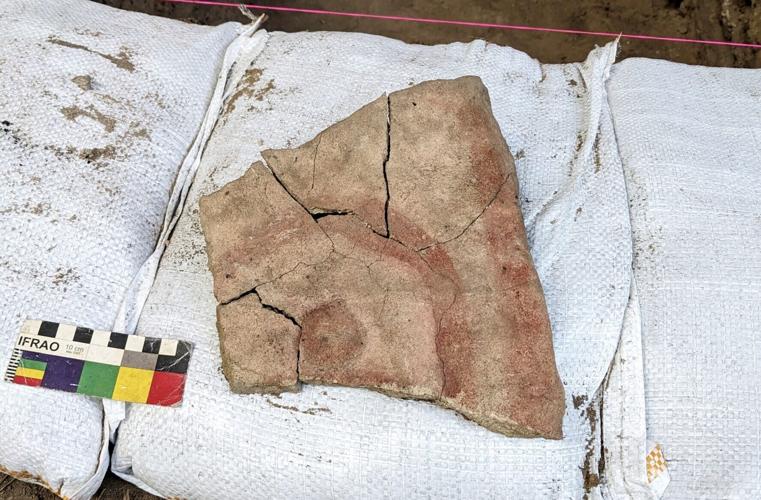





A 4,000-year-old painted stone plaque discovered on Wetar Island, Indonesia. (Shimona Kealy / ANU via SWNS)
By Stephen Beech
Ancient mariners took symbolic art on their epic voyages 4,000 years ago, reveals new research.
The paintings may have served as lucky charms — with early sailors regarding them as symbols of protection, say archaeologists.
A 4,000-year-old painted stone plaque discovered on a remote Indonesian island is the first known example of portable art belonging to the Austronesian Painting Tradition (APT).
The discovery, described in the journal Proceedings of the National Academy of Sciences (PNAS), was made by an international team during excavations at Huknaur rock shelter on Wetar Island, eastern Indonesia.
The team says it provides a "rare glimpse" into the symbolic world of some of history's greatest maritime voyagers.
The plaque bears a distinctive red concentric-circle and radiating "sun-ray" design characteristic of the APT — a style of rock art found across eastern Indonesia and the western Pacific in regions where Austronesian languages are spoken.

(Photo by Ylanite Koppens via Pexels)
Although APT paintings are widespread, most occur on cave and rock shelter walls and are difficult to date, leaving their chronology poorly understood.
But the Wetar plaque provides the first evidence that the designs were also painted on portable objects.
The research team says its securely dated archaeological context provides a rare age for the characteristic motif.
Study lead author Sue O'Connor says the discovery changes understanding of how the symbols may have been used.
O'Connor, from the Australian National University (ANU), Canberra, said: "This is the first portable example of Austronesian painted art ever found archaeologically.
"Portable symbols could travel with people and may have helped communicate shared identities, affiliations and beliefs between island communities.
"Similar sun-like designs were historically painted on boats and other objects, where they could function as symbols of protection and group identity."
Co-author Shimona Kealy, also of the ANU, said radiocarbon dating of the archaeological deposits placed the plaque between 4,090 and 3,900 years ago, when Austronesian-speaking peoples were "rapidly dispersing."
Kealy said: "This discovery shows that the characteristic sun-ray motif was already part of the APT during the earliest Austronesian expansion into southern Wallacea.
"These people were extraordinary seafarers, rapidly dispersing across thousands of kilometers of ocean.
"The Wetar plaque shows that art and shared symbolic traditions were part of this great maritime dispersal from its earliest phases."

(Photo by Mo Eid via Pexels)
She said the plaque was found in a pre-ceramic layer, indicating that the APT reached Wetar before pottery — one of the principal material traits traditionally used by archaeologists to trace Austronesian expansion.
Co-author Ceri Shipton, also of the ANU, says the find provides a new perspective on what the earliest Austronesian pioneers brought with them.
Shipton said: "This discovery shows that Austronesian pioneers arrived with a compelling ideology represented by the APT paintings, prior to more extended contacts bringing pottery."
He added: "People didn't just carry technologies and possessions when they voyaged to new islands.
"They carried ideas, identities, and new ways of understanding the world."