


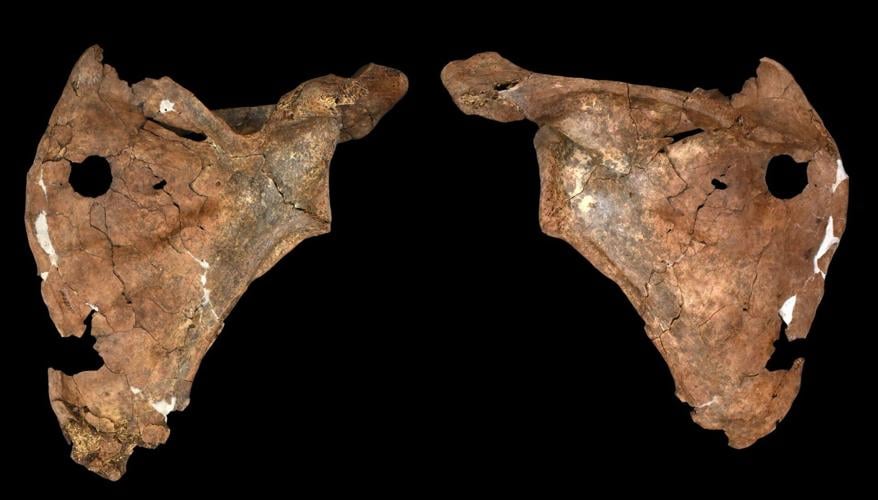


The ventral (left) and dorsal (right) views of the Shanidar A scapula. Ventral is the front of the scapula, the side that faces the ribs (chest). Dorsal is the back of the scapula. (Dr. Emma Pomeroy via SWNS)
By Stephen Beech
A fatal wound inflicted 75,000 years ago may be the earliest evidence of a human ancestor killed by a spear.
The circular hole was found in the shoulder blade of a Neanderthal whose partial remains were unearthed in a cave in Iraqi Kurdistan.
Scientists believe it could be the earliest known example of “lethal interpersonal violence” with a sharpened wooden spear in the fossil record.
They say the remains also show evidence of a painful facial injury from at least a year before the victim’s death.
The shoulder blade was excavated alongside a mostly complete right hand, two left ribs plus a right-rib fragment, and seven teeth from an adult Neanderthal estimated to have been around 45 years old when they died.
The Neanderthal’s scapula — a broad, flat bone so thin in places it becomes almost translucent when held up to light — was preserved almost intact under 7.5 meters (24.6 feet) of rock and sediment for around 75,000 years.
The only mark was a 15-millimeter-wide circular perforation made by a spear of sharpened wood, according to a study published in the journal Scientific Reports.
Cambridge University archaeologists, who led the excavation, said a spear tip of flint or stone would have left a flat or angular hole.
They say the spear penetrated the left chest cavity from the front and traveled through the body — including lung and likely major arteries — before punching a hole in the left scapula, causing rapid death.

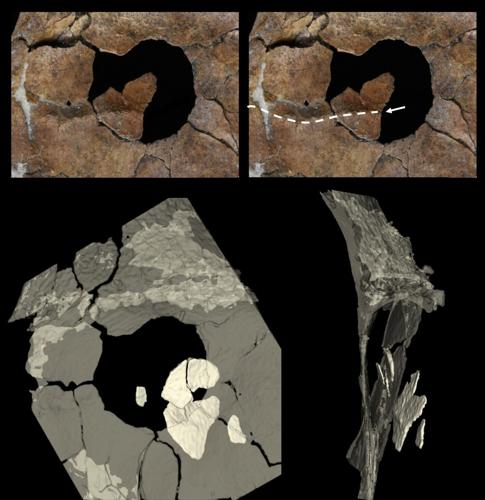
The hole in the scapula and the fragments found embedded in the sediment below the perforation. Top left: Ventral view of the hole in the scapula, showing two refitting fragments. Top right: The linea muscularis, highlighted by the dashed line, indicates that the fragments are correctly refitted. Bottom: 3D rendering of the hole and fragments embedded in the sediment underneath the scapula in situ prior to conservation. (Dr. Emma Pomeroy via SWNS)
The team believes the fatal strike may have been an intended “heart shot.”
They found tiny shards of bone displaced by the weapon, the position of which suggests a spear entered from above at a downward trajectory.
Study lead author Emma Pomeroy said: “It’s extraordinary to have a perfectly preserved scapula from 75,000 years ago.
“These bones are so thin that you often don’t get complete scapulae from modern burials.
“We were able to lift it out in one piece from under almost eight meters of rock and sediment.”
Archaeologists call the remains Shanidar A after the cave in which they were found.
Due to decomposition, very few wooden objects survive for long periods of time.
Some waterlogged examples of spears dated to around 200,000 years ago — when early Neanderthals roamed Europe — were found in Schoningen, Germany, in the 1990s.
The preserved spears were manufactured from carefully selected timber to have weight distribution optimized for throwing, like modern javelins, and were probably used for hunting game.
The earliest known rounded wooden spear is over 400,000 years old.
Just the pointed end survived after being pulled from the shoreline at Clacton-on-Sea, Essex, in 1911.
The research team believes similar technology may well have caused the death of Shanidar A.
Pomeroy, a fellow at Newnham College, Cambridge, said: “Holes left by recreations of spears from this time are an excellent fit for the one we found in the Neanderthal scapula.
“That early technology absolutely works for this wound.
“What evidence we have suggests that Neanderthals and their ancestors developed woodworking and weapon-making skills many thousands of years before the death of Shanidar A.
“This package of capabilities could have spanned the full range of Neanderthal homelands, from Wales to Siberia.”
Pomeroy suggested that the death might have been a hunting accident.

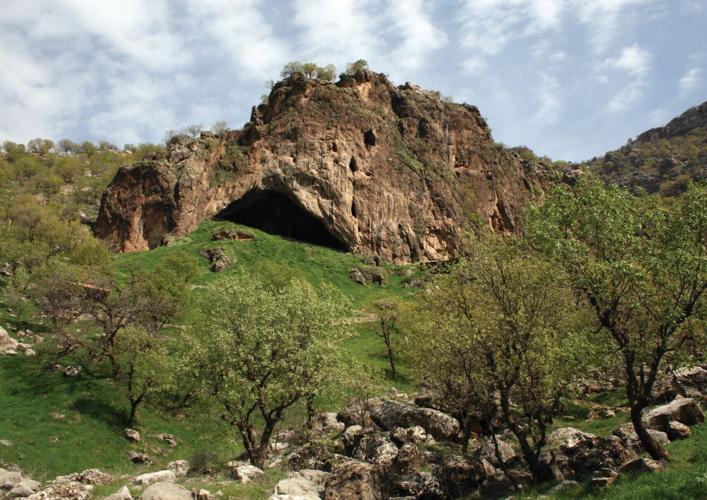
View of the entrance to Shanidar Cave in Iraqi Kurdistan. (Dr. Emma Pomeroy via SWNS)
She said: “Animals such as mammoths may have been hunted up close with thrusting spears, so it’s easy to imagine lethal injuries.”
Bur Pomeroy says there are hints of deliberate violence.
She said: “The position of the wound and the force required to push it right through the Neanderthal’s body bear the hallmarks of an intended kill shot directed toward the heart.”
The researchers say there is no way of knowing the context for the violence, and whether modern humans could have been involved.
Cambridge professor Graeme Barker, who leads the Shanidar Cave excavations, said: “All we can ever know about the end of this Neanderthal’s life is that it was violent, and came at the end of a wooden spear.”
He added: “Evidence of systematic violence is extremely rare in deep prehistory.
“The vast majority comes from periods of settled farming communities thousands of years after hunter-gather societies like our Neanderthals.”
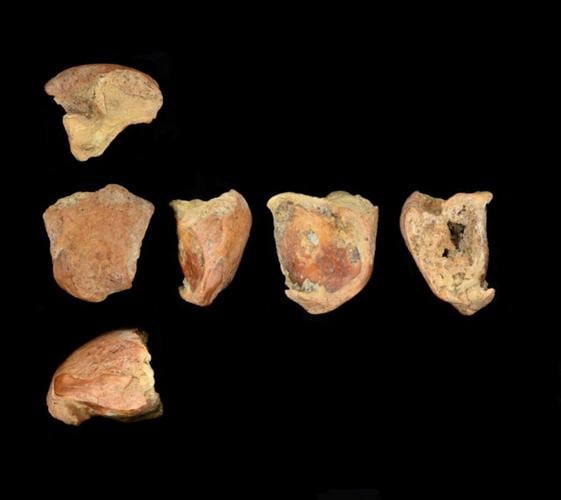
An incisor tooth from the front of the lower jaw had been split lengthwise, with only half remaining, while surrounding teeth had been rotated inward.
The half-tooth had significant tartar buildup along the exposed root canal, suggesting it stayed in the mouth for some time after what scientists say must have been major blunt-force trauma to the front of the face.
Pomeroy said: “Surviving a blow that splits a tooth in this fashion, then continuing to live and eat for a period of at least a year and maybe more, would have required care and support from other Neanderthals.”
She says Shanidar A may have been fed soft food after the initial injury.

Various views of the mandibular left lateral incisor that had been spilt longitudinally. Views of the tooth, from left to right: top (chewing surface), bottom (root end). Middle: toward the front of the dental arch (mesial), toward the lips (labial), toward the back of the dental arch (distal), and toward the tongue (lingual). (Dr. Emma Pomeroy via SWNS)
Previous research on sediment in Shanidar Cave shows that plant foods were being soaked before cooking around the same time.
Pomeroy said: “There’s no doubt that Shanidar A would have had difficulty communicating and been in absolute agony for a long period of time.
“The remains of Shanidar A reflect the dual nature of so much of what we recognize as human.
“On the one hand, we have evidence of a terribly violent end.
“On the other, this was clearly an individual who was cared for during their lifetime.”
Barker added: “It is fascinating to have evidence for both compassion and violence among Neanderthals, our closest evolutionary cousins, embodied in this one individual.”
The spot where Shanidar A was unearthed in 2020 is located directly behind a large vertical boulder, near where other Neanderthal remains have been found.
Pomeroy said: “These Neanderthals returned to the same place to lay their dead to rest.
“Some were deposited before the earlier body had fully decomposed, so this was happening within years or decades.”