
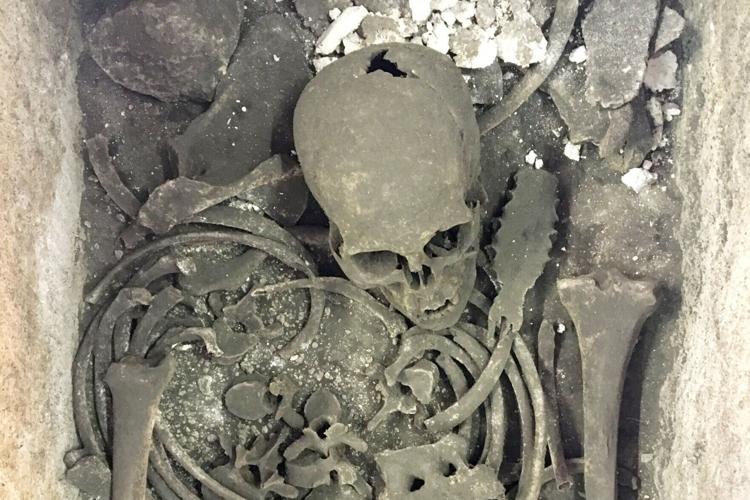
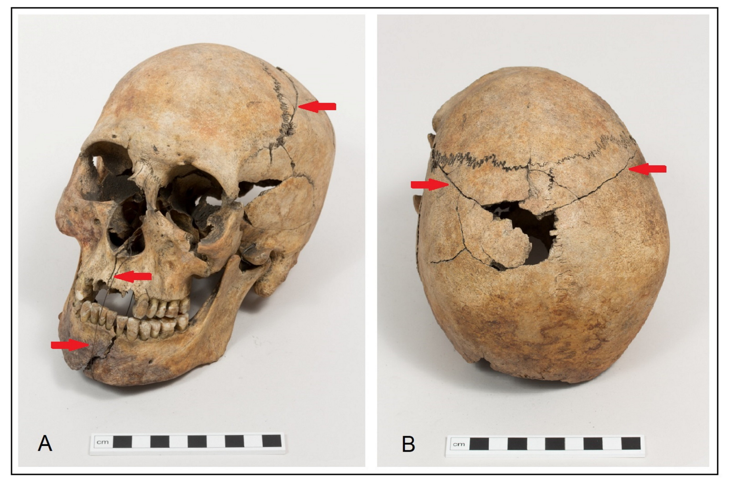
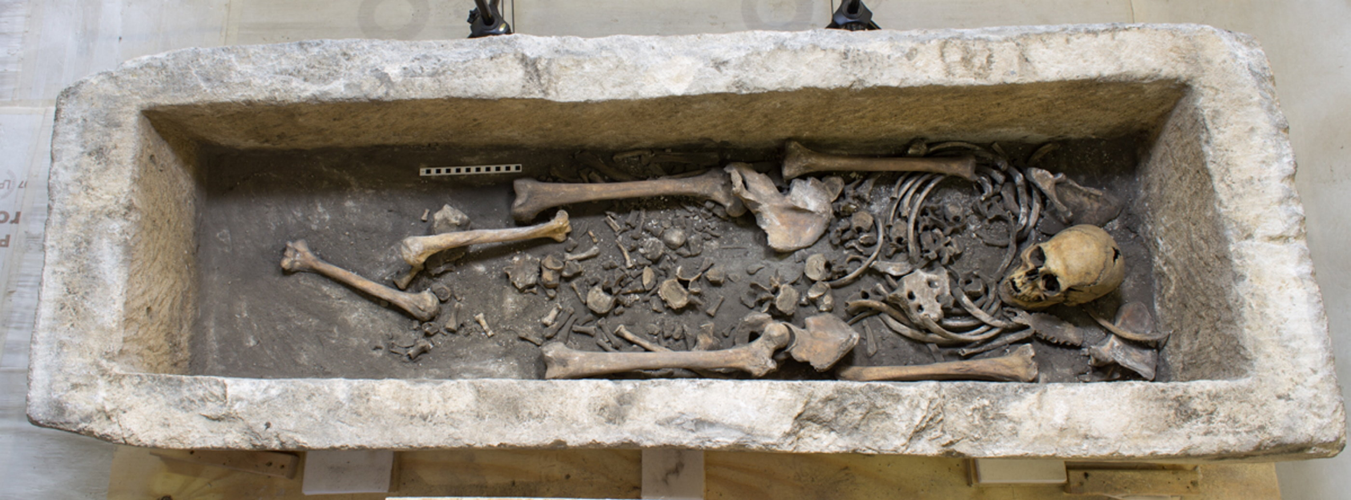

Interior of the sarcophagus. Detail of the western part, prior to in situ cleaning of the skeletal remains. (PreConstructArchaeologyLtd via SWNS)
By Stephen Beech
A mysterious skeleton found in a Roman sarcophagus in the grounds of Westminster Abbey more than 150 years ago may finally have been identified.
Archaeologists believe it may be the remains of one of two high-ranking medieval monks who died around 1,000 years ago.
The limestone sarcophagus was found bearing an inscription to Valerius Amandinus – a wealthy Briton who lived in London in the 4th century A.D. - when it was excavated at the Abbey in 1869.
But a Latin cross - dating from around the 10th or 11th century - was sculpted on the lid, suggesting that the human remains found within may be of someone who had died hundreds of years later.
Their identity had remained a mystery until a new analysis by Warwick Rodwell, consultant archaeologist at Westminster Abbey.

The limestone sarcophagus was found bearing an inscription to Valerius Amandinus, a wealthy Briton who lived in London in the 4th Century AD, when it was excavated at the Abbey in 1869.
His research, published in the Journal of the British Archaeological Association, concludes that it is most likely the bones belonged to a senior medieval monk called Aelfwig who died around 1020.
Rodwell said Aelfwig was an abbot at Westminster Abbey, and later at a Benedictine monastery.
He says another candidate is Aelfwig's successor Wulnoth, who died in 1049 and is presumed to have been buried at the Abbey, as was Aelfwig.
Rodwell said: "We have two viable contenders for the occupant of the sarcophagus.
"We do not know the date of birth of either.
"But either would fit equally well if we assume the Abbot was in his early twenties when the appointment was made and close to 50 when he died.
"The fact Aelfwig was already a monk of Westminster might favour him."

(PreConstructArchaeologyLtd via SWNS)
He says another clue that suggests the skeleton belonged to an abbot lies in the fact the occupant was "honored" with a "fine sarcophagus."
Rodwell said the wooden coffin was placed inside a stone burial casket in what could represent an early example of recycling.
He says the lid was then recarved to feature a large Latin cross.
The skeleton and Roman sarcophagus have been the subject of extensive research and discussion for many years.
The latest findings, from a series of extensive tests by Rodwell and other experts, provide fresh insights into its history.
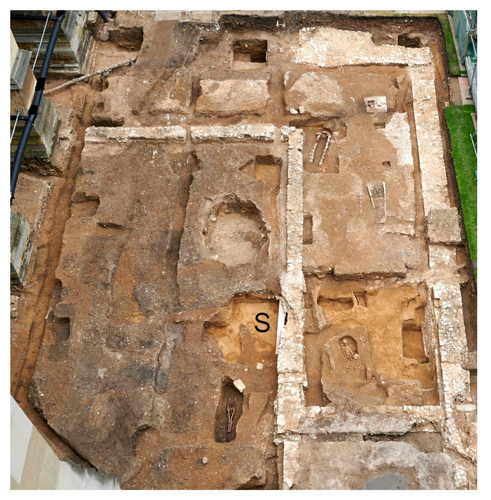
Channel 4's Time Team examined the archaeology and structure of King Henry III's original sacristy on the north side of Westminster Abbey in 2009.

(PreConstructArchaeologyLtd via SWNS)
It was in that area of the Abbey where in 1820 workmen accidentally unearthed the sarcophagus, smashing the lid into six pieces.
The damage was repaired when the Roman coffin was later officially "discovered" in 1869.
A recent excavation of the sacristy was completed last year by Pre-Construct Archaeology (PCA), one of Britain's largest commercial heritage practices.
The work was necessary to enable the building of the King Charles III Sacristy at the Abbey which is due to open next year.
The project included an analysis of the skeleton found in the sarcophagus by PCA's human bone specialist James Young Langthorne.
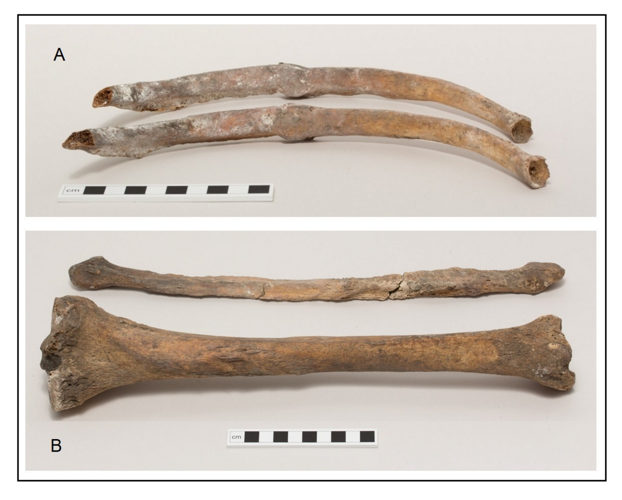
He determined the age of the deceased man to be between 35 and 49 and that he was around 5 ft 9 in tall.
That differs from an assessment in the 1800s which suggested it was a "robust young man" who was around 5 ft 7 in and no more than 30 years of age.

(PreConstructArchaeologyLtd via SWNS)
A bone sample was also sent to the Scottish Universities Environmental Research Centre for carbon dating.
Results indicated a date of A.D. 987 to 1052.
Rodwell said: "This confirms that the reuse of the sarcophagus, and the associated remodelling of its cover, occurred in the late Saxon period."
When the stone coffin was sent to a conservation studio in 2016, PCA researchers found an almost-complete skeleton inside.
Researchers in 2016 also found an outline of rectangular structure inside the sarcophagus, marked out in a white residue which had been left by lime - a substance traditionally used in burials.
Rodwell added: "Although no physical traces of that feature remained, it can only have been a timber coffin, which has completely decayed over the course of the seven centuries that the sarcophagus was buried in the sacristy courtyard."
The sarcophagus is on public display in the Queen's Diamond Jubilee Galleries at Westminster Abbey.