



(NASA via SWNS)
By Dean Murray
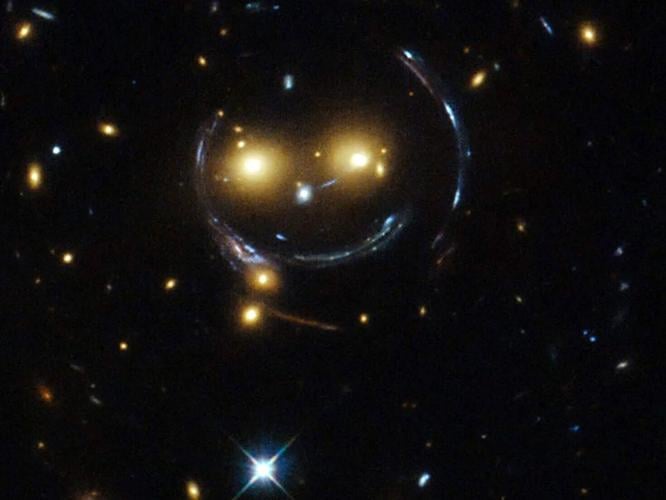
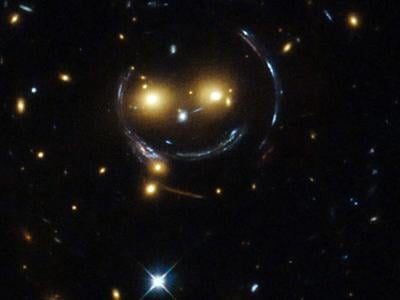
NASA has shown off a cosmic "smile" as an example of warped spacetime.
The space agency posted an incredible observation on Sunday, Oct. 11, showing how gravitational lensing can magnify the light of a more distant background object.
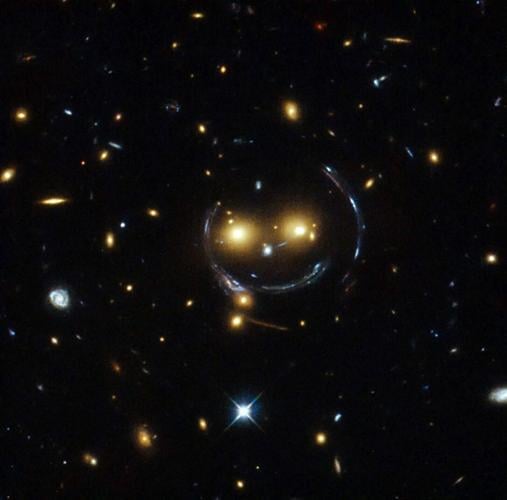
It wrote on X: "While observing the universe, NASA Hubble caught a galaxy cluster smiling for the camera.
"The smile lines are arcs caused by an effect known as gravitational lensing, where massive structures warp spacetime with their powerful gravitational forces and act as a cosmic lens."

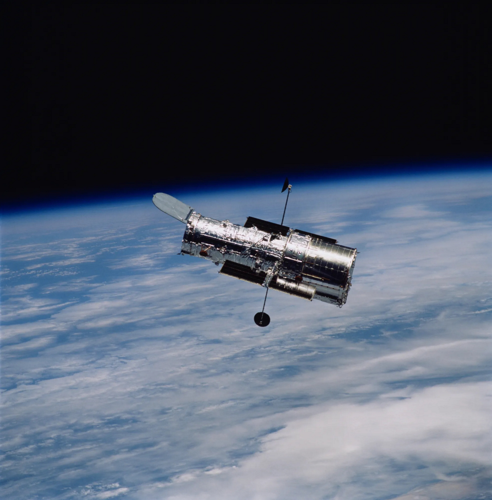
The Hubble Space Telescope. (NASA/ESA/STScI et al. via SWNS)
Astronomers use gravitational lensing as a natural magnifying glass to study galaxies and other objects that would otherwise be too faint or distant to detect.
By measuring how the light of background galaxies is bent and distorted, they can also map the distribution of dark matter in massive galaxy clusters.
NASA said the "upbeat-looking galaxy cluster" image, originally captured in 2015, shows an area designated as SDSS J1038+4849.
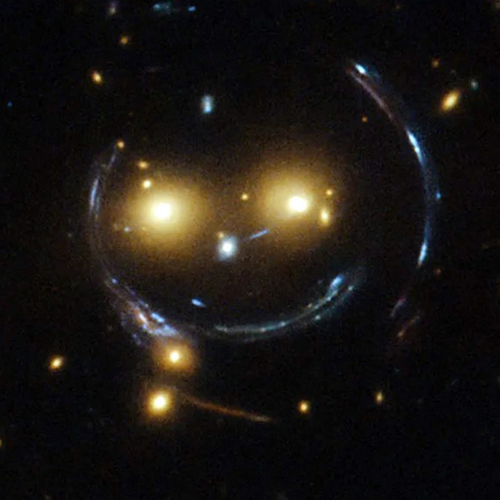
It added: "Those eyes are actually very bright galaxies, and the smile lines are, in reality, arcs caused by an effect known as strong gravitational lensing."

The cluster, designated as SDSS J1038+4849, appears to have two eyes and a nose as part of a happy face. (NASA via SWNS)
Social media users were impressed by the space smile.
Sem Day posted on X: "Gravitational lensing is genuinely one of the coolest things in astronomy... the universe literally bends light to show us objects we could barely see otherwise."
Bob D commented: "It's a beaming smile."
Tharindu Indrajith joked: "Aliens have finally discovered Emojis. No need to send super complicated signals now."