


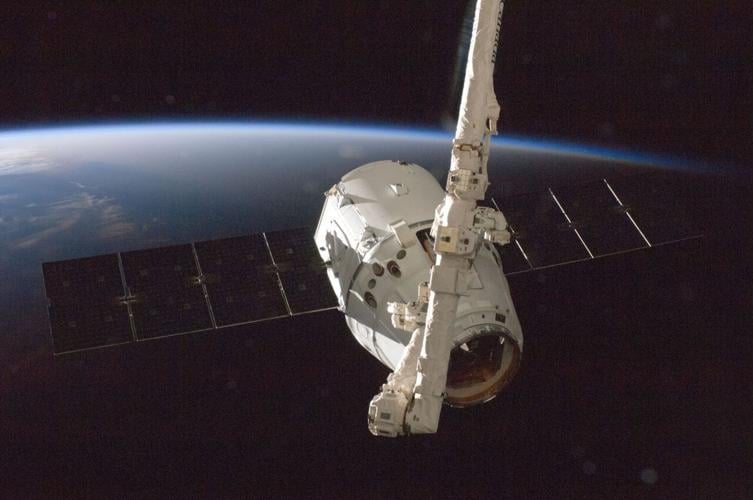


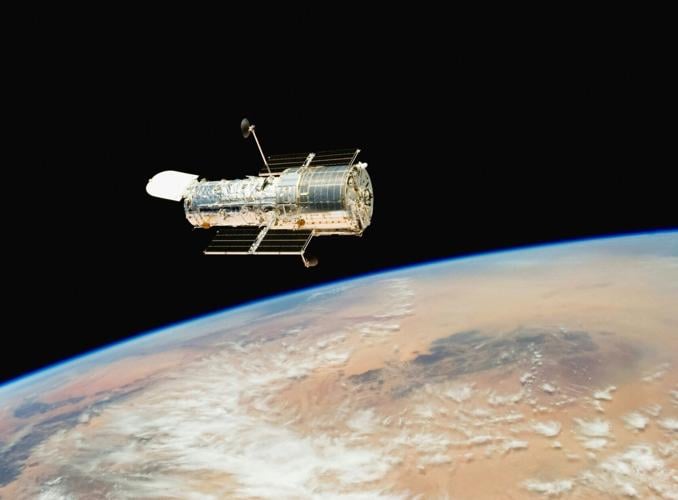

(Photo by SpaceX via Pexels)
By Daniel Johnson-Kim
It's a bird ... it's a plane ... no, it's a satellite with a nuke?!
An MIT physicist reports that there is a way to determine whether a satellite orbiting Earth is secretly carrying a nuclear weapon. You can simply count the neutrons coming off it, according to a new study published in the journal Nature.
A 1967 treaty bans nuclear weapons in space, and more than 100 countries are parties to it, including the U.S., Russia and China.
But no one has ever had a way to check.

Cardia Gong
Areg Danagoulian, an associate professor of nuclear science and engineering at the Massachusetts Institute of Technology, argues that physics can do the job.
The idea rests on the fact space is full of fast-moving protons, trapped by Earth's magnetic field in a radiation zone called the inner Van Allen belt. When one of those protons slams into uranium or plutonium, it can knock loose about 40 neutrons. The aluminum and plastic that make up an ordinary satellite do not throw off anything close to that.
The study suggests a small inspector satellite could fly alongside a suspect craft and listen for the extra neutrons.
Danagoulian says the sensor could be about the size of a large encyclopedia.

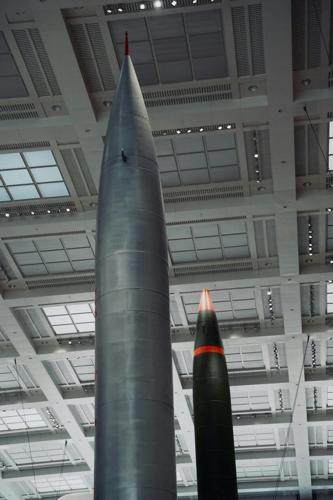
(Photo by Pixabay via Pexels)
By Danagoulian's calculations, an inspector holding station within about 2.5 miles for a week could identify a nuclear weapon with 99% accuracy. Move in to roughly 3,300 feet and the answer comes in about an hour, which is a single flyby.
The proposal lands amid U.S. warnings about Cosmos 2553, a Russian satellite launched three weeks before the 2022 invasion of Ukraine into a high radiation orbit that other spacecraft avoid.
Russia's Defense Ministry has said the craft tests instruments under radiation, and the Kremlin has dismissed the U.S. warnings as a fabrication.

NASA Hubble Space Telescope
The White House confirmed in February 2024 that Russia was developing an anti-satellite capability.
Danagoulian's paper models a hypothetical weapon in that orbit, not the satellite itself. He calls his paper a feasibility study. Nothing has been built ... yet.
"You can fake intelligence," Danagoulian said, "but you can't fake physics."