


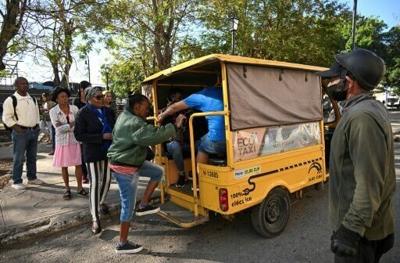
A green revolution is taking place on the streets of Havana, but it's by necessity rather than design.
Faced with a severe fuel crisis, which intensified after the United States placed the island under a de facto oil blockade last month, taxi drivers are ditching their cars and whisking passengers around on e-tricycles.
"Because of the gasoline and oil situation, we've had to resort to this alternative," Eduardo Romano, a father of two, told AFP, while waiting for customers in a park in central Havana.
Cuba, already contending with years of crippling fuel shortages, has reached a breaking point after US President Donald Trump moved to starve the communist nation of oil.
The flow of crude from top ally Venezuela dried up after the US overthrow of its leader Nicolas Maduro and Trump has threatened tariffs on any other country stepping in to fill the breach.
To conserve energy, the government has announced a series of fuel rationing measures and slashed public transport.
As the days pass and fuel supplies dry up, the number of taxis cruising the streets of Havana has dwindled.
The few drivers left fill up at an eye-popping $5 per liter on the black market, which has led fares to triple.
"It's a difficult situation for people," said Romano.
Six- and eight-seater e-trikes, which cost around one third of a taxi fare, have become a lifeline for cash-strapped Cubans.
"Right now, tricycles are the kings of the road," Romano joked.
There's a catch, however.
The vehicles have to be charged -- a constant headache in a city battling power outages of up to 12 hours a day, due to a lack of fuel for generating stations.
Like the even more ubiquitous e-scooter, e-trike owners have to wait for the lights to come back on to start their engines -- or plug in at the home of a friend or relative endowed with a generator or solar panels.
- Two- and three-wheelers -
The dearth of public transport is another nail in the coffin of the sputtering economy.
"There are people who have even had to quit their jobs because they can't afford transportation," said Ignacio Charon, a 48-year-old tire repair shop employee.
He has been inundated with customers wanting to have old bikes patched up.
Roselia Lopez, a 54-year-old dentist who was waiting for an e-tricycle to take her mother to a cardiology appointment, described the transportation situation as "disastrous."
"We offer an alternative," said tricycle owner Ariel Estrada, 54, while acknowledging that Havana's fleet of three-wheelers was grossly unequal to Cubans' needs.
Next to his shop is a parking lot for cycle rickshaws, another crisis-proof mode of transportation.
Faced with the US oil siege, some rickshaw owners have rushed to install electric engines on their "cars," as they refer to their vehicles.
Orlando Palomino, a 44-year-old who pedals up to 70 kilometers a day as he ferries people from town to town, boasted that he had work "from Monday to Monday."
lis/jb/cb/md