


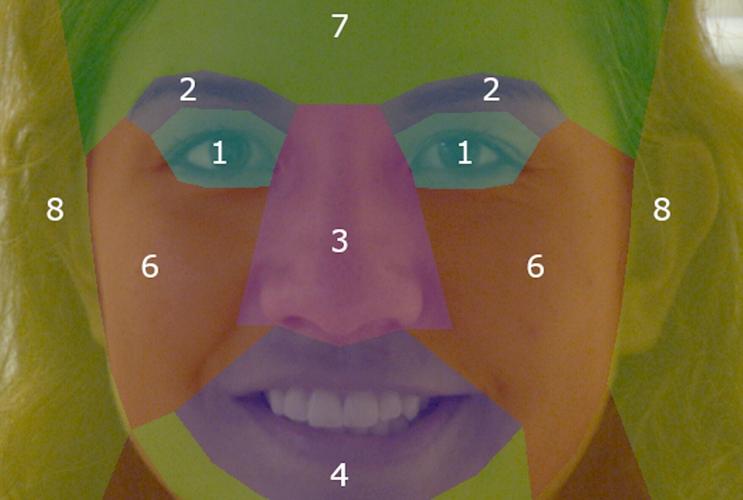
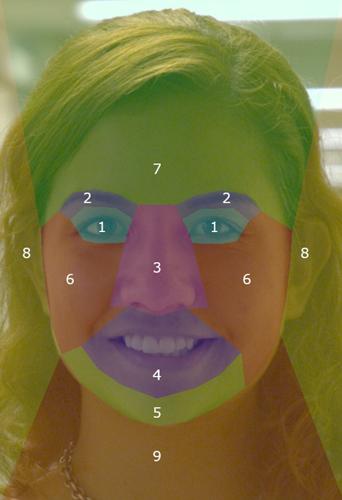
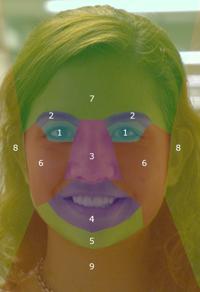

Facial feature boundaries. A face image with labeled shaded regions depicting the areas of the nine facial features defined in this study: 1. Eyes, 2. Eyebrows, 3. Nose, 4. Mouth, 5. Chin, 6. Cheeks, 7. Forehead, 8. Ears, 9. Neck. (Hahn et al2026,PLOS One,CC0 via SWNS)
By Stephen Beech
Facial identity experts can recognize someone just from their eyes or ears, reveals a new study.
Researchers found that forensic specialists in facial identification — known as “super-recognizers” — usually need only one or two features, such as eyes or ears, to identify a face when looking for a match.
They are often used during criminal investigations, and “super-recognizers” employed by the Met Police in London can recall up to 95% of faces seen compared to the average person, who remembers just 20%.
The new American study, published in the journal PLOS One, showed that specialists find ears to be the most useful, but are capable of adapting when recognizing that another feature might be more beneficial.
Study lead author Carina Hahn said: “Forensic face specialists help investigations and provide expert testimony at court trials.
“Understanding the cognitive processes that they use when identifying faces will be useful for improving how future experts are trained, as well as for improving machine-learning algorithms that are used for facial recognition.”

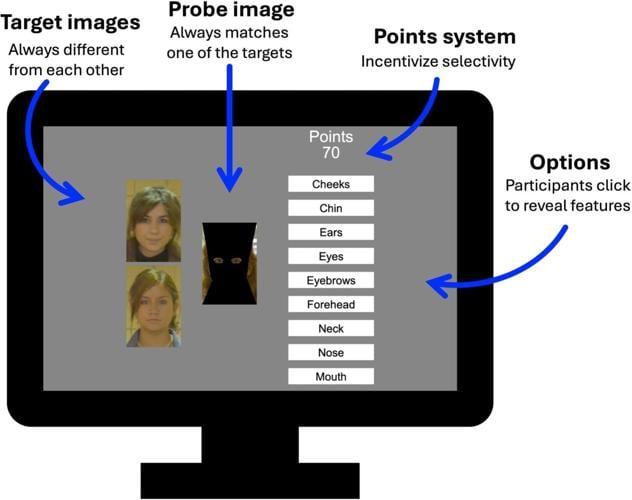
An example of an experimental trial in the self-selection condition is shown. On each trial, participants viewed two faces on the computer screen (Target images). They were always of different people. A third face began completely occluded (Probe image). Participants task was to match the identity of the probe image to one of the two target images. To make decisions, participants revealed features on the probe (Options). The example shown here corresponds to a participant selecting both Ears and Eyes. A points system was implemented to encourage selective feature reveal decisions and to discourage random guessing. Participants could keep track of their score at the top of the screen (Points system). The predetermined condition was identical except for the available feature options. Participants in that condition had only one button labeled. (Hahn et al2026,PLOS One,CC0 via SWNS)
For the study, facial specialists were given photos of two similar faces side by side and a hidden face.
For each face pair, their job was to identify which of the two faces matched the hidden face, with as little information as possible.
To do so, they requested the hidden facial features to be revealed one by one.
Accuracy averaged out to more than 90% correct, and the experts were able to identify the face after seeing only one or two features.
Hahn said: “Seeing the ears and forehead led to the highest accuracies in identification, with necks and chins being the least helpful.
“While ears were the most self-selected feature, the other features were not selected based on their usefulness.
“This was particularly true of the forehead, which was not frequently selected, but was associated with the highest accuracy.
“When not choosing the ears, experts adapted as hypothesized and generally requested features based on how different that feature was between the two faces.”
She says the findings don’t reflect real-world accuracy, as the conditions under which the study was conducted were artificial and designed to address certain research questions.

Facial feature boundaries. A face image with labeled shaded regions depicting the areas of the nine facial features defined in this study: 1. Eyes, 2. Eyebrows, 3. Nose, 4. Mouth, 5. Chin, 6. Cheeks, 7. Forehead, 8. Ears, 9. Neck. (Hahn et al2026,PLOS One,CC0 via SWNS)
The researchers also noted the facial features they analyzed may not generalize well to different sets of images.
But they say their findings can be used to improve training of both humans and machine-learning models for facial identification.
Hahn, from the National Institute of Standards and Technology (NIST) in Maryland, said: “What surprised me most was that specialists could accurately judge identity from a single facial feature most of the time.
“It’s remarkable how much identity information they can extract from so little.”
She added: “Specialists have a striking ability to adapt their strategy depending on the face in front of them, rather than applying one fixed rule.
“The combination of relying on features known to be useful, like ears, with adjusting when needed, hasn’t been documented before.”