


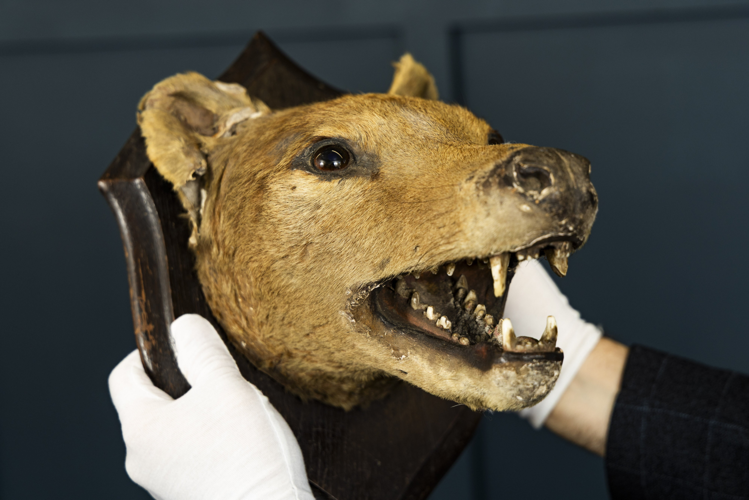
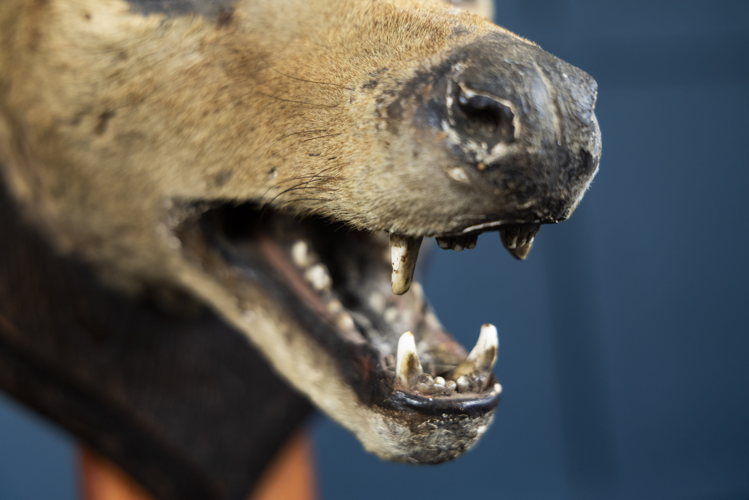
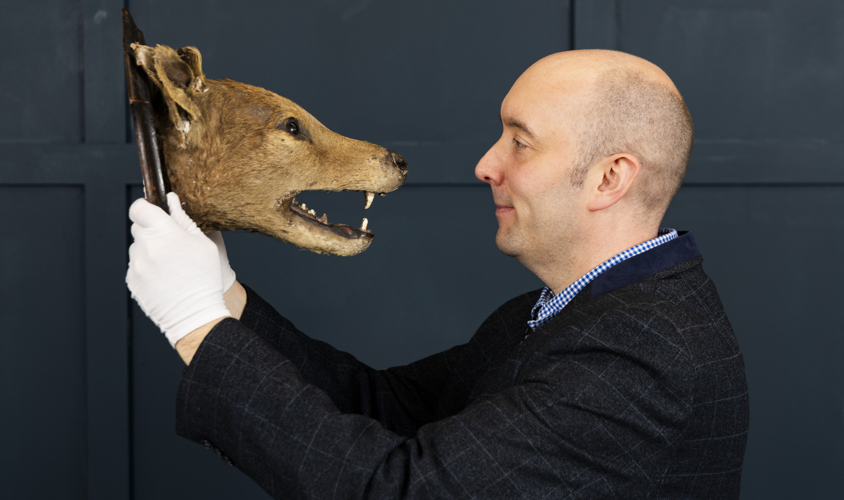
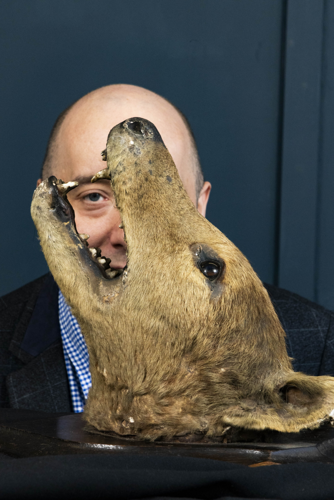

The extinct, rare tiger head. (Tom Wren via SWNS)
By Tom Bevan
An extremely rare extinct tiger head has been found hidden under a bed - just weeks after the "only one in existence" sold for $80,520.
The thylacine - also known as the Tasmanian tiger - was discovered at home by a couple who had no idea of its rarity.
They came forward after the only other known surviving taxidermy of its kind was sold at auction back in August under the mistaken belief it was a "fox head".
The species has been extinct since 1936 and only a handful of specimens - mostly skins made into rugs - have previously been sold over the years for hundreds of thousands of dollars.
The previous surprise auction was the first time a fully preserved head had been discovered - and its initial mistaken identity saw its auction begin with a lowly guide price of between $40-$65.
Its previous owner had bought it at an antiques market as they found it's "googly eyes" amusing - parting with just $65.
But two eagle-eyed bidders had spotted its potential and battled it out before it eventually sold to James Cranfield for $67,100 with $13,420 fees on top.
At the time he hailed it as the "holy grail" of the natural history world and stated: "The head I now own is the only one in existence."
But after the case made international headlines, the second thylacine head was unearthed - and is estimated to sell for tens of thousands of dollars next month.

(Tom Wren via SWNS)
It was brought into the same auction house and has now been affectionately named "Trevor" by staff.
Auctioneer Andrew Stowe said: "Our sale back in August made international headlines and we thought it was a once-in-a-lifetime moment.
"To have unearthed another is extraordinary. Scientists, academics, and collectors dedicate their lives to finding these rare specimens - to have two pass through our hands in a matter of weeks is nothing short of phenomenal."
Believed to have been shot by a farmer in Sheffield, Tasmania, around the turn of the century, the newly discovered specimen was brought to the UK around 1905.
Andrew added: "It's not much history but any provenance is vital. This is the only head to ever be offered for sale with some of its history known, albeit brief.
"In more recent years, he's been hidden away under our client's bed.
"When the client saw news of our previous sale, the head was rather swiftly brought to us. When I unwrapped it, I couldn't believe I was face-to-face with another of these incredibly special specimens."
Radiographs arranged by the auctioneers confirmed that the original skull remains intact within the mount.
Andrew added: "The discovery of the skull inside was another spine-tingling moment. Part of the cranium is missing on the right-hand side, likely marking the location of the fatal shot delivered over a century ago."
The thylacine was a unique carnivorous marsupial native to Australia, Tasmania, and New Guinea that evolved dog-like traits through convergent evolution.
While mainland populations disappeared around 2,000 years ago - likely due to competition with dingoes and environmental shifts - an isolated population survived in Tasmania into the modern era.
But it was wrongly viewed by European settlers in the 19th century as a threat to sheep and government-backed efforts were made to eradicate it.
The find has been authenticated by Stephen Sleightholme, and the mount has officially been added to the International Thylacine Specimen Database (ITSD), which logs all known physical remains in public and private hands.
Prior to August, only one taxidermy head was recorded worldwide but its whereabouts are unknown; Auctioneum's August sale added the second, with the latest find now standing as the third.
Andrew added: "Uncovering two-thirds of all known thylacine heads is extraordinary.
"We've sold some incredible pieces over the years, but this goes way beyond another rare item - it's a major scientific breakthrough and a vital piece of history.
"It's the most important item we've ever sold."

(Tom Wren via SWNS)
Sleightholme of the ITSD said: "Thylacine remains are exceptionally rare and rank among the most valuable zoological specimens.
"Their scientific, historical and cultural significance is reflected in the considerable interest surrounding surviving examples.
"Beyond their monetary value, these remains provide an essential record of a species lost to extinction.
"Preserved in museums, universities and private collections, they offer opportunities for scientific investigation and help researchers reconstruct the history of the Thylacine, its decline and its eventual extinction.
"The International Thylacine Specimen Database (ITSD) brings this dispersed collection of material into a unified record, helping to establish a clearer picture of what survives and supporting the ongoing study of this remarkable marsupial predator."
The thylacine head will go under the hammer on Thursday, Nov. 26 at Auctioneum.
The sellers are a private family in London who have declined to comment.
The last item was bought by James, 38, who described himself as a taxidermy and natural history curiosity collector, said he saw the "fox head" for sale and thought it looked weird.
He said at the time: "The more I looked at it over a period of about ten days I started researching I was adamant it was a Thylacine.
"You could not tell for sure by the pictures so on the day of the sale I got up at 4 a.m. and drove from my home in Essex three and a half hours to the auction house.
"It was sat on a table surrounded by all sorts of bric-a-brac and pottery. It confirmed exactly what I wanted to know."
He said its unique set of teeth meant there was "nothing else it could have been."
He added: "It is an incredibly rare thing.
"There is only one documented specimen on the database and its whereabouts are unknown. But the head I now own is the only one in existence."
The creature was driven to the brink by relentless hunting, habitat fragmentation, and introduced diseases and suffered a rapid decline. The last known individual died at Hobart Zoo in 1936, marking its complete extinction.
Only 756 specimens are known to exist of the extinct species and of those only 101 are taxidermy.
Other specimens include tissue samples mounted on microscopic slides to skulls and full mount taxidermy.

(Tom Wren via SWNS)
Only eight specimens are in private hands - with James now owning the ninth.
James added previously: "This was undocumented and undiscovered - and is the only known head in the world.
"For natural history collectors like myself this is the find of multiple lifetimes - it really is the holy grail.
"Nobody thought it was possible. I could not believe it. I did not sleep as soon as I saw it on the auction house. I would wake up in the middle of the night with a cold sweat just thinking 'it can't be, this can not be real.'"
James said he has already tried to have it valued at other auction houses and told it wasn't possible.
"It is priceless," he added. "There is nothing else to benchmark it against."
In the last 90 years only a handful of specimens have come to auction. They've all been items such as skin rugs and sold for small fortunes.
He added: "A head on a mount - one of one - is absolutely priceless."
The thylacine, commonly known as the Tasmanian tiger, was a carnivorous marsupial native to Australia and New Guinea that evolved striking canine-like traits.
This included a dog-like build, stiff tail, and striped lower back - despite being more closely related to kangaroos and wombats.
After dingo competition drove it off the mainland roughly 2,000 years ago, the species survived exclusively in Tasmania until 19th century European settlement brought relentless bounty hunting, habitat loss, and disease.
This culminated in the death of the last known individual at Hobart's Beaumaris Zoo on Sept. 7, 1936.