


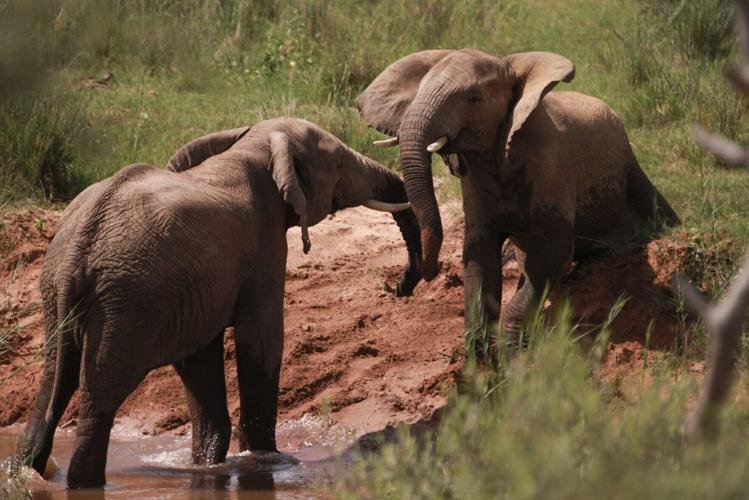







The male elephant on the right performs an Ear Flap to the other male on the left. (Vesta Eleuteri via SWNS)
By Stephen Beech
Elephants use a “rich repertoire” of more than 40 different gestures to show they “mean business.”
Researchers found that the various signals — such as spreading their ears or flinging their trunk — are ways of communicating clear messages such as “Move away!” or “Stop what you are doing!”
The “exciting” findings come from the first systematic investigation of intentional gestural communication in wild African savanna elephants.
The research team discovered that the species check whether others are paying attention, wait for a response and persist with further gestures when their apparent goal is not met.
They observed the pachyderms in competitive contexts in Addo Elephant National Park and Marakele National Park in South Africa.
The researchers conducted more than 90 hours of observation and recorded around 840 individual gesture instances for the study, published in the journal Animal Cognition.

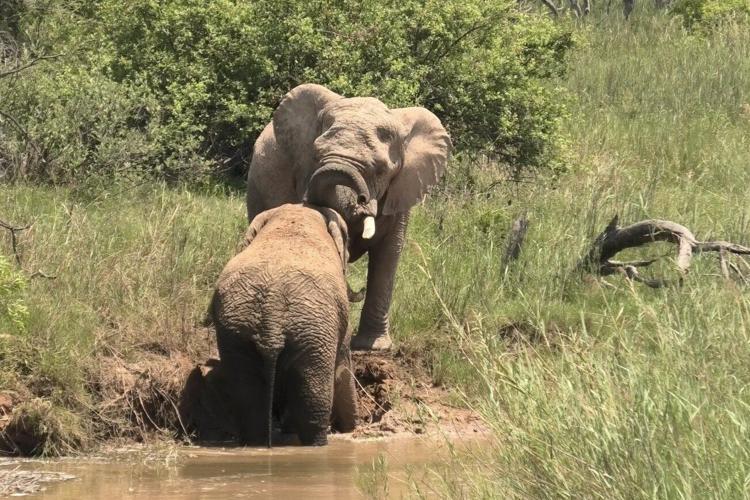
A male elephant lightly pushes the other male with his trunk without displacing him completely. (Vesta Eleuteri via SWNS)
They found that elephants were gesturing intentionally in a “recipient-directed and goal-directed way.”
The team visually checked whether another elephant was attending to them before and during gesturing, adapted their gestures according to the recipient’s visual attention, waited for a response, and produced further gestures when the recipient did not respond in a way that satisfied their apparent goal.
Study co-author Lucy Bates, from the University of Portsmouth, said: “Tracking and understanding that communication is not easy — it takes a lot of painstaking work.
“So, to have identified so many different gesture types — as ways of communicating clear messages to ‘move away,’ or ‘stop what you are doing’ — is really exciting.
“We humans use gesture all the time to get our meaning across to people we are talking to.
“Knowing that elephants also use these signals to communicate with each other suggests gesturing could be a feature of highly intelligent animals that have complex social lives.”

The male elephant on the right performs an Ear Flap to the other male on the left. (Vesta Eleuteri via SWNS)
Study lead author Vesta Eleuteri said: “If you spend time observing wild elephants, you can’t help but notice their conspicuous gestures.
“They may fling their trunk or spread their ears wide, and you intuitively understand that ‘they mean business.’
“But until now, we didn’t know whether wild elephants were using these gestures to communicate intentionally.
“Here we find for the first time that, in competitive situations, wild elephants use intentionally over 40 different gesture types made up of 32 gesture actions to achieve two main goals.
“They ask their recipients to ‘move away’ or ‘stop what they’re doing.’”
Of the 33 gesture types recorded in successful communications, she said 21 were used for both meanings, suggesting that elephants do not rigidly use gestures with a single goal, but rather communicate flexibly.

(Photo by Rino Adamo via Pexels)
Eleuteri said: “Such extensive, flexible gestural repertoires have previously been shown in apes and a few other primates.
“Finding the same in elephants is particularly exciting because elephants are so evolutionarily distant from primates.
“It suggests that sophisticated gestural communication may have evolved convergently in species that share advanced intelligence and complex social lives.”
The study compared the gestures used by two South African populations and their findings with the ElephantVoices database based on observations from elephants in Kenya and Mozambique.
Eleuteri, who completed the study as part of Ph.D. at the University of Vienna, added: “The populations shared the same gesture types, suggesting that elephants may share a common gestural ‘vocabulary’ across populations.”

(Photo by Piet Bakker via Pexels)
The research team says its findings highlight the need for further research into how elephants use gestures in other contexts.
Senior author Angela Stoeger, also from the University of Vienna, said: “These findings underscore why studying multiple modalities is essential.
“In the future, studying the interplay of acoustic, visual, tactile and seismic signals, together with context, will finally reveal their messages.”
Bates says elephants face major conservation challenges, including habitat loss leading to conflict with humans, and the findings carry implications.
She added: “This work is important because humans and elephants increasingly come into contact with each other, as human populations expand in elephant range-states.
“Understanding how elephants communicate when they’re feeling threatened could help us better read their intentions or recognize when they don’t want us around, giving us the chance to move away before interactions become dangerous.”