


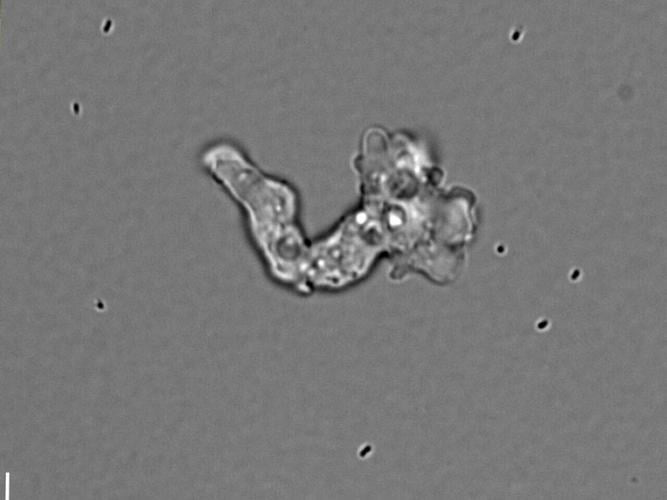
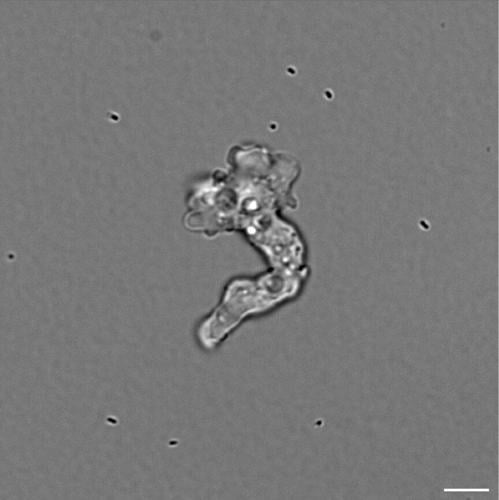
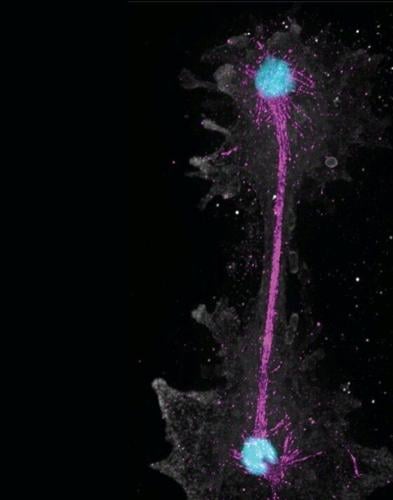
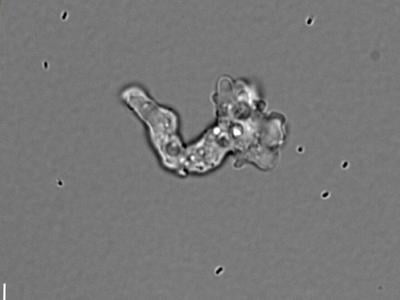

Incendiamoeba cascadensis cell at 55ºC, scale bar 5µm. (Felix Mikus via SWNS)
By Stephen Beech
A microscopic creature has been hailed a record breaker by thriving at scalding temperatures that would kill all other known life.
The single-celled organism smashed the previous record for heat tolerance of complex life by surviving in 158°F (70C) spring waters, say scientists.
They discovered the new species of amoeba that can eat and reproduce in water as warm as 145°F (63C) in California.
The amoeba can protect itself at temperatures up to 158°F by changing shape and forming a protective outer layer, according to a study published in the journal Cell.
Corresponding author Angela Oliverio said: "This finding pushes the bounds of what we thought was possible, which is incredibly exciting.
"There could be more eukaryotes that can survive at even higher temperatures than we know of."
The record for the hottest-growing organism belongs to Methanopyrus kandleri, an archaeon and relatively simple microorganism that lives at 252°F (122°C) around hydrothermal vents in the deep ocean.

Incendiamoeba cell undergoing mitosis at 63ºC. DNA is colored blue, tubulin is pink, and membrane is gray. (Felix Mikus via SWNS)
For decades, researchers have considered 140°F (60°C) to be the upper limit for eukaryotes, which are organisms with complex cells, such as animals, plants, fungi and some microbes.
Only a handful of eukaryotes can grow at temperatures approaching that limit.
Previous studies have found traces of amoebae — single-celled microorganisms that can change shape — near geothermal springs, where the water temperatures can exceed 140°F.
But, until now, scientists had not thoroughly studied those species to verify that they could cope with extreme heat.
Between 2023 and 2025, Oliverio and her team from Syracuse University, New York, collected organisms from geothermal streams in the Lassen Volcanic National Park in California's Cascade Range, where water temperatures at the sampling sites ranged from about 117°F to 147°F (47°C to 64°C).
Among all the samples collected, Oliverio said one previously unknown amoeba stood out.
The organism grew "robustly" at 135°F (57°C) in the lab, the highest temperature previously known for amoeba growth.
The researchers kept raising the temperature and, at 145°F (63°C), they saw the amoeba undergoing "mitosis" — a process by which eukaryotic cells divide.
Oliverio said the discovery confirmed that it could not only survive but also thrive at temperatures beyond the previously recognized limit for eukaryotes.
The research team named the new species Incendiamoeba cascadensis, roughly translating to "fire amoeba from the Cascades."

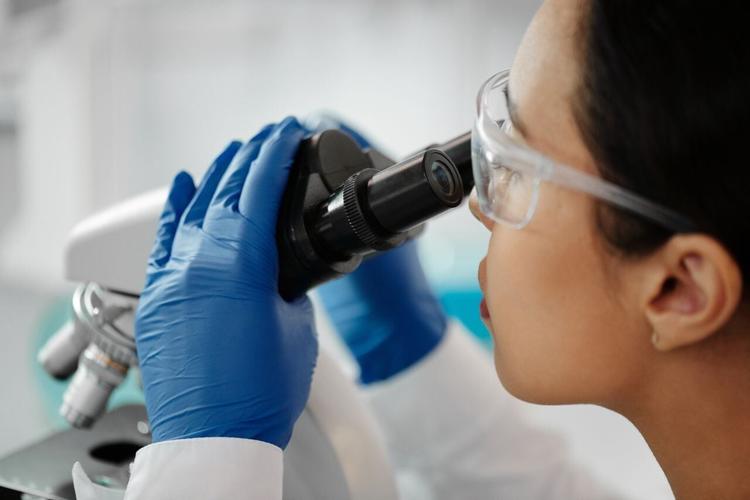
(Photo by Edward Jenner via Pexels)
They found that the fire amoeba can protect itself by changing shape and forming a protective outer layer when temperatures rise beyond 145°F.
When the amoebae were exposed to 158°F (70°C), they were able to recover after returning to cooler temperatures.
By sequencing the amoeba's genome, the research team found that it has extra genes associated with protein maintenance and DNA repair that could help the organism cope with extreme heat compared with other amoebae that live in more mild environments.
The research team also found that the fire amoeba's proteins have more positively charged amino acids on their surfaces, a feature also seen in some of the most heat-tolerant bacteria and archaea, a type of single-celled microbe.
The researchers believe those molecules may help keep proteins stable and prevent them from unfolding or clumping together under extreme heat.
Study first author Beryl Rappaport, a doctoral student at Syracuse University, said: "Even though these organisms are so different, there's convergence in how protein properties are selected for stability under high temperatures."
Despite the fire amoeba breaking the previous record for eukaryotes by only a few degrees, Oliverio says the finding could inspire future research to test organisms' environmental tolerance without preconceived limits.
She added: "Every time we set a new world record in sports, it's amazing and celebrated, even if it's by milliseconds.
"We should do the same for amoebae.
"These very small changes expand our understanding of what we think is possible."