


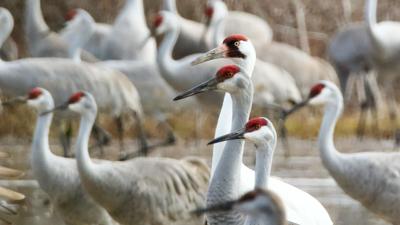
Why do thousands of travelers rush to a specific stretch of the Texas coast every February? Port Aransas is the only place in the United States where you can see the world's last wild flock of Whooping Cranes wintering in their natural habitat. Their presence is nothing short of a miracle; it is a conservation success.
How the Rarest Bird in the U.S. is Bouncing Back
After completing a grueling 2,500-mile commute from Wood Buffalo National Park in the Canadian sub-arctic, the world's last wild flock of whooping cranes will descend upon the Texas coast at Aransas National Wildlife Refuge at the end of February.
The refuge spans 115,000 acres of diverse habitat, from salt flats to marshes. It is home to more than 400 species of birds, including North America's tallest and rarest bird, the whooping crane.
Their migratory route is long. To reach Port Aransas, these "White Giants" must navigate treacherous routes that funnel them through critical "refueling" stops, such as Nebraska's Platte River.
Whooping Cranes sleep standing in the middle of the river. The water acts as a "moat" that protects them from coyotes and predators. The river is wide enough that they can see danger coming from far away. There are very few rivers in the United States that offer this specific "safe harbor."
A report notes that during the Spring 2024 migration, a record-breaking number of these birds (over 200) were spotted on the Platte River in Nebraska, nearly doubling previous records for that location.
It is, indeed, a conservation success story. "These survey results are incredibly encouraging as they demonstrate the whooping crane continues to steadily recover from the brink of extinction," said Kevin McAbee, the Service's Whooping Crane Recovery Coordinator, in an official statement.
The Aransas-Wood Buffalo Population rebounded from only 16 individuals in 1941 to about 557 during the 2024-2025 season.
The total wild population is actually over 700, including the Eastern migratory population of 75 birds, the Louisiana non-migratory flock of 82 birds and the Florida non-migratory flock of 5 birds.
A Four-Day Celebration of Science, Storytelling and Birdwatching
The 29th Whooping Crane Festival in Port Aransas, Texas, is both a spectacle and a celebration of their resilience and rarity. It offers a window to witness North America's rarest birds in their only natural winter habitat.
The festival starts on February 19, 2026, and lasts for four days. Based on its 2026 schedule, this year's festival offers a massive variety of events that go far beyond simple birdwatching.
Daily boat options range from dedicated whooping crane tours to sunset wine and dolphin cruises and kayak trips along lighthouse trails. These are also rare opportunities to enter typically off-limits areas, including private ranchland.
Workshops lean heavily into photography. Professional photographers will lead field sessions to teach visitors specific techniques, such as birds in flight, backlit subjects, and on-the-water shooting.
The speaker series invites global experts, including Dr. George Archibald, Dr. Richard Beilfuss, Andy Caven, Irvin Louque, and Brittney Palode from the International Crane Foundation.
Guided nature walks, social gatherings, film screenings of the "Dances with Cranes," a documentary featuring Dr. Archibald and his team, and conservation-focused meetups, such as a sunrise beach cleanup, will make the program even more colorful.
With the festival kicking off in less than a month, spots on the boat tours and photography workshops are filling up fast for this once-a-year event.