


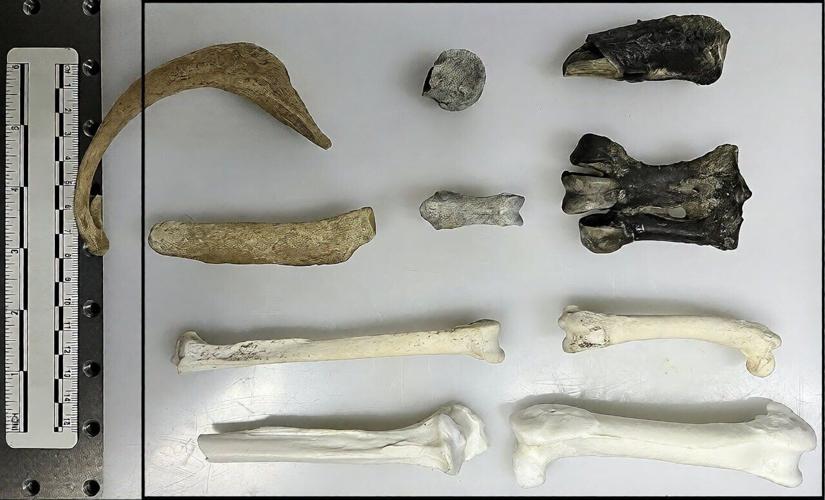
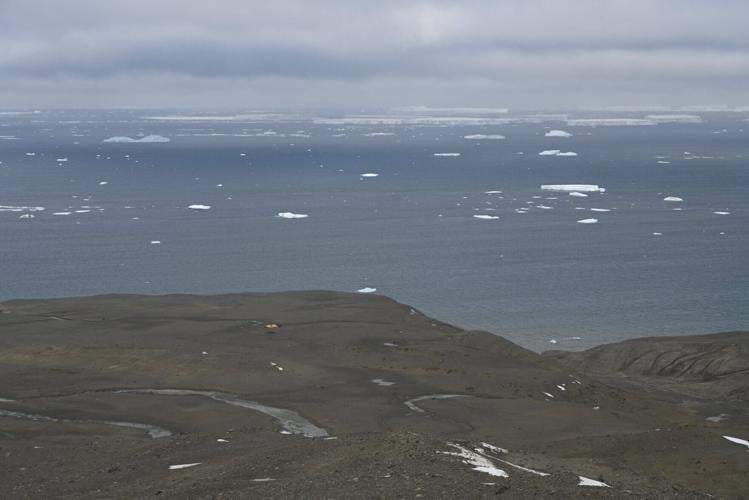

Overview of the fossil specimens and the µ-XRF scanning area. (Boyang Xia et al., 2026 via SWNS)
By Stephen Beech
Penguin fossils have offered a new window into Antarctica's changing climate over millions of year.
Analysis of remains from Seymour Island, off the Antarctic Peninsula, have shown how ancient bird bones can act as "chemical archives" of changing weather conditions.
Chinese paleontologists used non-destructive X-ray mapping to examine the elemental composition of ancient penguin remains.
The findings, published in the journal Fossil Record, provided key insights into how Antarctica shifted from a warm and humid environment to a cooler world.
Study leader Quanguo Li said: "Penguins are among the most iconic animals of Antarctica and represent one of the most distinctive groups of birds, having completely lost the ability to fly and instead using their flipper-like wings for swimming.
"Seymour Island preserves one of the world's richest and most stratigraphically continuous records of Eocene penguin fossils.
"These fossils span an important interval of Antarctic climate evolution, from the relatively warm and humid conditions of the early Eocene to the cooler climate of the middle and late Eocene."

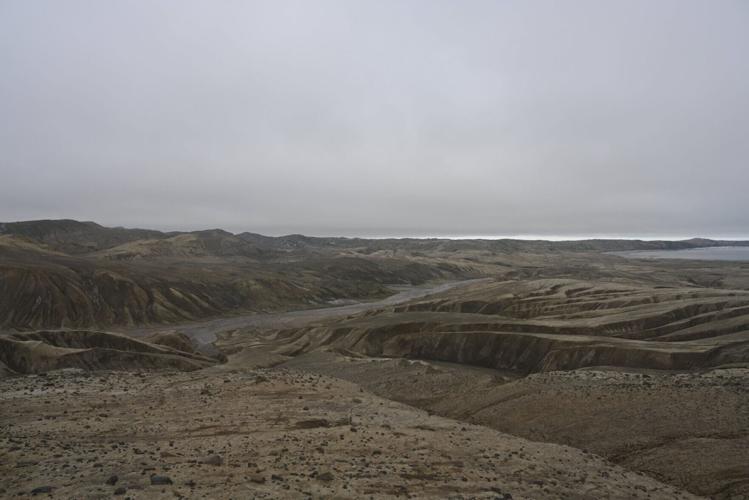
Sampling area - Tertiary Eocene La Meseta Formation on Seymour Island. (Boyang Xia et al., 2026 via SWNS)
To study the rare fossils without damaging them, the research team used micro-X-ray fluorescence scanning to map chemical elements across the surface of the bones.
The scans revealed clear differences in the chemical composition of bones from different geological periods.
Older fossils dating back about 55 million years contained "significantly higher" levels of titanium, silicon and potassium.
The researchers linked the chemical patterns to intense land-based weathering and heavy runoff during an ancient warm period, whereas younger fossils from cooler periods showed much lower elemental signals.
Li, from the China University of Geosciences, Beijing, said: "The most surprising result was that the early Eocene fossil showed substantially higher titanium, silicon and potassium signals.
"Based on the stratigraphic, sedimentological and paleoclimatic evidence, we interpret this pattern as being consistent with stronger continental weathering and terrestrial material input under the warm and humid conditions of the early Eocene."
Buy analyzing millions-of-years-old fossils presented distinct practical challenges.
Li said: "One of the main challenges was obtaining reliable elemental information without damaging the fossils.

Sampling area - Submeseta Formation on Seymour Island. (Boyang Xia et al., 2026 via SWNS)
"The irregular shapes and curved surfaces of the fossil bones created practical difficulties during scanning.
"To minimize the influence of variations in surface height, we positioned the bones as horizontally as possible and maintained a relatively constant distance between the scanning head and the bone surface."
Beyond tracking weather conditions on land, the scanning method also detected iron, manganese and sulfur patterns trapped within the bones, reflecting local chemical changes in the marine sediment as the fossils were buried over time.
The Chinese team said that studying bone geochemistry also offers a valuable tool for understanding historical Earth systems alongside traditional techniques such as marine sediment drilling and microfossil analysis.
Li added: "An important finding for us was that the elemental information preserved in penguin bones may record not only how external materials entered the bones, but also differences in weathering input, depositional conditions and early diagenetic environments.
"We believe that fossils can provide an important complementary source of information for studying paleo-environmental changes on the Antarctic Peninsula."