
At least three ambulance districts and two fire districts in Jefferson County will ask voters on April 7 to approve an increase in the sales tax the districts collect, and one county fire district will ask voters to allow it to start collecting a sales tax.
The Big River, North Jefferson County and Valle ambulance districts and the High Ridge and Rock Community fire protection districts each will seek a 1/2-cent sales tax increase in April. Each of those districts already collect a 1/2-cent sales tax, and if voters approve the increases, the districts would start collecting a full 1-cent sales tax.
The Saline Valley Fire Protection District will ask voters to establish a 1-cent sales tax.
Previously, ambulance and fire districts were not allowed to collect more than a 1/2-cent sales tax in certain Missouri counties. However last August, the state Legislature passed a bill to allow ambulance and fire districts in all counties to collect up to a 1-cent sales tax, with voter approval.
Six ambulance districts and 14 fire districts serve portions of Jefferson County.
Officials from the Antonia Fire Protection District and Rock Township Ambulance District told the Leader that their districts were still deciding whether to seek a sales tax increase. Those districts already collect a 1/2-cent sales tax.
Chiefs from five fire protection districts – Cedar Hill, De Soto Rural, Dunklin, Eureka and Mapaville – told the Leader their districts would not seek a sales tax in April. None of the five districts currently collect sales tax revenue.
Officials from the Hillsboro, Jefferson R-7, Goldman, Hematite and Pacific fire protection districts and the Joachim-Plattin and Meramec ambulance districts did not respond to Leader emails seeking information about a potential ballot issue.
The last day for governmental entities to place tax increases or other measures on the ballot is Jan. 27. The last day to register to vote in the election is March 11.
Sales tax
While the state now allows ambulance and fire districts to collect more sales tax revenue, it also requires those entities to reduce the amount of property tax they collect by half of the amount of sales tax collected in the prior calendar year.
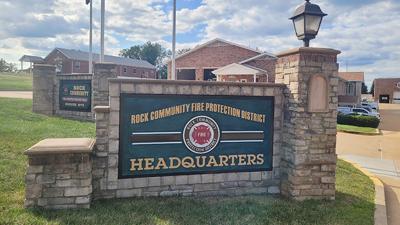
Rock Community Chief Kevin Wingbermuehle said the property tax rate would be adjusted before tax bills are issued and would appear directly on annual property tax statements. He said all property owners would benefit through the same reduced rate, with individual savings based on the assessed value of each property.
Rock Community covers approximately 38 square miles in Arnold and Kimmswick and portions of Imperial and Barnhart.
Wingbermuehle said Rock Community collected $5,185,785 in sales tax revenue last year, and over the last five years, the sales tax generated an average of about $4.8 million a year. He said the district has collected a 1/2-cent sales tax since 2006.
He also said the district’s property tax levy, which is 96.56 cents per $100 assessed valuation, brought in $10,361,569 in property tax revenue in 2025.
“An additional one-half of one percent would roughly double that revenue and, by law, would allow approximately twice the reduction in the property tax levy, providing greater property tax relief districtwide,” he said. “Sales tax collection reduces property taxes, providing measurable property tax relief throughout the district.”
If Rock Community voters approve the sales tax increase, the fire protection district will be able to fully staff an additional Advanced Life Support firetruck at House 1, at 1533 Jeffco Blvd. in Arnold, Wingbermuehle said. According to the district’s 2025 annual run review, House 1 responded to 1,814 of Rock Community’s 5,941 calls for service last year.
“Fully staffing that unit means faster, more dependable response times and better outcomes when emergencies occur,” Wingbermuehle said.
High Ridge Fire Chief John Barton said his district has collected a 1/2-cent sales tax since 2006, and last year, the sales tax produced $2.6 million in revenue. If voters approve raising the sales tax to 1 cent, High Ridge may collect an estimated $5.2 million in sales tax revenue.
Barton said High Ridge’s current property tax levy is 87.1 cents per $100 assessed valuation, and it collected about $5.1 million in property tax revenue last year.
High Ridge covers 52 square miles in northern Jefferson County, including High Ridge, Murphy, Byrnes Mill and a large portion of House Springs, along with the parts of Fenton and Eureka inside Jefferson County. It also includes the villages of Parkdale and Peaceful Village.
“Unlike property taxes, which are paid in a lump sum by property owners in our district, a sales tax shares the cost of fire protection and emergency response (costs) among everyone who makes a taxable purchase in the district boundaries, including visitors,” Barton said.
Saline Valley Fire Chief Bob Dunn said the district anticipates collecting more than $1 million in revenue if the sales tax is approved. The district’s current property tax levy of $1.38 per $100 assessed valuation would likely be reduced by about 13.5 cents if the sales tax were approved.
Dunn said Saline Valley collected $5,532,717.93 in property tax revenue last year.
“The main benefit is added revenue to help keep up with rising costs,” he said of the sales tax proposal. “It also allows the district to rely less on property taxes, which puts us in a position to reduce the property tax burden on residents while still maintaining the level of service people expect.”
Big River Ambulance Chief Scott Fisher said his district has collected a 1/2-cent sales tax since 2015, and last year, the sales tax produced $980,108 in revenue. He said if voters approve raising the sales tax to 1 cent, Big River may collect an estimated $1.8 million in sales tax revenue.
Fisher said the district’s current property tax levy is 26 cents per $100 assessed valuation, and it generated $1,052,963 in property taxes last year.
He said if voters approve the sales tax increase, Big River will likely hire three more paramedics and put a fourth ambulance into service. The district covers approximately 125 square miles, including Byrnesville, Cedar Hill, Dittmer, Morse Mill, Hillsboro, part of House Springs and Grubville.
“We are also looking at forming the community paramedic program that will help keep the citizens more aware of their health and possibly cut back on non-emergency 911 calls,” he said. “This, in turn, would leave the ambulances to respond to life-threatening 911 calls. By passing the tax, also the district would look at reducing the billing for utilizing the ambulance.”
North Jefferson County Chief Jamie Guinn said his district has collected a 1/2-cent sales tax since 2014, and last year, that tax produced $1,988,231 in revenue. He said if the sales tax increase is approved, the district may collect about $3.9 million in sales tax revenue annually.
Guinn said North Jefferson County’s current property tax levy is 45.62 cents per $100 assessed valuation, and the district collected about $1.5 million in property tax revenue in 2025.
North Jefferson County Ambulance covers Byrnes Mill, High Ridge, part of House Springs and the Jefferson County portions of Eureka and Fenton.
“This funding would ensure emergency services can keep pace with a growing community by supporting increased staffing, including the ability to staff a third ambulance 24 hours a day based on call demand,” Guinn said. “It would also allow the district to expand services like Mobile Integrated Health, helping residents receive the right care at the right time while maintaining fast, reliable emergency response when it matters most.”
Valle Ambulance Chief Jesse Barton said his district has collected a 1/2-cent sales tax since 2015, and last year, the sales tax produced $1,626,566.44 in revenue.
He said if voters approved raising the sales tax to 1 cent, Valle could collect an estimated $3,253,132.88 in sales tax revenue, but the district’s overall budget would increase by $813,283.22 due to the mandatory property tax rate rollback of half of the sales tax revenue generated.
Barton said Valle collected $1,516,258.74 in property taxes last year. He said the district’s overall tax levy would likely be reduced from $0.2730 per $100 assessed valuation to an estimated $0.1415 per $100 assessed valuation.
Valle covers approximately 233 square miles, including De Soto, Hillsboro, Victoria, Grandview, Hematite, Goldman and other parts of unincorporated Jefferson County.
“We believe that paying taxes in smaller amounts throughout the year, rather than as a single lump-sum payment just before the holidays, will be a benefit to taxpayers,” he said.
Barton said if voters approve the sales tax increase, Valle would use the extra revenue to staff an additional full-time ambulance.
“Currently, the district operates three full-time, 24/7 ambulances and one part-time, 12-hour ambulance,” he said. “Adding a fourth full-time ambulance is necessary to keep pace with increasing call volume, reduce the frequency with which neighboring ambulance districts are required to respond to calls within the Valle Ambulance District and decrease the number of times no district ambulance is immediately available to respond to emergencies.”
Wingbermuehle said a common concern about sales tax is that residents would end up paying more than they save in property taxes.
“Using today’s figures as an example, a homeowner with a $250,000 home would see an estimated $216 per year in property tax relief, based on current property tax reduction rates in Rock Community Fire Protection District,” he said. “To offset that amount through the sales tax alone, that homeowner would need to spend approximately $21,600 per year on taxable purchases.
“Under Missouri law, many everyday necessities are not subject to the district sales tax, which limits how much most households would pay through day-to-day spending. Because of that, it is unlikely that most property owners would personally pay more in sales tax than they would see in property tax relief.”