


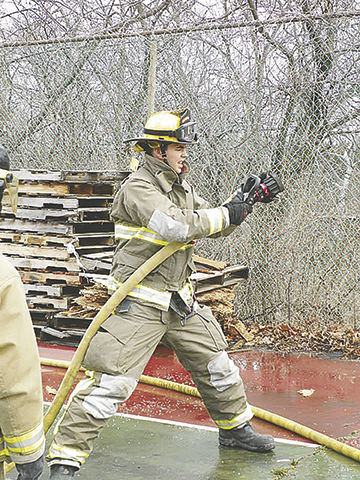
Tyler Prater always wanted to be a firefighter. Preschool photos show him in tiny fireman boots and hat, grinning alongside his firefighter dad. He began training in earnest as a young teenager, and volunteered with the Jefferson R-7 Fire Protection District all through his time at Jefferson High School and Jefferson College.
“I got to know him when he was around 14,” said Kevin Morrison, assistant chief at R-7 Fire. “He was active with the junior firefighters, went through the ATS program at the college. He is a sponge. Everything we showed him and taught him, he absorbed.”
Now 24, Prater is a St. Louis Fire Academy graduate and full-time firefighter and instructor with the St. Louis City Fire Department. He is headed to Kenya in November on a mission trip to help take supplies and training to the African nation.
Prater said he is one of 14 firefighters from across the country who will leave Nov. 13 for the 18-day mission.
“I’m by far the youngest,” he said. “Most who go are either retired or nearing retirement, because they can afford to be gone for two weeks at a time.”
Prater has employed a multi-pronged approach to arranging his own time off.
“I was able to trade workdays, and I have people covering shifts for me,” he said. “I’ll be using vacation, too.”
Morrison said his fellow firefighters have tried to give Prater a helping hand.
“He’s had to really work to get the money together,” Morrison said. “He is paying for a lot of it out of his own pocket.
“But he has such a passion for this, and I think he’ll carry that passion with him on this trip. He’s really a smart kid with a good attitude, and he’s a good instructor. He’ll do really well.”
Meeting a need
Africa Fire Mission is a nonprofit group based in Ohio that works to increase the capacity of fire safety programs across Africa.
“We’re blessed with what we have here,” Prater said. “You call 911 and you get a firetruck in a few minutes. In Kenya, it might be hours. And, even when it gets there, you don’t know whether it’ll have what you need – either the equipment or the people with training – to help you.”
Since 2012, AFM has organized trips for American firefighting volunteers to share training and provide equipment to African fire departments.
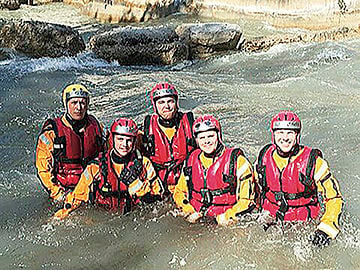
“The first few days, we’ll be touring some local (fire) houses, seeing their capabilities,” Prater said. “After that, we’ll be doing classes in things like firefighting technique, car rescue, water rescue.
“We do have a set agenda; I’m teaching auto extrication, for example. But whatever needs we see, that’s the training we’ll offer. Firefighting techniques, medical skills, all the way down to how to properly put on the equipment. Whatever the need is.”
Prater said the mission volunteers will take along some equipment as well.
“They got a grant for some forcible-entry tools,” he said. “I am taking a full set of gear that I’ll demo, then leave behind. The shelf life of most fire equipment is about 10 years according to American standards, but after that it’s still perfectly good to use.”
He said the biggest obstacle to sending equipment isn’t obtaining it.
“The problem is getting it there,” he said. “The 14 of us will have to bring it in our carry-ons and checked bags.”
Direct shipment isn’t an option, with the uncertain political climate.
“If we send a shipload of fire equipment to Kenya, we can’t guarantee it gets to where it was intended,” Prater said. “Somebody stops it along the way and says, ‘Hmm, I need this,’ and there’s nobody to say no.”
Bridging a cultural gap
One of the hurdles the fire missionaries face is rooted in the African culture.
“There is such a disparity between the rich and poor,” Prater said. “In their culture, knowledge is power, and spreading knowledge dilutes that power. So, they tend to hoard knowledge.
“We’re trying to bring the mindset of American firefighting that we are a brotherhood; that knowledge shared creates a greater good for everybody.”
Mission team members pay their own way for the trip.
“The total is $3,600,” Prater said. “That’s not counting the out-of-pocket stuff like immunizations.”
He held raffles, started a GoFundMe account, and ended up getting some backing from the Muddy River Fools, an informal fire organization, as well as the firefighters union.
“I got $2,800 in donations, and covered the rest on my own,” he said.
This will be Prater’s first venture outside the U.S.
“It’s not combat, but you’re going to a third-world country, and there’s not much security,” he said. “I get updates every day about terrorist activity, about pirates on the coast. Being a minority and a foreigner is a risk, for sure.”
Asked if he felt fearful, he pointed out the nature of his everyday job.
“Afraid? Nah; I think aware is a better word,” he said. “The job we do is dangerous, and we’re all aware of the risks. This is just more of that, in a different way.”
But the benefits will outweigh any potential risks, Prater said.
“Thankfully, I was brought to the firehouse at a very young age,” he said. “Going through the ATS program at the college, going to the fire academy – the team building and camaraderie just kept building.”
Prater, a Festus native, is the son of Tracy and Tim Todd of rural Festus. His dad is a full-time paramedic with the Jefferson-Plattin Ambulance District and a volunteer firefighter with R-7, where his mom is on the board of directors and serves as secretary.
“A lot of people along the way have taken time to help me refine my skills, and to mentor me in making the decisions that have enabled me to get where I am,” Prater said. “Hopefully, I can provide some of the same opportunities I have been given to someone else.
“It’s a ‘paying it forward’ thing for me. I love the people; the contact with the public, the camaraderie. Helping people is the icing on the cake.”
Although he lives in St. Louis now, Prater hopes to be back in Jefferson County before too long.
“The (St. Louis Fire) department requires that you live in the district for the first few years,” he said. “I enjoy working here – the pay is good and I like the people – but I’m not really a city guy; I’d really like to get back to living out in the country.”
Morrison likes that idea.
“Oh, yeah; we’d love to have him back here to run volunteer calls with us,” Morrison said. “He’s a big kid; he’s handy to have around.”
For more information about the Africa Fire Mission, go to www.africafiremission.org.