
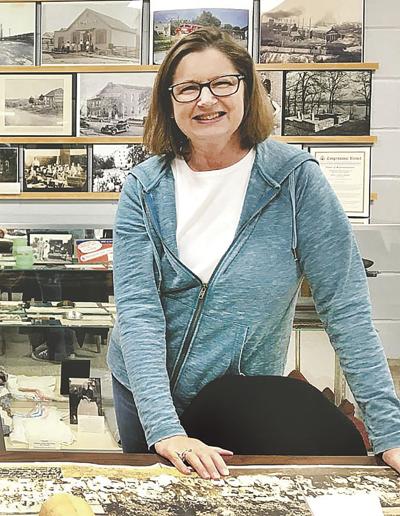
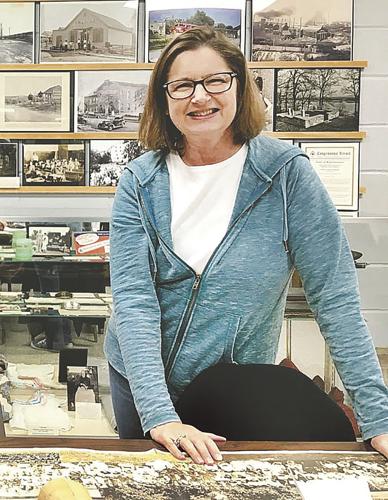

Like most Jefferson County natives, Lisa Lewis Gendron grew up fascinated by the stories and legends surrounding the mysterious, glamorous castle on the banks of the Mississippi River in the southern part of the county.
Gendron’s book, “Kennett Castle or Selma Hall and the Families Who Lived There,” published in January 2019, is full of information about the Italian Renaissance-style mansion and those who lived in it.
But there are still questions, and no easy way to get them answered, she said.
The Union Pacific Railroad, which acquired the property in 1986, used the estate as a corporate retreat for more than three decades. During that time, it was closed to the public.
The company announced the facility’s closing in November 2018, but has persistently declined requests for information about its future.
In January, however, the railroad listed the entire 2,400-acre property for sale, including the castle and its grounds, plus the facility’s nearby 18-hole golf course. (See related story below.)
“I have been extremely interested in the castle and collecting information for about 20 years, and I had started a narrative,” Gendron said. “But, when I heard it was for sale, that jump-started (the book project). Interest was high at the time, and that was a good incentive.”
Gendron is a member of the Jefferson County Heritage and Historical Society, which published her book.
“They (the JCHHS) get 100 percent of the profits from the book,” said Gendron, who serves as treasurer and webmaster for the society.
A hidden gem
An unmistakable aura of mystery surrounds the castle, which was built in 1854 by steamboat magnate Ferdinand Kennett at a cost of $125,000 (about $4 million in today’s dollars).
“We gave a tour in 1984 to raise money for the Fletcher House (in Hillsboro), and that was the last public tour of the property,” Gendron said. “It sold out immediately, and we could have done it five times and still sold tickets.”
She said restricting access to the castle has only added to its cachet over time.
“I think it’s been such a mystery all these years, so it’s kind of like bragging rights to say ‘I went there and got to see it’ for people,” Gendron said. “If it had been open to the public all this time, there probably wouldn’t be that draw.”
Gendron’s research shows that the estate has historical significance for the entire St. Louis region.
“Brookings Hall at Washington University is named for one of the owners,” she said. “He bought it from the Kennetts and used it as a hunting lodge. There are pictures of men in red coats on their horses, off to the hunt. When the railroad came in just below the house, it made him mad and he sold it.”
Early in the 20th century, a family named Cavanaugh owned the estate.
“They had it during the World’s Fair in 1904,” Gendron said. “They brought people down to spend the day. Society people in St. Louis spent a lot of time there. I’ve been contacted by people who have said they went for so-and-so’s coming out party or for a riding weekend.”
Gendron said she believes the mansion should be made accessible to the community and to the world at large.
“There are places throughout the country that are historically similar that people travel from all over the world to see,” she said. “This is a showcase that should be in that same classification – the shining star of Jefferson County. But it’s been kept such a secret that hardly anyone outside the county knows about it.”
Interesting tidbits
Gendron, a hobby genealogist, said she began her book by researching accounts of the families who occupied Selma Hall.
“I went to the state historical society in St. Louis,” she said. “They have five or six big boxes of papers on the Kennett family and associated documents. I spent a lot of time up there, going through those.”
She met with members of the Schock family, the home’s last private owners, who bought it in 1918 and spent more than its original cost to restore it after a 1939 fire gutted the mansion.
“I think in some ways, I knew as much about it as they did,” Gendron said. “But I found out tons of stuff – there are some interesting little tidbits.”
She said Selma was a “bustling little community” even before the castle was built. “Kennett had lead mines in Washington County, and he made the Selma Road to ship lead from there to the river,” Gendron said.
Bluffs near Selma Hall were used as a shot tower during the Civil War, and the house was vulnerable to attack from the river.
“Mrs. Kennett was crippled, and her husband and several of the older children were away in the war,” Gendron said. “The castle was being fired on from the river and she was scared, there alone with no men. She was nervous about having to run everything with only little kids and slaves.”
Gendron said a good portion of the Kennetts’ wealth was in slaves, and the Emancipation Proclamation meant an instant, drastic reduction in the family’s net worth. They moved to St. Louis; the war ended and the elder Kennetts both died, and Selma Hall sat vacant for some years before the estate was split up.
“At one point, the property was up to about 5,000 acres,” Gendron said. “It’s something like 2,500 now.”
Nearly 600 acres on the southern end of the property were sold to Price Acreage LLC for a subdivision, and 16 of those acres were donated to the county as Stonebridge Park in 2013.
Another 110 acres nearby were sold to the Jefferson R-7 School District in 2008 for its high school, built the following year.
The future of the rest of the property, including the castle, has been up in the air until the recent announcement of the sale.
“The persistent rumor is that Fred Weber is going to buy it,” Gendron said. “Maybe they would donate the castle and grounds to the county or the state as a park – wouldn’t that be great? People interested in history would like to see the shot tower, the cemetery. It’s very appealing.”
Gendron’s book is for sale through Amazon for $34.95 or through the Jefferson County Heritage and Historical Society website for $30. Copies may be picked up in person from 6-8 p.m. on Thursday evenings at the JCHHS Museum on the lower level of First Methodist Church, 113 Grand Ave., in Festus, or at any of the special events the JCHHS takes part in around the county.
For more information, contact Gendron at lgendron@swbell.net.