
Jefferson County native Bethany C. Meyers has made a name for herself in the fitness industry, founding the be.come fitness project and mobile app, and sharing workout tutorials and healthy lifestyle posts on Instagram where she has amassed more than 130,000 followers.
She has given a TED talk on empowerment and body neutrality, which she said is the mindset that people are not defined by their bodies.
She has been featured in articles about body neutrality in Shape, Women’s Health, The Washington Post, People, New York Times, Bustle, The Cut, Forbes, Refinery 29, Buzzfeed and Oprah Daily.
The fitness guru has now added author to her resume.
Her 237-page book, “I Am More Than My Body: The Body Neutral Journey,” was published in paperback by Penguin Random House on June 27. The list price is $20.
Meyers, 37, who grew up in the Festus and Crystal City area but currently lives in New York City, said she hopes her book’s message about body neutrality helps people feel better about themselves.
She said body neutrality is the practice of neither loving nor hating your body. Advocates of body neutrality believe the mindset can lead to feelings of joy, peace and fulfillment.
“Body neutrality is not saying that you shouldn’t have any feelings about your body or that you should never think about your body, or that your body doesn’t matter. But it is saying that your body does not dictate your worth,” Meyers explains in the introduction to her book. “You are more than a body, and your value as a person extends far beyond your physical presence.”
Starting out
Meyers lived in Festus from birth until she was 16, when her family moved to Crystal City. She is a 2004 Crystal City High School graduate. While in high school, fellow students voted her “most dramatic” and “most school spirited.”
After graduating, Meyers moved to Chicago to study public relations and then to Los Angeles for a PR job before transitioning to the fitness industry. After that, she relocated to Dallas for a job before eventually moving to New York City.
Meyers spent more than a decade teaching popular exercise classes, developing exercise class curriculum, training other instructors and leading pre- and post-natal workshops. During that time, Meyers battled an eating disorder and an addiction to unprescribed amphetamines.
“For many years, I looked like the embodiment of health – a poster child for the standards of diet culture. I had all the assets of what is deemed a ‘good body’ by mainstream society. But I starved myself so much that whenever I did allow myself to eat – some grapes in between teaching classes – I would be violently sick because my body had gotten to a point where it could no longer stomach food,” Meyers shares in her book. “In contrast to how I was perceived by my clients, I was actually damaging my body in so many ways.”
During the process to change her relationship with food and exercise, Meyers said she began to see the harmful messages promoted by diet culture, like the belief among many that a person’s appearance and body shape are their most important attributes, more so than their personality, achievements and character.
Meyers said she observed how the fitness and wellness world participated in perpetuating the idea that people needed to have thin bodies to have value.
“I had really been reevaluating what working out means to me, what movement means to me, and the more I began to heal the more I saw a lot of gaps in the industry, and I felt like there was a different way to approach working out. By that, I mean focusing on the things that make us feel good, focusing on incorporating activity into our everyday lives to get ourselves moving and less about feeling like ‘Your body doesn’t look a certain way. You need to change it. You need to fix it.’”
In 2018, Meyers founded “the be.come project,” which she said focuses on body-neutral exercises that make people feel good through movement. The purpose of the movement is not to change one’s appearance by losing weight or toning muscle but instead to bring joy and show respect to the body. Most of the routines available for users are zero-to-low-impact and combine Pilates, yoga and dance led by encouraging instructors.
Meyers said her family often inspired her work, particularly her 13 nieces and nephews.
“When I started my own fitness platform, the be.come project, my nieces were always in the back of my mind: Would I want them to do this workout? Would I want them to hear the way I speak about my body?” she said.
Meyers’ mother, Shela Prince, 72 of Crystal City, said she is not surprised by her daughter’s success and her desire to help others.
She said Meyers always has been a kind, loving person who cares for others, particularly her family. After the passing of Meyers’ father when she was 10, their already close relations became even closer.
“She was a wonderful daughter. She was supportive and confident and really my best friend,” Prince said.
She said Meyers’ desire to help others is one of her best qualities.
“Her compassion to help people who are struggling with some of the same struggles that she has been able to overcome and her love for people is what I think is most important,” said Prince. “I think it’s important that if you’re struggling with some of those issues, even eating disorder issues, that this might encourage you to seek help, get help and be healed from those things.”
Meyers said she plans to expand the be.come project to include more than movement classes by showcasing podcast-style conversations about body neutrality.
“The be.come project has been a movement platform and has a really incredible community. We welcome all kinds of people,” she said. “But, I’m really interested in moving it beyond just workouts because I think that there’s so much more to our brand than just the workout side of things. We’re playing with this idea of conversations as a way to help reinforce body neutrality and help people who are in their journey, wherever that may be.”
Meyers said many of those who follow her program are in eating disorder recovery and speaking with like-minded people allows them to have conversations without worrying about the negativity and internet trolling that often happens on social media.
The book
Meyers said she hopes her book provides a good starting point for anyone exploring body neutrality.
“I want anyone to be able to pick it up and gain something from it. I really wanted to keep the feet on the ground and have some toolbox tips and some things that hopefully anyone can connect to. I think sometimes when we get into conversations like this, it can feel really lofty or really heady. And I just wanted anyone, regardless of how much they connect with what’s in the book, to be able to find something that can help give them more self-acceptance.”
In the book, Meyers shares personal stories as well as experiences and thoughts from experts and activists to help readers learn to care for their bodies without tying their worth to their appearance.
Meyers said she believes taking away the pressure people have about their bodies can allow them to focus more energy on their mental and spiritual self.
Also in her book, Meyers offers advice about how people can acknowledge their emotions; understand where those emotions come from and why they are surfacing; and reconnect with their self-worth by feeling gratitude, healing trauma and eating intuitively.
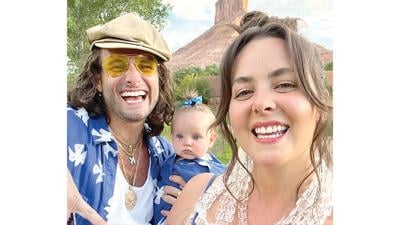
Meyers, who struggled with infertility and had a miscarriage, got pregnant during the year and a half it took her to write a book, and she and her spouse, Nico Tortorella, welcomed a daughter, Kilmer Dove Meyers Tortorella, in March, just days after Meyers finished her book.
Tortorella is an actor, author and podcast host who starred in the TV series “Younger” and had a role in the TV series “The Walking Dead: World Beyond” and “City on Fire,” as well as the film, “Scream 4.”
Meyers said it can be hard to maintain the body neutral mindset when you feel like your body is letting you down, whether experiencing infertility issues or going through chronic health issues. She said she struggled with it when she experienced the physical changes that come with in vitro fertilization (IVF), miscarriage and then pregnancy after loss.
“It was challenging. It was rewarding. It was an incredible experience,” Meyers said. “Growing a baby and now feeding a baby with my body has given me a lot of gratitude and a lot of amazement for the things that my body can do. And it’s helped me see my body as so much more than just a body because I am more than my body.”