

The Missouri Department of Health and Senior Services reported Monday that eight St. Louis area businesses, including four in Pacific, may have been recently exposed to measles.
The department said someone with measles visited numerous locations between Sept. 12 and Sept. 14.
Lisa Cox, communications director for the Department of Health and Senior Services, said the exposures are all tied to a single case of measles and are unrelated to a case reported by St. Louis County last week.
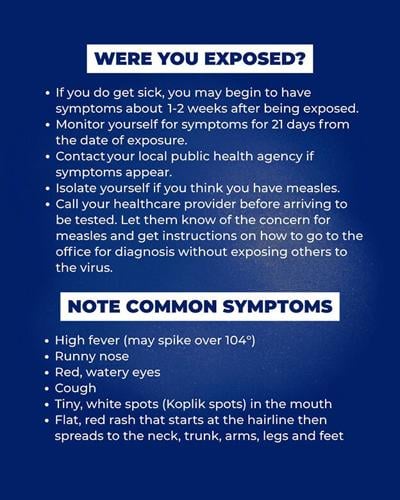
Measles is a “highly contagious viral illness” that usually begins with fever, cough, runny nose and red, watery eyes, according to the department.
“One person with measles can easily pass it on to nine out of 10 people around them who are unvaccinated or do not have natural immunity,” the department stated.
Possible measles exposure could have taken place at the following locations at approximate times, the department said.
■ 3:30-7:50 p.m. on Sept. 12 at The Cat’s Meow-Soulard, 2600 S. 11th St., St. Louis
■ 6-11:30 p.m. on Sept. 12 at Busch Stadium, Section 141, 700 Clark Ave., St. Louis
■ 9:30 p.m. to close on Sept. 12 at Paddy O’s, 618 S. Seventh St., St. Louis
■ 11:30 a.m. to an unknown time on Sept. 13 at Little Ireland, 125 N. First St., Pacific
■ 6:30 p.m. to an unknown time on Sept. 13 at B&H Market, 2244 W. Osage St., Pacific
■ 8 p.m. to close on Sept. 13 at Pacific Brew Haus, 220 S. First St., Pacific
■ 3-5:15 p.m. on Sept. 14 at Goodcents, 173 Long Road, Chesterfield
■ 5:30-7:45 p.m. on Sept. 14 at Bud’s Market, 312 E. Osage St., Pacific
Symptoms typically appear one to two weeks after contracting the virus, the department stated. Tiny white spots may appear inside the mouth two or three days after symptoms begin, and a measles rash appears three to five days after first symptoms.
“The main concern at this time is for people who are not already protected against measles,” the department stated. “The measles, mumps and rubella (MMR) vaccine provides strong protection against measles, especially after two doses. Measles can be especially dangerous for pregnant women and their unborn babies. Children too young to be vaccinated are more likely to have severe complications if they get infected with the measles virus.”
Measles can lead to health complications such as pneumonia, inflammation of the brain and death. It can be transmitted via infectious droplets or through the air if the infected person breathes, coughs or sneezes, the department said.
“The virus can remain infectious in the air and on surfaces for up to two hours after an infected person leaves an area,” the department stated.
People exposed to measles are asked to monitor their symptoms for 21 days from the exposure date and to contact their local public health agency if symptoms appear.
A directory of local public health agencies can be found on the Department of Health and Senior Services’ website home page, health.mo.gov.
Other measles cases
St. Louis County Health Department officials last week announced the first confirmed case of measles in the county in 20 years.
An individual from St. Louis County, who is vaccinated, boarded a Chicago-bound Amtrak train on Aug. 27 that was later determined to already have a passenger infected with the measles virus. He or she boarded in Sedalia.
“Measles is one of the most contagious diseases we see, which is why identifying potential exposures quickly is so important as is abiding by isolation and quarantine requests by the health department,” said Dr. Kanika Cunningham, director of the St. Louis County Department of Public Health. “Our public health team is actively investigating this case and working with our state and local partners to identify anyone who may have been exposed. We encourage residents not to panic, but to be aware of the symptoms, review their vaccination status and contact their health care provider if they develop symptoms consistent with measles.”
Missouri’s measles vaccination rate for beginning school-age children is 89.5 percent, according to the Department of Health and Senior Services, “well below” the 95 percent needed to prevent disease outbreaks and protect those who cannot receive vaccines.
People more likely to develop measles complications, such as pneumonia, are children younger than 5 years old, adults older than 20 years old, pregnant women and people with weakened immune systems.
According to the department, one to three of every 1,000 children who become infected with measles will die from respiratory and neurologic complications.
Vaccination is the best protection against the disease, St. Louis County Health officials said. Two doses of the measles, mumps and rubella vaccine are approximately 97 percent effective at preventing measles.