


De Soto School District residents may be asked to consider a tax increase in the April 2022 election.
The district’s Board of Education discussed at its Dec. 2 special meeting the possibility of asking voters to approve a property tax increase of 25 cents per $100 of assessed valuation. The board members also talked about possibly asking voters to allow the district to transfer 25 cents from the portion of the property tax used to pay off bond issues to the general operating fund.
The proposal calls for revenue from the 25-cent tax increase to be used to raise employee’s salaries, and the additional money that would be available after the transfer from the debt service fund to the operating fund would be used for capital improvements.
The board took no action Dec. 2, but if it decides to seek the tax increase and the transfer, the question would appear on the ballot as a single issue.
The district’s current tax rate is $4.3853 per $100 of assessed valuation, and 98.01 cents of that are used to pay off its bond debt. The remaining $3.4052 is used for operating expenses.
If the 25-cent tax increase is approved, the levy would increase to $4.6353 per $100 assessed valuation, and the owner of a home valued at $200,000 would pay $95 more per year in real estate taxes.
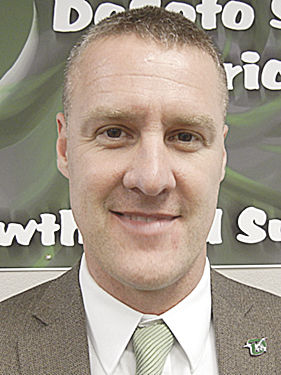
“We figure that with personal property taxes mixed in, it would cost that person about $120 per year,” Superintendent Josh Isaacson said.
The transfer of the 25 cents from the bond debt fund to the general operating fund would not result in a tax increase.
However, taxes levied to pay bond debt expire after the bonds are paid off, so transferring the 25 cents into the general operating fund would make that tax permanent.
Isaacson noted that voters haven’t increased the district’s operating levy since 2002.
In November of that year, voters approved a rollback of the Proposition C waiver that increased property taxes by 75 cents per $100 of assessed valuation.
The last tax levy increase before that was in 1992.
In November 2002, district officials said much of the money generated by the rollback waiver would be used to improve salaries, and the message in April would be similar.
Isaacson said the 25-cent tax increase, which would go into effect in 2022, would generate about $569,000 a year and all of it would be used to bolster employee salaries.
“We know there’s a teacher shortage in the state, and the board said two years ago that we needed to commit to get to the level we need to be. Nothing’s changed in the last two years, certainly,” he said.
Isaacson proposed that if the measure is placed on the ballot and approved, the pay for all employees would be boosted by $1,500 a year.
The base pay for a starting teacher would move from $40,000 a year to $41,500, and counselors’ salaries would be similarly adjusted. Workers paid hourly, such as bus drivers, food service workers and custodial staff, would see their wages adjusted so they would realize the same $1,500 raise over a year, he said.
The board earlier in the meeting had discussed the learning gap caused by the shift to all-virtual classrooms last school year because of the COVID-19 pandemic, a need to hire more teachers at Athena Elementary School to reduce staff-to-student ratios and a general need around the district to hire counselors, tutors and education intervention specialists to provide help to individual students.
Isaacson pointed out that it would be difficult to attract additional teachers, as well as keep the ones the district already employs, if it continues to fall behind what other districts in the area are paying.
“We need to make sure we have access to the highest-quality resources for every student in our district,” Isaacson said. “This helps our community as well. If we can attract high-quality teachers to come here and live here and then stay here, they are spending money in our community.”
The transfer of 25 cents from the debt service fund to the general operating fund would take effect in the 2025-2026 school year, after some bonds are retired.
That money, he said, would be used to pay for capital improvement projects such as replacing heating-ventilation-air conditioning systems and repairing roofs.
“We had an estimate a few years ago that we needed $4.5 million to do everything we needed to do in the district,” he said. “Transferring the money from the bond fund would give us a steady income stream that we wouldn’t have to keep going to the voters to approve.”
Board members generally agreed about the need to go to voters, but board member Jeff Russell asked how the administration decided on a 25-cent tax increase.
“Ask for what you need, not for less than what you need,” Isaacson said.
“Ask for what you think you can get,” Russell replied.
“We realize that times are tough,” Isaacson said. “But our schools are also seeing the consequences of inflation.”
Russell said he agreed, though, that more money is needed to keep the district’s pay competitive.
“We need high-quality teachers and enough of them to serve our kids in an adequate way,” he said.
“I hope the public will see that we’re trying to help the kids,” board member Beverly Wilson said.
Board member Tarrole Milfeld said the board should proceed if it gets the support of employees.
“We need to get our staff behind this,” she said. “If 90 percent of our staff can get 10 people each to vote yes, we’d pass it.”
“I would hope our staff would see that we’re doing it for them,” Wilson said.
Board member Mark Ferrell said that support must be tangible.
“Having sit-on-the-couch support is one thing, but are they willing to go door-to-door?” he asked.
Isaacson said he would speak with De Soto Community Teachers Association representatives, the teachers’ bargaining unit, to gauge support for the idea.
The deadline to place issues on the April 2 ballot is Jan. 25, and Isaacson said the board may be asked on Dec. 16 or Jan. 20 to vote on placing the issue on the ballot.
“This is the right thing to do for our people who are working for our kids every day,” Isaacson said. “All of them, regardless of the position they hold with us, deserve to be paid a living wage.”