
When Plattin Primary School students were struggling to cope with the loss of a first-grade student who died after being struck by a school bus in December, the National Crisis Response Canines (NCRC) group answered the call for help.
The group uses dogs specially trained to handle crisis situations to comfort people dealing with a tragedy.
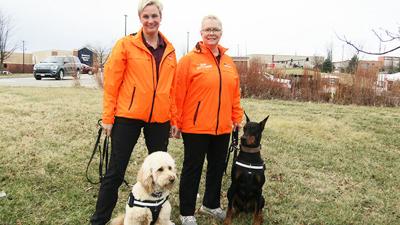
Kellyjean Schmidt, 56, of Arnold coordinated with Jefferson R-7 School District officials and arranged to have two dogs and their NCRC handlers at the school the day after Damon Rice, 6, died on Dec. 21. The dogs and their handlers returned to the school when classes resumed Jan. 5.
“I was standing at the front door as kids walked in and saw the dogs, and you could see their shoulders relax,” said Steve Horn, Jefferson R-7 intervention specialist. “You could see the anxiety for a lot of them minimize, and for some of them, it flat disappeared. It was extremely helpful to have those dogs. A lot of kids sat in the lobby with the dogs until it was time to go to class. It was a huge asset to have the dogs here.”
Schmidt and her dog, Corbin, a Doberman pinscher, joined the national nonprofit group in March 2021 to help people facing crises. She did not take her dog to Plattin Primary, but she oversaw the two handler-dog teams who visited with students.
“I wanted to give back,” said Schmidt, who also competes in dog shows with Corbin. “I know what my dog gives to me and what dogs in general can give back. At R-7, we watched the kids who were highly affected sit and relax and open up around the dogs.”
NCRC
The NCRC was formed in the wake of the Sept. 11, 2001, terrorist attacks that destroyed the World Trade Center twin towers in New York, according to the group’s website, crisisresponsecanines.org.
Cindy Ehlers of Eugene, Ore., and her dog, Tikva, along with four other handler-dog teams were invited to the World Trade Center by the American Red Cross to provide therapy at the site of Ground Zero.
The teams worked for two weeks to help first responders and others relax and talk about the tragic event. After providing help there, only Tikva was able to continue to work as a therapy dog because the other dogs were retired because they experienced post-traumatic stress disorder.
This inspired Ehlers to create a more rigorous training program to elevate handlers’ and dogs’ abilities to handle high-stress situations. She developed a six-month program and three-day exercise regimen to make sure dogs could handle being in crisis situations that could involve numerous blaring sirens, falling buildings, blazing fires or other loud, distracting noises that may leave a dog traumatized.
Dogs must display 24 core traits that show they can handle crisis environments, and handlers have to be certified in psychological first aid, suicide prevention and intervention, first aid for humans and dogs, CPR for humans and dogs and Federal Emergency Management Agency incident command.
More than 300 canine teams, which consist of a dog and a handler, have been certified, according to the NCRC website.
“Not every dog and person is capable of walking into a crisis,” Schmidt said. “You need to be specifically trained.”
Coming to the county
Schmidt said she was inspired to become part of NCRC after reading a story about Erin Hampton, 45, of Godfrey, Ill., and her goldendoodle, Serine.
“I wanted to do more,” Schmidt said. “It has always been in my heart that I have to do more with this dog (Corbin) than run around a ring (during competitions).”
Hampton, who said she was inspired to train dogs for therapy work while she was in a treatment center for alcohol abuse, helped develop five other teams in the St. Louis and southern Illinois area.
She said she has recruited handlers and dogs from therapy work, and she also helps train people like Schmidt who reach out to her to become part of NCRC.
“Not every therapy dog can become a crisis response dog,” Hampton said. “They have to have the right temperament to be in a chaotic or emotionally stressful situation. We also need people interested in helping people. We look for the team to have a canine-human bond. (Handlers) need to watch their canine and deal with someone at the same time. They have to know their canine well. The canine needs to have a desire to be with people. Canines have to engage with the person being helped.”
As part of their training, Schmidt said she and Corbin participated in mock drills at the Alton Little Theater in Alton, Ill., where actors portrayed people who were displaced after their apartment building was destroyed by fire.
“They (the dog and handler teams) had to use skills they learned to respond to these people,” Hampton said.
She said Schmidt and Corbin also trained at the Alton Memorial Hospital, where they met with doctors and nurses who were feeling stress because of the COVID-19 pandemic.
“We provided relief,” Hampton said. “We inspired resilience. When someone is closed off, crying or doesn’t want to talk, a dog can help break down that barrier. It can get someone talking and help us find out what they need. Then we can point them in the right direction to receive help.”
Rock Community Fire Protection District Capt. Bryan Menke, the district’s chaplain and a member of the Fire Chaplains of Jefferson County, said fire district chaplains have met with Schmidt and other members of NCRC and plan to call on the group to help people dealing with traumatic situations.
“They have been to some of the big disasters that we have all heard about on the news,” Menke said. “It is huge to have someone local because they have offered to respond to scenes that are not big, national news. They are happy to respond because this is their community.”
Menke also said the group may be used to help county first responders deal with some of the tragic events they encounter.
“Some first responders are very closed off when talking about a situation, but when they start petting a dog, you see them relax,” he said. “There is a great opportunity for the dogs to be used with first responders to help them deal with the stuff we deal with.”
Horn said he was impressed with the help the dogs and handlers provided at Plattin Primary, and he would like to use the NCRC for more than just crisis situations.
“I have thought about doing it quarterly or the first day of school,” he said. “The first day of school, especially at the elementary school when it is the first day of kindergarten, can be difficult for students. We have talked about that a lot. There are a lot of different ways to utilize the service. We don’t have to wait for a crisis.”