


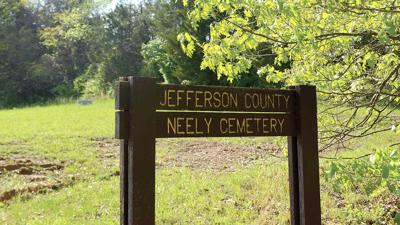
As it has for many years, Jefferson County will continue to take care of burials for poor people who leave behind no means for their final arrangements.
County Counselor Wes Yates said the county has traditionally provided “pauper burials” for people who die without any known family, insurance or Social Security or Veterans Administration benefits or any other way to pay for their own burials.
“Every year, we budget about $8,000 a year for pauper burials, and we usually do four or five a year,” Yates said. “I don’t know how long the county has been doing it. Certainly since the Great Depression, maybe since the turn of the (19th to 20th) century and maybe even post-Civil War. But those are just guesses.”
Public Works Director Jason Jonas, whose department oversees the pauper burials, said about 100 people have been buried in a 1-square-acre site west of De Soto.
“We use one of our backhoes to dig the grave,” Jonas said. “We contract with Robert D. Brown Funeral Home (in Hillsboro). They bring the caskets to the cemetery – it’s called Neely Cemetery – and our workers lower it into the ground.”
Jonas said one of his staff members does a lot of research to ensure anyone buried as a pauper qualifies.
“It takes a lot of work to figure out whether the person has truly died without any assets or family members,” he said.
The Jefferson County Council voted unanimously April 27 to approve an ordinance allowing the county to provide for pauper burials.
Yates said the ordinance was necessary because of a glitch in state law.
“When we were presented with a memorandum of understanding whether Jefferson County would participate in the (Dignified Transfer Station, a temporary morgue in north St. Louis County designed to handle overflow bodies that hospitals, county morgues and funeral homes wouldn’t be able to accommodate in a worst-case scenario during the COVID-19 pandemic), there was a clause in there that each county would assume responsibility for its unclaimed bodies.”
Yates said an unclaimed body is not the same as a pauper.
“It may be because with the social distancing someone might well decide they don’t want to claim Uncle Joe because they can’t have a proper funeral for him,” he said. “We need to make a distinction between someone who doesn’t want to pay for a funeral and someone who has passed away without the means to provide for one. We have the money to pay for four or five burials a year – not 24 or 34.”
Health departments in the participating counties were asked to sign the memorandum, and Yates said because Jefferson County’s Health Department is an independent agency rather than a branch of the county government, it could not sign the agreement and bind Jefferson County to assume responsibility for unclaimed bodies.
County Executive Dennis Gannon said the county has not signed the agreement.
“I spoke with representatives of hospitals and funeral directors, and they assured me that they would be able to handle what was expected,” Gannon said.
Yates said the Health Department’s attorney, Jessica Mikale of the Wegmann Law Firm in Hillsboro, did some research into the matter and found the county had no authority to perform pauper burials.
“In 2018, the state Legislature got tired of the laws that talked about county poorhouses, county poor farms and other things that had probably been on the books for 150 years, so they cleaned them up,” Yates said. “I don’t know what they were thinking or not thinking, but they also eliminated legislation that enables counties to do pauper burials, which every county does.
“The state Legislature needed to cut a hangnail and instead cut off the entire arm with those statute repeals.”
Yates said once he learned that, he drafted emergency legislation to remedy the problem.
“I knew we needed to pass an ordinance so we have a law on the books,” he said.
“It was considered an emergency (in which an ordinance can be approved at a single meeting) because we didn’t know what we’re going to be dealing with concerning the pandemic.”