






(Photo by cottonbro studio via Pexels)
By Stephen Beech
Vivid dreams make sleep feel deeper - even when the brain is more active, suggests new research.
The discovery of a "key" relationship between dreaming and the feeling of having had a good rest may help treat sleep-related and other mental health issues, say scientists.
They explained that the feeling of having had “a good night’s sleep” lies not only in how much we have actually slept, but also in the subjective impression of having slept deeply and without interruption.
But, until now, what constitutes the neural base of that perception was not well understood.
The new study by Italian scientists, published in the journal PLOS Biology, suggests that dreams, especially the most vivid and immersive ones, rather than disrupting sleep, could help it feel deeper and restoring.
The team say it could explain why people sometimes sleep for eight hours but don’t feel rested, while other times can feel like they've had a great night’s sleep after only five hours.

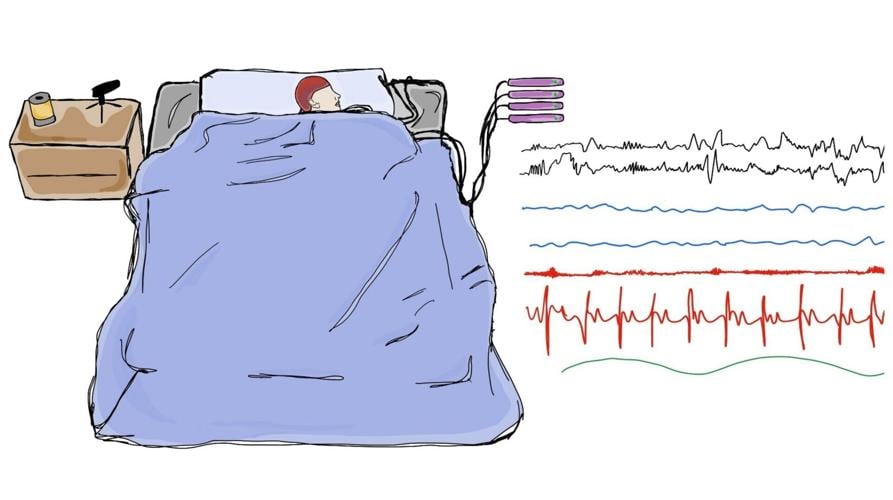
An image depicting the experimental setup (the image shows on the left, a sleeping participant wearing the EEG cap and, on the right, the recorded EEG, EOG, EMG, and ECG signals during NREM2 sleep). (Valentina Elce via SWNS)
For years, scientists believed that deep sleep meant a "switched off" brain - slow brain waves, little activity, no awareness.
Dreaming has been associated with Rapid Eye Movement (REM) sleep and is acknowledged to reflect partial “awakenings” of the brain.
However, the REM stage marked by intense dreaming and wake-like brain activity is also commonly experienced as a relatively deep sleep.
To investigate the paradox, the Italian team analysed 196 overnight recordings from 44 healthy adults who slept in a laboratory while their brain activity was measured with high-density electroencephalography (EEG).
The data was collected in a larger study investigating how various types of sensory stimulations impact on the sleep experience.
Across four lab nights per participant, the researchers collected more than 1,000 awakenings with corresponding reports, creating one of the largest datasets linking brain activity, dream experience, and subjective sleep perception.

(Photo by John-Mark Smith via Pexels)
For the experiment, participants were awakened repeatedly from non-REM sleep, a stage characterised by broad variability in both subjective sleep depth and dreaming.
They were asked to report their mental experiences just before awakening, and to rate perceived sleep depth and subjective sleepiness.
The results revealed that the deepest subjective sleep was reported not only when participants had no conscious experience, but also after vivid and immersive dreams.
By contrast, minimal or fragmentary experiences, such as a vague sense of presence without clear dream content, were associated with the shallowest perceived sleep.
Study senior author Professor Giulio Bernardi said: “Not all mental activity during sleep feels the same: the quality of the experience, especially how immersive it is, appears to be crucial.
“This suggests that dreaming may reshape how brain activity is interpreted by the sleeper: the more immersive the dream, the deeper the sleep feels."
The research team also found that although physiological markers of sleep pressure steadily decreased across the night, participants paradoxically reported feeling that their sleep was becoming deeper.
Bernardi said the subjective deepening closely tracked a rise in the immersiveness of dreams, suggesting that dream experiences may help sustain the feeling of deep sleep - even as the biological drive for sleep wanes.

(Photo by Artem Podrez via Pexels)
He believes immersive dreams may help maintain our sense of disconnection from the external world, a defining feature of restorative sleep, even as parts of the brain become more active.
Bernardi, of the IMT School for Advanced Studies Lucca, said: “Understanding how dreams contribute to the feeling of deep sleep opens new perspectives on sleep health and mental well-being.
“If dreams help sustain the feeling of deep sleep, then alterations in dreaming could partly explain why some people feel they sleep poorly even when standard objective sleep indices appear normal.
"Rather than being merely a by-product of sleep, immersive dreams may help buffer fluctuations in brain activity and sustain the subjective experience of being deeply asleep”.
He says the idea echoes a long-standing hypothesis in sleep research - and in classic psychoanalysis - that dreams may act as “guardians of sleep.”

(Photo by Ron Lach via Pexels)
Bernardi said: "Our study suggests that dreams may help shape how we experience sleep by immersing us in an internal world that keeps us disconnected from the external environment.
“Understanding how dreams contribute to the feeling of deep sleep opens new perspectives on sleep health and mental well-being.
"Alterations in dreaming - for example, a reduction in the richness or frequency of dreams - could influence how people perceive their sleep depth or duration, and may contribute to dissatisfaction with sleep quality.”
He added: “This kind of research is extraordinarily demanding.
"Serial awakening studies require waking participants repeatedly across multiple nights and collecting detailed reports each time.
"It was only possible thanks to the dedication, resilience, and coordination of an exceptional team of researchers.”