


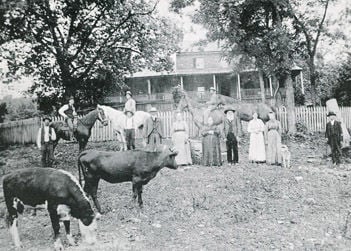
In a place sometimes called Plattin, just south of Festus, near the intersection of Harness and Charter Church roads, a pile of bricks, chimney flues and a cemetery are all that remain of the Red Brick Plantation, built by the McCormack family, some of the first pioneers in Jefferson County.
Peter P. McCormack was the patriarch. An Irishman by birth and a soldier in the Revolutionary War, he came to Missouri from Kentucky in about 1802 with two sons – James and Hardy – his second wife, Isabella, and her children. He settled along Plattin Creek and later moved south, but not before establishing his family’s heritage in the area and donating a portion of ground for the first Methodist church, according to an article “McCormack – A Pioneer Family” in the February 1995 Jefferson Heritage & Landmarks Society Newsletter.
It was his son, James, however, who built the big red brick plantation house in 1836. Judy (McCormack) Dixon of Festus remembers the family place as “impressive both in size and history.” She wrote in her article, “Old House of Memories,” in a 1988 Jefferson Heritage and Landmark Corporation’s Newsletter, that the house had the reputation as the first brick house in Jefferson County. It had seven rooms and five fireplaces and for many years it served as an inn for people traveling Selma Road. For Dixon, however, the house had ties of a personal nature.
“My great-great-grandfather, James, built it. My grandfather, Lawrence, was born in the front upstairs bedroom. My grandmother, Mattie, came there with him as a bride to stay until their own house could be built,” Dixon said. “My father, Harold, as a small boy, snuggled into bed in that same upper room, shaking with delicious freight, as his grandfather, Hardy, told him stories about the owls they could hear hooting in the tall, old trees that surrounded the house.”
Dixon says headstones behind the house include names such as McMullen, Donnell, Boyce, McClain and, of course, McCormack.
The house was part of her roots, Dixon wrote.
“I was never in the house when it was occupied,” she wrote. “I have only seen it as a deserted, derelict shell, but still, I loved to drive by it, high on its hill shaded thickly by trees and vines in the summer and stark and lonely in the winter. It always gave me a feeling of home, of continuity.”
Unfortunately, the house is no longer standing. Vandals burned it to the ground, probably about 30 years ago now. The cemetery is still there but no one maintains it any more, Dixon said.
“The surprising thing is that there are graves dating as late as the 1950s,” she said.
Dixon steers clear of the old place now, she wrote.
“I rarely drive out that winding country road anymore, or cross the bridge over Plattin Creek that leads to where the road forks around that tree shrouded hill. That way, in my mind, it still stands, that old house of my past, the way it was – forever sheltering the memories of those who laughed and loved, were born and died there. All those who preceded me and helped shape and make me who and what I am,” Dixon wrote.
Send submissions to LOOKING BACK to nvrweakly@aol.com or bring or mail them to the Leader office, 503 N. Second St., Festus (P.O. Box 159, 63028). Please include your name, phone number, a brief description of what’s in the photo and tell us how you came by it. Please also include when it was taken, where and by whom (if known). A new LOOKING BACK photo will be posted each week.