
By Peggy Koch
Introduction: On Nov. 28, 1905, a major storm raged on Lake Superior. Waves 20-30 feet high turned this calm inland sea into a destructive torrent of wind and water. At least 29 ships were sunk and 36 men died. In response, the government began to build a string of lighthouses along the shoreline. Lighthouse keepers were hired to keep watch and warn water craft away from the treacherous shoreline at night and during fog and storms.
Meet the characters
Father: Henry Lane
Mother: Mattie Lane
4-year old Sam
9-year-old Ann
10-year-old Blake
14-year-old Becky
15-year-old Matt
Mr. Sloan, assistant light keeper
Helpers: Gene and Kenny
Chapter 1: Summer Plans
In March of 1914, Henry Lane gathered his wife and five youngsters to share the news.
"I'm going to work at a lighthouse," he told them. "And you can stay with me from May until September."
"We're going to a lighthouse, we're going to a lighthouse," 4-year-old Sam sang out in delight. "What's a lighthouse, Daddy?"
"Remember when I told you about how a big storm about nine years ago had sunk many ships to the bottom of Lake Superior?"
"Yes, I remember," 15-year-old Matt indicated.
"Well, since then, the U.S. Lighthouse Service has been building lighthouses around the lake. Hazard Island Lighthouse has a big light that ships can see for miles around and foghorns, too. Both are there to warn ships of dangerous bluffs and rocks concealed in shallow waters."
"Can't the people on the boat just see the rocks?" 9-year-old Ann questioned.
"Not at night, dear, and not in the middle of a bad storm," came the reply. "I want you all to help me this summer. Matt, you and Blake will have to do some serious fishing. We'll need the extra food. We won't have supply deliveries very often. The lighthouse is on an island near the shore. There's no road. The only way to get there is by boat or ship.
"I'm a good fisherman," Blake insisted proudly.
Matt grinned.
"Boys, I also expect you to help me with the equipment. You will have to learn how to keep the machinery cleaned and oiled and the brass polished."
Matt groaned.
"I knew there'd be some real work involved."
"And girls, I expect you to help your mother. You'll be busy keeping house and preparing food for all of us plus my three assistants."
"I'd rather go fishing," 14-year-old Becky sighed.
"Are there other children to play with?" Ann asked.
"No, dear. There aren't any. The assistant lighthouse keeper will be there but he has no children. Neither do our two helpers."
"Will I be able to have a garden, Henry?" Mrs. Lane wondered.
"If you wish, Mattie. But the ground is rocky. You may not be able to grow much food."
"Is there a school nearby?" 10-year-old Blake wanted to know.
"No, so you five and your mother will have to come back to Iowa in the fall and live on your grandfather's farm so you can go to school."
"Oh, drat," 15-year-old Matt remarked.
"Watch your language, son," his mother warned.
"Just what is your job, Father?" Matt asked.
"As the head lighthouse keeper, I'll have to make sure that the tower light works day or night and also see that the foghorn sounds at 20-second intervals whenever a fog comes up and ships can't see the light.
"That sounds easy," Blake commented.
"Oh, that's just the beginning, son. My helpers and I will have to keep the buildings painted and in repair, wash windows, keep the light's lens clean and maintain our boats and boathouse. We're expected to fix cement if it cracks. We have to be prepared for a fire and be ready to use first aid if someone gets hurt. Remember, the closest doctor is miles away."
"That does sound like a lot," Becky noted.
"I'm also supposed to keep the financial books and order parts and kerosene and anything else we need. Once your mother brings you home, I'll have to order food and cook and keep house.
"How soon do we leave?" Blake asked excitedly.
"I have to travel right away," Mr. Lane explained. "The rest of you won't move in until late May."
"Ohhhh," the youngsters moaned in disappointment.
"Why can't we go now?" Matt demanded.
"Because our quarters aren't finished yet. By May we will be living in a big brick house with plenty of room for all of you. I'll oversee the last chores of setting up the light and see about furnishing our rooms before you arrive."
"Can't we stay with you all winter?" Ann questioned.
"I won't even be staying this winter," her father explained. "Once Lake Superior freezes over, no one can get in or out. I'll come back to Iowa by early December and stay with you until April."
LOOK IT UP
All the Great Lakes were scooped out by glaciers in the distant past. Lake Superior is by far the largest of the Great Lakes. It stretches 350 miles long by 160 miles wide. If you wanted to circle its shoreline, you would have to walk 2,726 miles. Its average depth is 483 feet. At its deepest, it reaches 1,332 feet. At Sault Ste. Marie, the lake flows into Lake Huron by way of the St. Mary's River. The Soo Locks allow huge ore barges to be gently dropped into the lower water level of Lake Huron and from there to ore processing plants along our nation's waterways.
Lake Superior has shoreline along Michigan, Minnesota, Wisconsin and Ontario, Canada. Native American Chippewas named this lake Gitchi-gummi, which means "Great water" or "Great lake."
The head lighthouse keeper was expected to see that the light works dependably whenever it was needed, day or night. The crew would have to turn the light on every evening and turn it off during the daytime unless there was a storm. Most keepers would set up four-hour shifts. Someone had to be on watch all night to make sure the clock-like machinery for the light would run correctly and the engine wouldn't run out of kerosene. They would have to test the foghorn daily to make sure it sounded at 20-second intervals. They also oversaw administrative duties and maintenance.
Chapter 2
"Don't be afraid," Mr. Lane encouraged as his younger children eyed the docked steamer with mistrust.
Reluctantly, they climbed aboard the ship along with their oldest brother, Matt, who was obviously enthusiastic about the new adventure.
The family had spent the night on the southern shore of Lake Superior. Today, they would visit ports at Marquette and Munising, Mich., to pick up supplies.
They had just settled on the deck when their small steamship began rocking violently. Past them churned a freighter covered with large dark-colored rocks.
"What is that?" Mrs. Lane questioned, holding on to a rail on the deck with whitened knuckles.
"That's an ore carrier, Mattie, probably coming out of the harbor at Marquette," Mr. Lane explained. "Freighter traffic like that is a big reason why so many lighthouses are needed along the lake. There are many iron mines up here. Logging companies, too. That one's probably headed for the Soo locks at Sault Ste. Marie. When we pass Marquette, I'll show you and the youngsters the ore pocket dock. Makes it easier to load ore onto the carriers. But before we get there, we'll pass the Pictured Rocks."
"Do rocks really have pictures on them?" Ann asked.
"Wait and see," Father replied.
At lunchtime, they sat on the open deck and ate the bread, cheese and pickled cucumbers that Mrs. Lane had packed.
"I'm so glad we got a sunny day for this trip," Father commented, looking directly at Matt. "We're making good time. But I want you all to understand that this lake is dangerous when storms come up and that the weather can change quickly."
"Yes, Father," Matt acknowledged.
"Oh look, how pretty!" Becky called, pointing toward shore. "Those cliffs have all kinds of colors on them. Look, yellow and black and blue-green and red. They really do look painted. Why is that, Father?"
"Minerals leach out of the rocks. The red is iron, of course, and the blue-green is copper. Don't know about the rest."
"Look how amazingly clear and blue the water is close to shore," Mother noted.
"That looks like a castle up ahead," Becky exclaimed, running to the other end of the deck to inspect it more closely."
"That's a sea stack," their father explained. "Don't know how they got here but it's fun to imagine what they look like. Captain says one's shaped like a piano and another one looks like a giant vase or a teapot."
"Get away from that railing, Sam," Mrs. Lane shouted just as Sam nearly teetered over the edge. "Get him, Matt."
Matt lunged for his brother and caught him by the heels.
"Why did you do that?" he demanded.
"I wanted to see the pretty fish," Sam explained, looking puzzled. "Why can't I?"
"Because you'd drown," Mother sputtered.
By mid-afternoon, the steamship had docked at Munising.
"You may as well go out and walk around town," the captain told Mr. Lane. "We've got more cargo to load than we planned on."
And so the family hiked up to a local waterfall.
Ann, Blake and Sam took off their shoes and splashed in the water while Matt and Becky explored and their parents rested in the shade. When they heard the boat's horn toot three times, they knew they had to return.
After another short ride, they arrived at Ashland, Wis., as the sun was beginning to set. The family walked to an inn where they bought their supper.
Just before dark, they strolled back to the dock. A sudden splash caught their attention.
"Where's Sam?" Mother demanded.
Several sets of eyes searched the darkening water where the splash had been heard.
"There he is," Matt shouted.
Matt jumped in and hauled Sam out sputtering and spitting water.
"I warned you not to do that," Mother screamed at him, once she had checked to see that he was breathing regularly. "Why did you do it again?"
The soaking wet little boy looked up at her with a let's-be-reasonable expression on his face. "I just wanted to pet a fish," he explained.
"Well, if you don't learn to behave, I'm going to give you to the Indians tomorrow," his mother threatened.
LOOK IT UP
Sea stack: As the great glaciers melted, they left depressions that formed the five Great Lakes. The tremendous weight of all that ice had forced the surface of the earth downward. As the ice turned into water and escaped to join rivers and oceans, the submerged rock formations began to rise, exposing sedimentary rocks to the forces of wind, ice and water. The weaker limestones were washed away over the years while the stronger sandstones were blasted by the winds into fantastic shapes that still entice the imaginative person into giving them names.
By the 1850s, Marquette, Mich., linked to the mines by a railroad line, was becoming a leading shipping center for iron ore. Townsman John Burt designed the first ore pocket dock, which was built in 1859. These ore loaders made it much more efficient to unload rail cars of ore into waiting ore barges or carriers. Today, Marquette is still a major shipping port for hematite (a form of iron) and iron ore pellets.
Chapter 3
As darkness overtook them, the Lane family unpacked blankets and quilts and bedded down on the upper deck of the steamer. The evening air was mild but misty. It was well after dark before the mist cleared and the bright night sky loomed above them vast and mysterious. They stayed awake late, admiring the universe of bright stars.
"It's such a beautiful night. I'm glad we didn't have to sleep downstairs," Mother commented.
"This gentle rocking is like a cradle," Ann sighed.
"But this deck is awful hard," Blake noted, squirming to get comfortable.
"Just consider it a chance of a lifetime," Father whispered. "You'll remember this experience for the rest your lives."
As they awoke the following morning, a cold fog was enveloping the steamer deck. One by one, they stood up and wrapped their blankets tightly around their shoulders. Together they climbed down the steps to the galley for warming drinks.
"As soon as the fog breaks, we'll head past the Apostle Islands," the captain told them. "Be on the lookout for Indians."
"There are real Indians?" Blake's eyes widened.
"Yes, many of them from the Chippewa tribe. They've had a treaty with the U.S. government for 50 years or more. We'll be passing their reservations. The names of their clans give you an idea of what animals live around here. The Crane, Loon, Eagle, Bear, Marten, Lynx, Bullhead, Sucker and Turtle.
"Will they scalp us?" Ann wanted to know.
"I doubt it," the captain answered. "They've been peaceful for a long time. But you may see them fishing."
"Why do they call them Apostle Islands?" Becky asked.
"The earliest explorers thought there were only 12 of them. There are actually 21, young lady."
"What do people do there?" Matt wondered.
"A few people have tried to farm," the captain explained. "Others have made their living by fishing. One business concern has begun quarrying brownstones for buildings in Chicago."
"How do they get those heavy stones so far?" Blake asked.
They use heavy metal cranes to move them, then ship them onto giant barges, he said.
"I see a big white building up there. What's that?" Ann wondered.
"That's Raspberry Island Lighthouse."
"It's funny looking. Why is the light is built right into the house? Will our house look like that, too?"
"No, our house is separate from the lighthouse," Father explained. "The noisy machinery won't disturb you as much from a distance. Besides, that lighthouse was built close to the edge of the water. Ours is way up high."
"Look!" Becky shouted. "What are those big holes in the rock?"
"They're called sea caves," the captain said. "Smaller boats have to be very careful of them. The wind and waves can smash a careless pilot's ship into them in a heartbeat.
"See, over there? That's where the Indians live, on Madeline Island."
Sam looked apprehensively in that direction.
"Are you going to give me to them, Mother?" he stuttered, tears forming in his eyes.
"Of course not," Father reassured him. "Your mother was only trying to warn you of danger, son. You must learn to swim before you go jumping into the water again. You hear me?"
Then he gave the boy a not so gentle swat on his rump.
By noon, clouds began forming to the north and just as they caught sight of the massive bluff of Hazard Island, the steamer began to rock unsteadily.
"You folks better come downstairs," the captain told them. "I think we're in for a blow."
Soon lightning crossed the now lead-gray sky and gusts of wind tore at the vessel as it chugged along.
"Hope this storm has blown over by the time we get to the lighthouse," Mr. Lane commented.
"Don't worry," the captain told them as the family huddled below deck. "This is just a storm, not a gale. It will probably have passed by the time we get to ..."
He paused and caught his breath as a great gust of wind hit the steamer, rocking it violently back and forth and ending his sentence prematurely.
"Got to get back to the wheel," he muttered, rushing toward the wheelhouse.
LOOK IT UP
Sea caves have been sculpted by wave action and freezing and thawing of ice along the shorelines of the Apostle Islands. Worn down from sandstone of the Devil's Island Formation, these sea caves appear as delicate arches, honeycombed passages and vaulted chambers.
Over time, lighthouses have been built on six of the Apostle Islands. The second was on Raspberry Island, built shortly after the locks at Sault Ste. Marie were completed in 1885. A fog signal was added in 1903 and major remodeling was done in 1906.
Ojibwa tribes (Chippewa) had occupied the lands we now call reservations long before the first French explorers arrived in the 1600s. In 1854, the U.S. government made a treaty with the Chippewa tribe that recognized a reservation on Madeline Island and in six communities along the mainland: Bad River, Red Cliff, Lac Du Flambeau and Lac Courte Oreilles, St. Croix and Mole Lake.
Even in the 1800s, the Ojibwa people were able to keep records written on birch bark scrolls in a pictographic writing system. They were able to keep records of the treaty for themselves and defend their rights.
Along with fishing, today some Ojibwa support themselves by growing and selling excellent long-grain rice.
Chapter 4
The steamer bobbed up and down in rhythm with the waves as it approached the dock at Hazard Island Lighthouse.
"I'm so glad the storm has subsided," Mrs. Lane rejoiced. "Look, the sun is coming out just in time to land."
"Is this really an island, Father?" Becky asked. "I can see the shoreline for a long way."
"Sort of," their father explained. "The north side of the island hugs only a few hundred feet from the mainland. Just behind the island is a protected shallow channel that separates the two. That will be a safe place for you to play and fish, but only for those of you who can swim."
He looked directly at Sam, who hung his head.
"Our home is up there," Father continued, pointing to one of the shadowy boxes at the top of the cliff.
"How do we get up there?" Becky questioned.
"You have a choice. The assistant lighthouse keeper will use the hoisting engine and derrick to haul our supplies up the cliff. Each of you can ride up in the basket if you wish."
"I don't want to do that," Ann insisted, shuddering.
"Your other choice is to walk northeast for a ways and follow the path up to the top, then double back to the house. The path is steep but grassy. You will have to walk about a mile."
"The children and I will walk," Mother volunteered. "I'm tired of sitting still on this boat. Need to stretch my legs anyhow. Is the path clearly marked?"
"Guess I'd better lead you the first time," Father said.
"I want to ride in the basket," Matt insisted.
"Me, too," Blake chimed in.
"OK, boys, you ride up."
"Are there bears around here?" Ann wondered as they climbed the steep ascent.
"Sure are," her father told her. "But there aren't many trees so you can see them coming for a long way," he replied, chuckling.
Mrs. Lane didn't laugh. "There aren't any on the island, though, are there?" she asked.
"Could be. Bears can swim. But most of them mind their business if we mind ours, Mattie."
"Why aren't there any trees on top, Father?" Becky asked. "All I see are tree stumps."
"That's because the construction workers cut them all down to use for building the houses."
"Did it all take a long time to build?" Sam wanted to know.
"Nearly four years to complete all the buildings."
Huffing and puffing, the family finally reached the top of the steep bluff.
"Why didn't they build the lighthouse down lower where it would be easier to reach?" Ann asked.
"Because the point of a lighthouse is to be seen for a long way. The higher the better," Father explained.
"Oh, I guess that makes sense," she muttered.
"I know you are anxious to get a look at your home for the summer, Mattie. But first I want you to meet my helpers. This is my assistant, Mr. Sloan. And Gene here helps with maintaining the light and foghorns. That's Kenny coming up in the basket now. Must be done unloading.
"I'll have to check now to make sure all the supplies and our boxes and trunks have been hoisted up. You go on ahead and explore. That one's our house. Go on in."
The rectangular two-story house smelled of the white pine wood used to construct it.
"It's larger than I had expected," Mother said with approval.
Downstairs, they found a comfortable parlor and an even larger dining room served by a small kitchen. At the back was an office filled with Mr. Lane's maps, charts and books on everything from first aid to how to maintain the mercury light in the lighthouse tower.
Upstairs, they found three large bedrooms with beds and dressers in place. Hooks lined the walls for hanging up clothes.
In the kitchen, their mother quickly unpacked a few Mason jars and heated green beans to go with slices from a ham they had brought. Becky stirred up cornbread mix and made johnnycakes in a skillet on top of the stove. From the dining room window, the family watched a spectacular sunset in the west.
"I can't wait to begin exploring," Matt announced.
"Just be cautious," Father commented. "There are many dangers here. You have a lot to learn."
LOOK IT UP
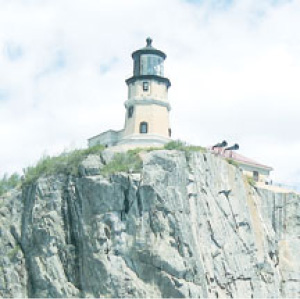
At Split Rock Lighthouse, the first head lighthouse keeper stayed at his post for 18 years, from 1910-28. His wife and four children came for long visits but never lived there permanently.
By the time another man took over his position, that family was able to live there year-round. By then roads were being built. Mail service had improved. Automobiles were becoming popular, making it easier to get supplies.
Two communities were vitally important to the staff at the lighthouse. The community closest to Split Rock Lighthouse was Beaver Bay. That community survived the recession of 1857 that caused other North Shore communities to be abandoned. A tannery, saw mill and grist mill provided a living for the residents through the turn of the century.
By the mid-1880s, the county seat was moved to Twin Harbors. By 1911, that town had both a grade school and high school with seven teachers serving about 100 students. Classes offered included science, music and Latin at the high school in addition to the basic reading, writing and arithmetic.
Chapter 5
"We want to go for a swim," Blake announced the next morning as they finished breakfast. "Right now."
"It's too cold to go," Father explained. "You'll be surprised by how cold the water is even on the hottest days of summer. I thought you'd want to see the lighthouse first anyhow."
"I do," Matt agreed.
"Me, too, Father," Becky added.
So off they all went to see the lighthouse.
"If you will notice, the foundation of the light tower was set into solid rock. The tower is octagonal in shape. It's made of a steel-framed brick."
"What makes the light at the top work, Father?"
"I'll show you, Ann."
Together, the family climbed the steep iron stairs that led to the top.
"The light-making incandescent oil vapor lamp is set into a steel lantern. The second order, bi-valve type Fresnel lens floats on a bearing surface of liquid mercury. It's rotated by this clockwork mechanism that is powered by weights running down the center of the tower. The weights have to be wound by a crank at the top.
"You mean, like a cuckoo clock?" Becky questioned.
"Something like that," Father agreed.
Matt whistled through his teeth: "Boy, that is a complicated piece of machinery. What powers it?"
"Kerosene," Mr. Lane answered. The tower is 55 feet tall. The bluff is 110 feet above the lake. The light can be seen from up to 22 miles away, giving a ship miles of warning. A flash goes out every 10 seconds."
Blake yawned. "I want to go swimming," he whispered to Ann.
"Doesn't the wind ever stop blowing?" Becky asked as they left the tower and headed for the fog signal building.
"No Becky, since the trees were cut down, there's nothing to stop it from whistling through the complex."
"You children need to be careful," Mother warned. "There really should be some kind of fence along this cliff's edge, Henry!"
"We'll get a fence put up sometime, Mattie."
"Now, in this fog signal building, we have two Franklin 30 horsepower gasoline-driven air compressors," Father continued. "They force air into the foghorns."
"Where are the horses?" Sam wanted to know.
Ann giggled. Her father frowned.
"That's a good question, Sam. There aren't any horses. The air compressors do the work it would take 30 horses to do."
"I didn't think horses could compress air," Blake teased.
"Stand behind one sometime and you'll find out," Matt replied with a grin.
"That's enough," Mother interrupted. "Back to the house now. We all have plenty of work to do today."
At breakfast a few days later Father was smiling.
"Things are going pretty well around here, Matt. How about if I take you and Blake fishing early tomorrow morning?"
"I want to go, too," Becky insisted.
Mr. Lane looked at his boys.
"She has to bait her own hook," Matt snapped.
In the rowboat, Father and Matt rowed the double pair of oars in rhythm.
"You have to help row, too, Becky," Father said as he moved over.
"That's fine with me," she replied, trading places with him.
They stopped the boat in a deep cove.
"I'm going to try these yarn flies I made up," Matt announced with confidence.
"I'm going to bait with some of the minnows we caught in the creek," Blake decided.
"I dug some night crawlers," Becky announced. "Anyone else want to use some?"
"Good thinking, Becky," Father encouraged. "I'll try one. We really didn't get up early enough, though. But since it's overcast, I think we'll still have some luck."
"How was the fishing?" Mrs. Lane asked as they trooped up to the house at noon.
"Look, I caught a little salmon," Blake showed her proudly.
"And I got two lake trout on those flies you helped me make," Matt grinned.
"I pulled in six small walleye, Mattie. But look what your daughter caught."
Becky smiled and showed her mother a large walleye.
"I think it weighs about 10 pounds," Father said. "I'm expecting some tasty fish for supper, Mrs. Lane."
"Only if you clean them, dear."
"Sure. OK, Becky, this is the day you learn to clean fish."
"And if you do a good job, maybe Father and I will take you out hunting with us," Matt taunted. Becky stuck out her tongue at him.
LOOK IT UP
The fishing around this lake is said to be "superior" with a variety of lake and river fish frequently caught including Atlantic, Chinook, Coho and pink salmon; steelhead and rainbow trout; lake and brown trout; whitefish and smallmouth bass.
Chapter 6
"You mean we finally get to go swimming?" Blake smiled.
"Yes, it's a fine day for it," Mother replied. "It's unseasonably hot, so the water should feel refreshing."
"We'll all hike down and take a splash in the shallow channel by the creek," Father added. "You can pack a lunch for us, can't you, Mattie?"
"I will. But shouldn't I stay up here with Sam? You know how he is."
"Sam will have to learn sometime."
The grassy path down to the shallow channel was a more gradual hike.
"You're right, Mother," Matt shouted. "This water is cold but the sun is so hot that I don't mind."
Then he plunged into a deep blue hole, turned over and floated on his back.
A curious gull plopped down on a rock. Then a dozen more landed nearby, squawking and screeching.
"What are they doing, Father?" Blake asked.
"Probably looking for baby herring. See that school of shimmering fish just beyond us."
And sure enough, the gulls began to dive for the tiny fish.
"Look what I found," Matt shouted, holding up a small crayfish in his hand. "Next time we go fishing, I'll have to take a few of these for bait."
"What's that cute little the furry animal on the bank?" Ann wondered.
"That's a ground squirrel," Father called.
"I want a piece of bread," Sam demanded.
"Here," his mother said, breaking him off a bit.
Sam waded across to the shore on a natural bridge of submerged rocks, then offered it to the curious animal. The squirrel scurried away, but once Sam had laid the morsel of bread on the ground, it ran back and inspected the bread with a sniff. Quickly it ate the bread, then ran back to a burrow at the edge of the woods.
"What's the difference between a chipmunk and a squirrel?" Ann asked.
"Ground squirrels have fluffy tails. And don't climb trees, like other squirrels," Mother replied.
"Sam, I want Becky to show you how to swim," Mother called.
Becky caught Sam under her arm as he waded back from the shore.
"I'll teach you to float first," she explained.
While she supported Sam's back, she told him to relax. Instead he let go of her, flipped over and flailed his arms and legs wildly. She caught him as he began to sink.
"OK, let's try again."
She slowly removed her hands when she felt him relax. Once again he panicked.
"Oh, just go and play for awhile in that shallow pond over there," she ordered. "We'll try again later."
She noticed that Ann was keeping an eye on Sam, so she dived into the deeper water and swiftly swam out to where Matt was standing on a nearly submerged rock watching a passing sailboat.
"Where's Sam?" their mother suddenly shouted.
They all looked around. He was nowhere to be seen.
"Oh, no," Mother cried. "That boy has run away again."
Quickly, Father sent the other four youngsters in different directions. It was Becky who found him a few moments later.
She had followed the creek bed. At a sharp bend, she found Sam standing close to a huge moose who was calmly taking a drink of water. The moose looked up as it spotted Becky.
"Sam," she whispered, "Come away from that moose. Walk slowly."
"No, I want to see him," Sam challenged. He began stepping closer.
The moose lowered its head and seemed to focus on the nearby boy.
"I'll give you a piece of candy when we get home," Becky quietly bribed.
Sam turned and began wading toward her.
Finally aware of the intruders, the moose began to charge toward Sam. Suddenly a shot rang out. Then another. The moose stopped in midstream, took a great gulp of air, and then fell.
Becky spun around. There stood Matt with his father's hunting rifle.
"We'll be having fresh meat for some time," he quipped.
Quickly Becky scooped up her little brother into her arms. She was crying when she reached her mother. "I should have watched him better."
"I should have, too," Mother whispered.
"Where's my candy?" Sam demanded.
"Oh, you'll get candy if Becky promised it," Mother told Sam. "But you are also going to get something you won't like as much. Blake, break me off a willow switch."
LOOK IT UP
The gulls that survive around Lake Superior feed mostly on small marine fish such as herring but they will also consume smaller birds, eggs and even human garbage.
Gulls prefer nesting in colonies in a location sheltered from the wind. They line their nests with feathers and grasses. Their hatchling young are able to fly in about six weeks.
The American red squirrel (a variety of ground squirrel) lives in the forests of North America. Ground squirrels build burrows in the ground. When frightened, they head for a burrow, not up a tree. They are most active during daytime. They eat grasses, seeds, grains and nuts in forest areas. In cultivated fields, they may help themselves to vegetables and grain crops. In cold weather they hibernate. A few have been observed swimming in shallow pools to feed on aquatic grasses.
Moose range in much of lower Canada around the Great Lakes and in Minnesota and Michigan's Upper Peninsula. Their meat was a staple of Native Americans in times past. They are the largest member of the deer family, and like the rest of that family, they are vegetarians.
Chapter 7
"Now that it's almost time for you to go back to Iowa, I'm going to give you a special treat," Father told them. "I'm going to take you to Gooseberry Falls."
"That's a funny name," Ann noted.
"It's an Indian name," Father replied.
"We've been so busy, none of you have seen the splendid waterfalls yet. These hills are full of little creeks and rivers that have torn though the solid rock and spill downhill as waterfalls.
"Beaver Bay Falls would be close if there were a road. But we can get to Gooseberry Falls from the lake. Besides, you'll get to see three falls at one time. We'll take the boat and row it up to where the Gooseberry River joins the lake. "Once we beach the boat, we'll have to follow the river upstream through heavy brush. It's worth the hike to see the three separate falls. We'll bring a picnic lunch and have fun."
"Don't stand up in the boat, Sam." Father yelled.
As usual, Sam's curiosity had gotten the better of him and he was reaching out, trying to catch a butterfly as it flew overhead. His mother tugged him down by the shirttail.
The rowing was easy on a calm, sunny day. That is until they turned the rowboat into the Gooseberry River and tried to head upstream. Then Father and Matt struggled against the current. Within a few hundred yards, they had to beach the boat and proceed through the heavily overgrown brush.
"How are we supposed to find the falls, Henry?"
"We'll walk as close to the river as we can, Mattie, and listen. Hear that roaring? We're already close."
"Look at that!" all the youngsters seemed to say all at one time.
The family hesitated to admire the onrushing water of the Lower Falls.
"Just wait until you see the next one," Father encouraged.
A short distance later, they stopped to watch water flowing mightily in two cascading falls through a towering formation of solid dark rock.
"This is the Middle Falls," Father explained.
"There's nothing like this on your father's farm," Mother sighed in admiration.
A short but steep hike brought them to the Upper Falls, not quite as high or as spectacular, but just as mesmerizing.
The family returned to the Middle Falls, where the youngsters took off their shoes and socks and waded into the shallow pools.
"Look, there's a cave in those rocks," Matt noticed. "May we explore it?"
"That might not be a good idea, Matt. Up here we never know what kind of animal might call that cave home."
"I'm not afraid."
"Well, you should be. What if it's home to a family of skunks?"
"Pe-u-eey," Blake snorted, holding his nose.
They ate their picnic lunch sitting on the solid rock that lined the falls.
"Daddy, Daddy, I see a bear!" Ann shouted.
"Children, be quiet." their father ordered.
"Mattie, cover the food so he can't smell it. It's a black bear. He probably won't bother us if we sit still. Glad it's not a female with a cub."
They watched breathlessly as the bear ambled slowly around the deepest pool, looked disappointed when he swished the water with his paw, and ambled back into the woods.
"See, they don't usually cause problems," Father explained. "But never get between a mother bear and her young."
The family spent the rest an enjoyable afternoon playing around the waterfall.
"Why has it gotten so dark all of a sudden?" Mother asked.
Father looked up at the opening between the canopy of high trees. "It's clouding up. We'd better get back. Pack up, youngsters."
By the time they had hiked down to the rowboat, a solid bank of clouds had gathered along the shore and the water was becoming choppy. Both father and Matt rowed vigorously toward home. Toward the western end of the lake, a small steamer appeared, bouncing up and down as the wind bore in from the northwest.
"Guess they're trying to get ahead of the storm," Father shouted. "We're close to the dock now. We should make it home."
A few moments later from the safety of the dock, Becky screamed. "The ship is tipping over, Father."
"I can't see it anymore. It looks like the ship has capsized," Matt cried out. "What should we do?"
LOOK IT UP
Gooseberry River's name was given long ago. It may have been named after Sieur des Groseilliers, who was an early French explorer whose name translates to Gooseberry. Gooseberries were imported from Europe. These bushes grow in the northeastern and north central U.S. and Canada. The deciduous shrub grows 3-6 feet tall. It produces small tart green berries that make delicious pies.
Chapter 8
"We can't do anything for the people in that capsized boat right now," Father shouted. "I'm glad Gene and Kenny have turned on the lighthouse light anyhow. We may be able to take the rowboat out later. But if we went out now, we'd likely sink too."
As the family hesitated on the dock, thunder began to boom, lightning flashed across the sky in firework timing and the wind screamed and whistled in their ears.
"Matt, you stay here with me. Mattie, you get the youngsters back to the house. Get warm blankets ready. Tell Mr. Sloan and Gene to get down here and Kenny to be ready to turn on the hoist.
By nightfall, the storm had blown over. Lake Superior was back to its gentle lapping as Gene, Mr. Lane and Matt surveyed the miles of darkening water from seats in the rowboat.
"Look Father, I've spotted something over there."
"I see it," Gene called.
Coming closer, they saw a silent body. The man's head was held above the water by a life vest.
"Is he alive?" Matt questioned.
"We'll see," Father whispered. "He's been in this cold water a long time."
As soon as they had dragged the man into the boat, they wrapped him in a blanket.
"He has a pulse," Gene announced. "I think I can hear him breathing. And his heart is beating, but slowly,"
"Can you spot anyone else?" Father questioned, squinting into the growing darkness. "If not, we'd better head for shore. The battery of my flashlight is about out of juice."
Each one searched the gentle waves. "No one else in sight," they finally agreed.
Back on shore, Father made a rude torch from some driftwood. Mr. Lane signaled for Kenny to hoist the unconscious man up the bluff.
"We'd better take shifts watching the shore in case someone else floats in," Father decided.
By breakfast time, the rescued mariner had recovered from his hypothermia and was eating with the family.
"I warned the captain that the boat wasn't loaded evenly," the man explained. "He was in such a hurry to get the cargo of newly brewed beer delivered to Grand Marais before it spoiled that he left Duluth knowing that a storm was coming in. We capsized because we didn't have time to balance the load before the high winds hit us.
"How many in the crew?" Mr. Sloan asked.
"Just four of us. Sure hope he and my mates made it to shore."
"You were taking quite a chance, weren't you? Father questioned.
"Guess we were. But then anyone who crosses Superior takes risks. Our luck didn't hold this time.
"Thanks to you folks, I'm feeling pretty good now. But I don't know how to get home. Any ships due here?"
"No more supply boats are scheduled. If you'll wait, you can go back with my family. I'm going to take them by rowboat to Two Harbors. From there, you can all catch the regular mail train to Duluth."
And that is what happened. In early September, the family made their first stop at Twin Harbors.
"What is that funny looking thing that goes way out into the lake? Father," Becky asked. "The other youngsters stared at the huge construction.
"Look, train rails ran right up to the edge," Matt noted.
"Actually they run most of the way to the end of that ore loader," Father explained. "Those arm-like things on the side are chutes. The workers open a port at the bottom of a railroad car and the ore drops from there into the chutes and, thanks to gravity, into a waiting cargo space in a freighter below.
"Look at that funny boat," Blake pointed out.
"That's the Edna G. She's a tugboat. She brings freighters safely through the harbor."
Mattie sighed. "If we could save our pennies, maybe we could rent a small house and live here in the winter next year, Henry. What do you think?"
"I think, Mattie, that you'd better think about how hard the winter is up here first. Oh, here's the train."
"Goodbye Father. We'll miss you," Ann said. And the others hugged him in agreement.
"I'll miss you, too. But I'll be sure to be home by Christmas. That's a promise."
LOOK IT UP
The tugboat Edna G. was built in 1896. "She" [influenced by Latin where all water craft are feminine] worked the shallow waters off Two Harbors nearly continuously until 1981, moving ships and barges. She was powered by a coal-fired, steam-powered engine. She was also involved in several dramatic shipwreck rescues over the years. Now open for tours, the boat is listed in the National Register of Historic Places.
Hypothermia: When the temperature of a person's body (normally about 98.6 degrees) is cooled to a certain point, the person passes out and eventually dies.
An often repeated saying is that Lake Superior never gives up its dead. This is based on the coldness of the deeper waters. Usually bacteria grow rapidly in submerged dead bodies and the resulting gasses cause the body to float. But the water slightly below the surface is so cold that the bacteria don't have a chance to grow.
Chapter 9
In the snug farmhouse in northern Iowa, the Lane family gathered to celebrate Christmas Eve.
"I wish Father were home," Becky sighed. "Be sure to pray for him, Grandpa, even before you read the Christmas story tonight."
"I thought he was supposed to get here last week," Blake added. "The snow is already two feet deep in places and it sure looks gray outside."
"Yes, we surely have had an early winter this year," Grandmother commented. "I hope Henry is close to home by now."
In fact, Mr. Lane was wondering if he would ever get home. It had taken the five men two weeks to get to Duluth. The harbors had iced up too early to risk rowing to Twin Harbors, so they had slogged the 20 miles in knee-deep snow, spending a night in an unheated cabin that the owner had left unlocked.
From Twin Harbors, they had waited to catch the mail train. When it finally arrived a couple of days late, so did a snowstorm. They found themselves waiting again. When they finally boarded the mail train, they were delayed in several places where they had to get out and help to shovel high drifts off the train tracks.
Three days before Christmas, Henry was still waiting impatiently for a Great Northern train to take him to Sioux Falls, S.D. The train had been due in four days earlier.
"Guess I'd better send a telegraph," Henry decided. "It's expensive, so the fewer words I use, the better. Let's see: "In Duluth. Train delayed. Henry."
He questioned whether he should add the expensive greeting, "Merry Christmas."
They probably won't get the message until at least a day after Christmas anyhow, he decided, so better save my money.
On Christmas morning, the five Lane youngsters excitedly opened their presents. Included in the packages were warm coats and mufflers. Their grandfather had made them a wooden puzzle by cutting out each of the 48 United States separately. They spent some time laughing as they assembled the pieces. But the best present of all arrived around noon.
"Bert, what you doing all the way out here?" Grandfather asked of the man who had just driven up in a sleigh.
Their neighbor explained that he was the last of a chain of people. The telegraph man had given Henry's message to a neighbor who lived south of the town of Hinton. He'd spotted another neighbor who lived near Merrill. Bert and his family had gone to church in Merrill that morning and he had agreed to deliver the telegraph to Henry's family.
"Not the regular way it gets done," Bert said, "but we all wanted you to get the message by Christmas Day."
Mattie read the telegram to all of the family. The youngsters groaned in disappointment.
"But at least we know he's safe and thinking about us," Grandmother pointed out.
It was the middle of January before their father walked through the door.
"He's home," Becky yelled at the top of her voice. The other youngsters crowded around him, sharing hugs and kisses.
After spending a good deal of time explaining how he had managed to get to his parents' home, he turned to his wife and said, "I think you were right. We'd better figure out a way to stay in Duluth next winter. I really like the job and I think you liked spending your summer at the lighthouse..."
"Oh, we did," Ann interrupted.
"It was the best time I ever had," Blake added.
"Can we go swimming?" Sam asked. Mattie raised her eyebrows at her husband in exasperation.
"It's cold and there's lots of snow, isn't there? Even more than here," Ann pointed out.
"Yes, that's true. But Duluth is even bigger than Two Harbors. The city has a grade school and a high school for you to attend. They've just opened a State Normal School, too. Be good if Becky wants to be a teacher."
"We could try living at a boarding house first. There are several. There's a real F.W. Woolworth store downtown with lots of things for a nickel or a dime. There are churches, several of them. And there are lots of people to keep the streets cleaned off.
"Best of all, we'd be together as a family all year."
LOOK IT UP
In 1914: Duluth, Minn., had a population of 150,000. The State Normal School opened. (A few years later, it became Duluth State Teachers College.) A high concentration of wealthy people lived there because of all the mining profits and no income tax. The Mesabi Range alone produced 12 million tons of iron ore that year. More wealth had been generated by timbering, but by 1914, that industry was close to playing out. Townsmen were finishing a steel manufacturing plant and improving the harbor.
Aerial Lift Bridge: Its drawbridge-like gondola was capable of carrying 60 tons of traffic, allowing residents of Minnesota Point to reach the mainland at Duluth. This unique bridge is now listed in the National Register of Historic Places.
States puzzle: In 1912, the last of the 48 continental states was recognized in Washington, D.C. Alaska and Hawaii were not included until 1959, bringing the current total to 50 states.