
AMONG THE ARCHES
By Peggy Koch
Chapter 1 -- The Letter
Moab Utah, Post Office, Box 24
April 18, 1917
Dear Grandmother Riddell,
Please let me come home. I hate it here. Jeb says everything is fine. But it isn't.
The grand log cabin he told Mother about is full of cracks. We nearly froze this winter.
Last summer, the sun beat down and turned it into an oven. Scorpions and lizards crawled in and out all the time. Once we had to chase down a rattlesnake.
We finally gave up and began sleeping in a dry cave. We have to climb a rope ladder up a steep cliff face to reach the cave.
Mother couldn't climb the ladder safely in her skirts so she has taken to wearing a pair of Jeb's britches. I don't think she is very happy here either but she grits her teeth and agrees with Jeb when he tells her things will get better.
Jeb keeps ordering me to call him Father. But I won't. Caleb is my father, even if he is dead.
I want to come home where the trees are green and the creeks and rivers have water in them. I hate the brown scrub brush and the dry arroyos. The dust blows day and night and makes us cough.
There's no school either. I know you think that getting an education is important.
Please Grandmother, make them send me back to you in Amelie, Missouri. I promise I'll never skip school again. I'll do all the chores you ask, as soon as you ask me to, without an argument.
Sincerely,
Your Grandson, Blaise
"Who is Blaise Riddell?" 14-year-old John asked his father one quiet spring morning in 2012.
Henry Riddell looked puzzled. "Blaise? Oh, that was your great-grandfather's name. Why do you ask?"
"When you sent me to the attic to find your tax records., I also found some books in an old trunk. This letter fell out of one."
John handed his father a crumbling envelope.
"What's this letter about, Dad? It's signed 'Your grandson Blaise.' That's our address on the envelope, but Blaise mailed it from Moab, Utah."
"I'm pretty sure Blaise was your great-grandfather. The books in that small trunk were passed down to your grandfather, Edward. As far as I know, Edward Riddell, lived in this house all his life. He farmed and worked at the railroad yard in De Soto. A lot of men worked in the mines but he always swore he'd never do that. Don't know why.
"Who was Lucinda Jones? I found her name written inside the book."
"I think that was the name of Blaise's mother."
"So what was Blaise doing in Utah?"
"I don't know, son."
"Is there any way to find out?"
"You could check the other books in the trunk. See if there are any more notes.
"Sounds like our family has lived in this house for a long time, Dad."
"Yes, part of the house is about 120-years-old. Caleb's father built the original two rooms in back as a log cabin.
"Really? Is that why the floors kinda sag in there?"
"I imagine so. Like many settlers, they added rooms as they needed them. Various parts of this house are different ages."
"So how was Caleb related to me?"
"Caleb? Let's see, there was Caleb and then Blaise, then Edward, then me and then you. Caleb was your great-great-grandfather."
Don't you know anything about him?
"Not much. My father wasn't interested in family history. But you can do some digging. If you happen to find a few horse thieves, so be it.
"Why don't you start by researching Moab, Utah. Check the Internet for references to the town at the time this letter was written. Oh, and see if Moab had a newspaper then. Some historical societies are posting newspaper articles from way-back-when on the Internet."
"I'll do all that, Dad. But will you also try to remember anything you can?"
"Yes, of course I will."
A few days later, John told his father: "I did find something else in the trunk this morning. This was folded into another book."
"What in the world is it, son? Looks like a couple of pages of random numbers."
"I'm not sure either, Dad. What if it's some kind of code? I'm going to try to solve it."
"Okay, but make sure you do your homework first."
LOOK IT UP
The study of a person's ancestors is called genealogy. Most families keep informal genealogies based on stories and information handed down from older relatives (oral histories). Others may use historical records to add to their understanding of their ancestors' lives. They may try to learn about their ancestors' lifestyles, biographies, and motivations., not just where and when they lived. This often requires-or leads to-researching antiquated laws, old political boundaries, migration patterns and past economic or religious conditions.
Chapter 2 - The Code
"So what have you found out about Moab so far?" John's father asked a few evenings later.
"Moab is in the eastern part of Utah, Dad. It's the county seat of Grand County. The town was settled in 1878 and incorporated in 1902. The town's altitude is high compared to ours; about 4,000 feet above sea level with higher elevations all around.
The Colorado River runs past the town but otherwise the area doesn't have much water. According to Google Maps, there's a green band along the river. Outside that band it's really sand-colored. Settlers and traders first came there because of the good river crossing nearby. That was in the early 1800s, long before any bridges were built.
Today, the town gets lots of visitors because it is close to Arches National Park and Canyonlands.
"John, I think I've seen photos of some of the arches. Look, here's one on the calendar we just got from the bank."
"Wow, the rock formations are so red. "
"Maybe we can go see the place sometime, son. Would you like that?"
"That would be great."
A week later, John met his father at the door. "Look Dad, I think I've figured out the code in this letter I found. I studied it for a long time before I realized that there were no numbers higher than 26. After I translated some, I realized that Blaise's mother wrote this, using a number to represent each of the 26 letters in the alphabet. 1 equals A, 6 equals F, 20 equals T, 5 equals E and 18 equals R. That stands for the word after. I'll read you what I've translated so far:
July 1, 1915: My name is Lucinda Jones Riddell. I have six brothers, but I'm the only one of the Jones children who graduated from the eighth grade. I married Caleb Riddell when I was 17 years old. He built us a house near his father's farm outside of Amelie, Mo. He helped with the farming sometimes, but mostly worked in a mine south of here. We had only one child, a son.
My heart was broken when Caleb died in a mining accident. I had to sell the house and move in with my in-laws when Blaise was 10 years old.
My life changed again two years later. A man named Jeb Stuart Bothwell got off a train at Festus, hired a horse and rode to our place. Jeb was a distant cousin of my husband's family.
I was working in the garden when he arrived. He said he had come to see my husband's brothers.
It didn't take him long get to the point. Mining was going on in the desert outside of the town of Moab, Utah. There were fortunes to be made in digging out something with a funny name I'd never heard before.
"What use is that uranium stuff?" my brother-in-law, Jake, asked with a sneer. "Haven't they found gold or silver in the area?"
Jeb answered in a hurry. "No, but I'm telling you men that buyers are giving good prices for uranium right now. They use the ore to extract radium. Haven't you ever heard of Marie Curie?"
"Ain't interested in what no woman does," Jake insisted, as he spit out some of his chewing tobacco juice.
Vernom wasn't interested either but Caleb's youngest brother, Noah, kept listening and asking questions.
July 5: Jeb got back from St. Louis today. Told us he'd had some success getting a few men to invest in the mine he hopes to start up and work. Told them he had found a good deposit of carnotite in the bright red rocks on the claim he had inherited from an uncle.
"You ever done any mining?" Vernom questioned.
"No, but I can hire men who have. I'll learn as I go."
Jeb paints a wonderful picture of life in the desert. He lives in a grand log cabin about 10 miles from the town of Moab. Says there are some Mormons there but he gets along fine with them and they make good neighbors.
At that point, John stopped reading.
"Go on," his dad urged.
"Sorry, this is as far as I've translated the code."
"Well, let me hear the rest just as soon as you can, son."
LOOK IT UP
Moab, Utah: Much of Utah was settled by Mormons (Church of Jesus Christ of Latter-day Saints) in the second half of the 1800s. The location that is now the site of Moab was used as the only Colorado River crossing along the Old Spanish Trail. In 1855, a group of Mormons attempted to establish a trading fort there. After Native Americans attacked the fort repeatedly, they abandoned the site. In 1878, a new band of settlers finally established a permanent settlement. Moab was incorporated as a town in 1902.
In 1883, a railroad line was built 45 miles north of Moab. During the next few years, as bridges were built in other locations along the Colorado River, farmers and the few cattlemen had to adjust. In previous years, they had traded with passing travelers. Now they had to learn how to ship their goods to distant markets.
Moab's economy changed again when sources of uranium and vanadium were discovered in deposits of carnotite in the immediate area around 1910. In addition, potash and manganese were later mined. Sources of gas and oil were exploited some time later.
With the resurgence in interest in nuclear power during World War II, rich deposits of uranium were mined south of Moab during the 1950s.
Chapter 3 - The Search
"How's the search going?" Henry asked John as he walked in the door from work.
"I'm really discouraged, Dad. I can't find the name of Blaise Riddell among the Census reports or the property owners in Missouri until 1930. By then, he was living in this house. If Blaise was about 12 when he wrote the letter, he must have been born around 1904. How long did he stay out west? What did he do there?"
"Sorry son, I don't know. Have you found out anything else about Moab?"
"I discovered that mining was big business in the West at one time. Along with uranium, mines have also produced potash, manganese, and copper in more recent years.
"Dad, I'm glad that Blaise did live to grow up and have children no matter how unhappy he was. And he did have a mother to care about him as a boy?"
Henry gave John a sympathetic groan.
"Your mother wanted to be with us, son. She just couldn't."
"I know. By the way, I've managed to get some more code turned into words." Here's what Lucinda says:
July 12: A week's gone by and Jeb is still trying to convince Noah to go back to Utah with him. Told us it's mostly dry out there but there is a little creek running across his land. Says the rocks out there look like statues. He tells me the sunsets are amazing. In fact, he has made a habit telling me about everything he knows until late in the evenings. Then my mother-in-law finally yells at us that it's time to be going to bed.
My son Blaise, waits up for me.
"What you want to go talkin' all night to that feller for?" he asks me.
"He was telling me some interesting stories," I'd explain.
"Grandpa says you are acting silly over that man," Blaise tells me.
"Your grandpa should mind his own business," I reply. "But he means well."
July 15: I get pretty lonesome sometimes since Blaise's father died. After Caleb's death, we moved back in with his folks and younger brothers. Noah worked our patch of land, along with his own.
I feel secure living with them but sometimes I get restless and think I'm going to up and move to a bigger town like Hillsboro or De Soto and learn how to use one of those gadgets they call a typewriter. A woman can make good money if she can type, they say.
July 30: Today, I'm beginning to think that Mr. Jeb Bothwell has plans that include me. Jeb got back from another trip to St. Louis today. Says he's satisfied that he's gotten all the investors' money he's likely to get. Plans to head back for Utah. Noah sounds like he wants to go along. He's 21 now so he can decide for himself.
Jeb told me tonight that he has a surprise for me. He'll give it to me tomorrow on my birthday.
July 31: Well, Jeb surprised me all right. His present is a wedding ring. He wants Blaise and me to go back with him to Utah.
I told him it would take me a couple of weeks to get ready. He explained he'd rather wait and open the mine in September anyhow, when it's cooler.
There won't be any school for Blaise there so I'm packing all the books that I can find. I'll teach him how to read and do his numbers.
"Dad, do you think that is how Blaise got to Utah? John asked.
"Sounds like it to me. By the way, would you still like to visit Utah and see what we can find?
"That would be great!"
Dad smiled. "Today I booked a trip for the two of us on Amtrak. We'll take a train west to Grand Junction, Colo. From there, we'll rent a car and drive to Moab. It's only a couple of hours away. Nose around a little bit and see what we can find."
"When?"
"Two weeks after school's out."
"Only a month to wait then, Dad. That's not too long."
"In the meantime, I want you to keep searching so we'll know where to look when we get there. And look up Canyonlands National Park, too. They say that area looks like a smaller version of the Grand Canyon."
LOOK IT UP
The earliest visitors to the Moab area were nomadic hunters and gatherers. About 2,000 years ago, they began cultivating maize, beans and squash. They settled south of Moab in the Four Corners region, where the boundaries of Utah, Colorado, New Mexico and Arizona meet. Although there is no evidence that Pueblo villages were built in the area around Arches and Canyonlands parks, rock paintings, pottery, tools and later petroglyphs are still in evidence in many places. One artifact shows men on horseback, so it must have been painted after the Spanish brought horses to the North America in the early 1500s.
Chapter 4 - Consequences
A few days later, John ran into his father's room.
"I've found some more code, Dad. Only this time, it was written inside a book on some blank pages at the end. There's another letter, too. Wait until you hear what Lucinda says now."
Aug. 15, 1915: Traveling the 40 miles from the train station to Moab, I noticed the barren hills all around us and shivered. During the train trip, Jeb and I had been promising Blaise how wonderful life would be in the west. We'd get him a horse. He could become a real cowboy if he wanted. We would all live happily every after.
But when I saw the land and the dusty towns, I began to have second thoughts about Jeb's promises. The summer heat is awful. Jeb had told us it was dry heat and didn't bother much. And he's right about one thing - it's so dry that my perspiration evaporates almost immediately. But the word "poached" comes to mind when I think about my skin.
I wonder what my brother-in-law Noah will think when he arrives next week.
Sept. 30: My first chance to write since August. The grand cabin Jeb promised us is just one tiny room with a dirt floor. Lizards and other critters run freely back and forth between the logs day and night. There are big gaps in the walls. Jeb cut down cottonwood trees from around the creek and chinked them with mud. Now the chinking is powdering away. Jeb says we'll appreciate the cabin more this winter.
For now, we have taken up residence in a dry cave. This red sandstone is fairly soft. When it gets cooler in the late evenings, Jeb has taken to using some of the mining tools to enlarge the cave so we can have more room.
Blaise has been exploring the area. He's found some stone knives and dart points. He has also found a few pictures painted by Indians on the rocks.
Jeb says the Indians lived farther south but came up here to get minerals for making war paint.
He's promised Blaise that after the mine gets going, he'll take him to see an Indian village south of here that's built beneath great stone canopies. Says there are several of them called pueblos. Sounds like a tall tale to me.
"Lucinda doesn't sound very happy, John. Is there more?"
"Yes, here it is. The letter was written nearly two years later.
May 5, 1917:
Dear Mother Riddell,
Blaise told me about the letter he has sent to you. I hate to admit it but I want him to come home to you. I have made a terrible mistake marrying Jeb.
He and Noah got into an argument and Jeb has sent him away. Before he left, Noah told me that things were not going well at the mine. Turns out Jeb doesn't know much about constructing or running a mine. But when the experienced miners try to give him advice, he gets angry and curses them instead of listening.
Noah says that at Jeb is urging his crew to work too fast. They have tunneled deep into the mountain using dynamite but Jeb is in too much of a hurry and isn't allowing the miners to shore the supports properly. He keeps telling them he has to show a profit.
Jeb's pressuring me to let Blaise to work in the mine to take Noah's place. He says a 14-year-old is a man. I've already lost one man to a mining accident. I don't want to lose two. So let me know if arrangements could be made to send him home. I guess you know, I have no money of my own to pay his train fare.
I don't know where Noah is now. He headed back toward Colorado. Perhaps you have heard from him.
Blaise still doesn't have a horse. In fact, Jeb hasn't kept any of his promises.
Soon summer will come again. I dread spending another summer in this awful place. I'll have to live with my choice but I want Blaise safe with you. If you will send money to the bank in Moab, I will see that he gets to the train. Please, please hurry.
Your loving daughter-in-law,
Lucinda
LOOK IT UP
Even today, mining is considered one of the most dangerous professions. Early miners worked in unstable rock and handled explosives with little in the way of training and none of the safety gear available today.
Uranium: This radioactive element was mined in Colorado after 1871. Two hundred pounds of pitchblende was sent to London the first year and by 1898, Pierre and Marie Curie had isolated radium from the pitchblende.
The reddish or yellow ore named carnotite was once used as body paint by the Navajo and Ute tribes. The discovery of the properties of carnotite (which contains uranium and vanadium) began a prospecting boom in southeastern Utah. Established mines in Grand County became a major source of ore for the Curies. Moab was and is the county seat of Grand County.
By 1906, approximately 200 tons of uranium were mined each year in Colorado and Utah. Demand for the radium and vanadium grew during World War I. Vanadium was used for strengthening steel. Radium began to illuminate watch faces, compasses, gun sights and airplane dials. At that time, nearly all known deposits of uranium were located in the United States.
Chapter 5 - Travel quest
"Dad, I'm disappointed," John said, as they watched the scenery of eastern Colorado pass them by in the early morning light. "It was too dark to see most of Iowa and Nebraska last night. All I got was the impression of rolling hills changing to flat grasslands."
"Did you sleep well, son?"
"Not really. I kept waking up and looking at what I could see by the light of the moon. How about you?"
"Slept like a baby. I enjoy the rocking of the train and the clickety-clack of the rails. I can tell you from experience that sleeping lying down in a compartment like this is much nicer than sleeping sitting up!"
"How do you know?"
"We made a trip like this once when I was a boy and we slept sitting up. The only thing I miss is talking with other passengers in the coach.
"Dad, when are we going to see the mountains?"
"We're still on the High Plains, son. Keep looking west. First you'll see purple shadows that look like clouds.
"What do you mean 'High Plains?' "
"Where we live in Jefferson County, the river flows by at about 300 feet above sea level. By the time it washes its way south to the Gulf of Mexico, the water is at sea level. The land gradually tapers lower and lower along the way.
"The highest point in Missouri is 1,772 feet. Heading west, the land seems nearly flat or slightly rolling but it gradually rises higher and higher. At Denver, it has increased to more than 5,000 feet above sea level. And soon we'll be seeing mountains that rise up as high as 14,000 feet.
"Wow!"
"Let's get some breakfast, son. Hope the food is as good as it used to be."
In the dining car, they were seated at a table with an elderly couple.
"So you're going to Moab," the man asked as he buttered his toast. "Used to live there back in the old days. Didn't we, Martha?" The woman nodded in agreement.
"Ever hear of someone named Jeb Stuart Bothwell?" John asked.
"Bothwell? I don't recall the name. Do you, Martha?"
Martha shook her head no.
"Moab was a much more wide-open town in the early 1900s," the older man said. "All those miners coming and going. Lots of strangers. Small mines opening and closing or being bought out by the larger mining concerns.
"Exciting times those were, young man. Those early miners took risks and some lost their lives in cave-ins. Worst one I ever heard of was when some fool of a man took his wife into a mine with him. They both were trapped in a cave-in and died. Long time ago."
"That's a sad story, sir," John said as the brakes on the train began to screech.
"Look, John, we're coming into Denver now," Dad said. "We'll have a two hour layover here."
They excused themselves from the table and prepared to go on a quick photo-taking expedition around the train station.
Three hours later, the train was once again moving swiftly. This time they were definitely in the mountains. "Here comes another tunnel," John almost shouted.
"There's the Colorado River," Henry said. We'll be able to see it for another 100 miles. The builders laid railroad tracks close to water so they could to keep the trains running on as level a grade as possible."
"Dad, there are some people camping along the river. That looks like fun. Maybe we can camp too?"
"I'll think about it."
As the train moved west, the terrain seemed dryer. By afternoon, mountains that had been covered with trees and gray boulders took on a more reddish hue.
"Dad?"
"What?"
"That story about the couple that died in the mine cave-in was really tragic, wasn't it?"
"It sure was."
"You don't think it could have been Lucinda, do you?"
"It's not likely, son."
At Grand Junction Colo., John's father rented a car. They spent the night at a motel. The following morning, they headed toward Moab.
LOOK IT UP
Denver: Parts of the city are exactly one mile high. To make that point, the 11th step at the state capitol building has been carved with the measurement.
It has recently been discovered that the spot is actually higher up the steps. But the basic fact remains that Denver is "The Mile-High City."
Three related terms are used to describe the geography of the central and western United States. Prairie is used to describe the flat, low-lying parts of much of Illinois and northern Missouri. As the land rises it toward the west, it is called the Great Plains, which include the eastern parts of Kansas and Nebraska. The High Plains (a part of the Great Plains) is a continuation of the upward trend that culminates in the Rocky Mountains. They include western Kansas and Nebraska and eastern Colorado. Going west, the Great Plains rise in elevation from around 1,160 feet to more than 7,800 feet at the foothills of the Rocky Mountains.
In the vast Rocky Mountains, several terms are used to distinguish the topography. A mountain peak or pinnacle is the highest point, a mesa is a long stretch of relatively flat land with steep sides while a butte is an isolated hill with steep sides and a flat top, but narrower than a mesa.
Chapter 6 - Searching for a cool place
In two hours, Henry and John had driven the 113 miles from Grand Junction to Moab.
"Let's wait until tomorrow to see Arches Park," Dad suggested. "We can rest and hang around Moab today. See what we can find."
After lunch, they walked to the local library and questioned the librarian.
"Do you have any old newspapers on file from around 1917?" John asked.
"Is there someone specific you are researching?" she asked.
"Yes, Could you check for the name Bothwell?"
"I can try checking the computer listings," the librarian said. "That's not a common name around here. Let's see. Yes, here's a Lucinda Bothwell."
Excitedly, John asked: "What does it say?"
"Here, you can read the article for yourselves."
Nov. 11, 1918: Jeb Stuart Bothwell and his wife, Lucinda, were killed last week when the mine he had been working for three years collapsed. Their bodies were buried under a pile of rubble. At this time, the debris is too unstable to recover the bodies. Fortunately, no one else was in the mine that day.
No one knows what caused this tragedy. Some townspeople are questioning the timing of the apparent accident because creditors and investors had been hounding Mr. Bothwell in the previous months. His crew had recently quit and moved on to other mining operations in the area. Why his wife was with Mr. Bothwell also remains a mystery.
"Here, while you were reading, I found another clipping," the librarian volunteered.
April 14, 1923: With the reopening of the Bothwell mine that has recently been purchased by the Hastings Corp., the bodies of former owner Jeb Stuart Bothwell and his wife, Lucinda, have been recovered and given a proper burial in the cemetery.
"Where's the cemetery?" John asked.
After thinking for a moment, the librarian said: "You might find something in Grand Valley Cemetery. It opened in 1860."
After a long, hot search at the cemetery, John shouted, "They're buried over here."
Crudely carved into a rough stone were the names of Jeb and Lucinda Bothwell.
"Well, son, at least now we know they rest in peace."
"Yes, but it's so sad how they died. I wish we knew more.
"We'll keep searching, John, but right now I could use some chilling. Let's go somewhere in our air conditioned car. In town, I saw an ad for a place called Hole N' The Rock. The ad says someone blasted and chiseled a complete house into one of these rock formations."
"Cool."
After driving through what seemed like a dozen miles of desolation, Henry pulled the car into an oasis of tourist attractions. A large sign announced a petting zoo and desert garden. But the windows carved into a large rock formation suggested something more interesting.
"What's this all about?" John asked the man collecting money for the tours.
"Want to see a 5,000 square foot home carved out of the solid rock over 20 years?" the man replied. "A couple of dollars apiece and the tour guide will tell you all about it. It's naturally air conditioned inside."
Soon the two entered the cool inner chambers.
A guide began the explanation.
"During the Great Depression, a man named Albert Christensen inherited five acres of land. That's not enough to do much with out here but he and his wife, Gladys, moved here anyhow.
"At first, he opened up enough space in the sandstone to build a couple of small rooms. Then they started a cafe. It was very popular. No one had air conditioning. Over time, Albert Christensen opened up a 14-room house supported by three massive columns.
"Those big curved columns look like mushroom stems, just like the ones in the quarries in Missouri," John whispered to his father.
"Albert passed away in 1957," the guide continued. "Gladys kept on working. She finished hollowing out this stone bathtub and later added a gift shop. She gave tours of her home until she passed away in 1974.
"Were they the only ones who built a home in the rocks?" John asked.
"No, several settlers did," he said. "Be sure to check out the carving of President Roosevelt before you leave."
LOOK IT UP
Albert Christensen knew how to use a miner's tools. So when he and his wife, Gladys, moved to Utah, he saw the potential of the site he had inherited.
Over many years, Albert began cutting a home out of the Entrada Sandstone. He slowly enlarged the area. It's estimated that he eventually excavated 50,000 cubic feet of sandstone.
In winter, the home was heated by a fireplace. He opened the chimney void through 65 feet of rock. They also had an indoor bathroom.
When his beloved donkey died, Albert stuffed it. The donkey, Harry, is still on exhibit at Hole N' The Rock on U.S. Hwy. 191 in southeastern Utah. So is some of Albert's artwork, including a painting of the Last Supper. He also carved the face of President Franklin D. Roosevelt near the door of his hone.
While Albert was painting or carving, Gladys was collecting dolls and developing a cactus garden in her spare time.
Both Albert and Gladys are buried behind the home.
Chapter 7 - Arches National Park
"I'm glad we started out early," Dad said as he and John drove into the parking lot of Arches Park. "It's warm already."
"Do you have any questions?" the park ranger asked as they paid their fee.
"Sure," John replied. "How come these rocks look so funny and kinda rounded?"
The ranger explained: "Underneath this park are thick salt beds. In some places they are thousands of feet deep. About 300 million years ago, seas covered this area. Then the water evaporated. The winds brought in tons of debris. With time and pressure, this sandy debris was cemented into rocks that once may have been a mile or more thick."
"That must have weighed a lot," John noted.
"It did. The salt below it was unstable and began to shift. The surface rocks buckled. Some sections were thrust up and some dropped. That left lots of curves and cracks.
"When it rained or snow melted, water seeped into the cracks. As it did, the cement that held the rock layers together weakened and parts of the rock were washed away. Ice expanded and broke off bits and pieces, too.
"Do you know what a fault is, young man? You saw one as you drove in. The Moab Fault is right across from this Visitor Center. See how the rock has moved diagonally.
"Today we have names for the sandstone that remains. The salmon-colored rock is called Entrada sandstone. The banded, tan colored formations are of Navajo sandstone.
"Stay on the paths," the ranger emphasized. "A biological soil crust covers the rocks and sands. That crust is made up of lichens, algae and bacteria and provides a secure foundation for desert plants. Be careful not to disturb it."
Back in the rental car, they began to drive around.
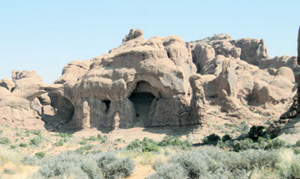
"Check that out, Dad. There are at least three caves in that formation and what looks like statues of two Native Americans guarding them."
"And there's a double arch on the left, son. I'll bet that formation was once a cave, too."
"Do you think that Blaise lived in a cave that looked like one of those?"
"It's quite possible. The one in the center has a steep approach. Who knows how far the cavity extends back into the rock?"
"Do you see two people up in that rock formation?" John asked as they drove along. "Let's drive closer."
"Your are right, John. Looks like those climbers have made it nearly to the top."
"I'd like to do that too, Dad."
"Climbers need a lot of experience to do that safely, son. Maybe you can get some training at home."
"I'm tired of riding, Dad. Let's take a hike along that path. It's called Devil's Garden Trail."
"OK, but look at the dust flying. Let's be sure to bring our water."
"Wow, Dad, the path gets narrow," John said later, while they were walking. "And where is all this sand coming from? It's hard to walk.
"Why do you think they call it sandstone?"
"Oh, yeah."
"Notice how the bands of sandstone are different colors, John? That's what the ranger was telling us."
"Dad, have you noticed that most of the people hiking around us don't speak English?"
"I sure have. Seems lots of tourists come from all over the world. Not many of them can see anything like this at home. The ranger wasn't kidding when he told us how unique this area is in more ways than one."
After the mile walk to the Landscape Arch, Henry groaned and said: "We could walk on further, son, but the trail looks like it gets narrower and steeper from here. It's getting hot. Let's check out Wolfe Ranch instead. The cabin preserved there was built at the same time as Jeb built his cabin."
John sounded disappointed as he said: "This cabin is so small. Just one room. This one has a wooden floor. Lucinda didn't even have that. I don't think I'd want to live there, either. So, are you up to hiking to Delicate Arch now?
"I guess so, son. Then we'll see if we can rent some equipment in Moab so we can camp at Canyonlands tomorrow.
"Really? That would be great!"
LOOK IT UP
Arches National Park lies atop an underground salt bed called the "Paradox Formation" which is responsible for the arches, spires, balanced rocks, fins and eroded monoliths common throughout the park. The park contains more than 2,000 natural stone arches.
Some species of plants and animals are found only in the park. Those that have survived the arid climate, with less than 10 inches of rainfall annually, have developed special adaptations.
Arches Park is located on what is called High Desert. Elevations range from 4,000 - 6,000 feet above sea level. In a day, the temperature may rise and fall as much as 50 degrees. Hot summers are followed by very cold winters.
Hiking trails vary in length and are rated from easy to strenuous.
Sunset is a particularly good time to enjoy the play of light and shadows. Shades of color change the entire scene.
Wolfe Ranch: After John Wesley Wolfe moved from Ohio to the Moab area of Utah in 1888, he built a small cabin with a dirt floor.
He settled in a tract of more than 100 acres along the Salt Wash. Along with his son, Fred, he built a one-room cabin and a corral. They also built a small dam across Salt Wash and began raising cattle.
The family lived there until 1906, when Wolfe's daughter came out West with her husband and children. She urged her father to build a more substantial cabin with a wooden floor. This cabin is the one that has been kept in repair. Later, the property was sold to Marvin Turnbow, who helped with the first geological mapping of the area.
Delicate Arch: Perhaps the best known and most widely photographed, the landmark has been shown on Utah license plates. Its distinctive shape has suggested "a cowboy's chaps" or sometimes "the schoolmarm's bloomers." Formed by Entrada sandstone, the original fin was worn away by erosion. The erosion continues. Naturalists express growing concern for the survival of this elegant natural monument.
Chapter 8 - Canyonlands Camping
"Let's see - tent, cots, food, water, bug spray: I think we're ready to go camping." Henry checked off his list as they prepared for their visit to Canyonlands National Park.
"It's going to be a little different from camping in Missouri," Dad warned. "Hope you will enjoy it. Renting all this equipment cost more than staying at a hotel."
As they drove, the two discussed what they had learned the previous afternoon in Moab about Jeb and the Hastings Mine.
"So Dad, Mr. Hastings bought Jeb's mine about five years after Jeb and Lucinda died, right? He wanted it for the tailings, the stuff that was left after the uranium was removed. He wanted to sell the left-over vanadium for making steel."
" That's right son. There was no more market for uranium from the mid-1920s until World War II. Hastings bought several other small claims in this area, too. All we learned was that Jeb's claim was on a little creek west of Moab a dozen or so miles."
"But there's no road to get to Jeb's old claim?"
"No, we can't get there without hiking miles into the desert with nothing but a GPS to tell us where we are. The trail to the mine has long since disappeared.
"And you don't want to try it? We could at least see the cave."
"No, sorry. The librarian did say that Jeb's cabin has probably fallen down by now, anyhow.
"Whoops, here's the turnoff to Canyonland."
Later, as the two of them gazed at the vast panorama of the canyon carved by the Green River and its tributaries, both were silent for a long moment.
"Dad, how high is this Rim Walk above the river?
"The sign says about 2,000 feet. Look at all the buttes and mesas. Can you tell that the higher mountains beyond them were formed by volcanic activity?
"They do look different, Dad. They're darker and have a more regular shape."
"Look at that vast mesa to the right and the butte at the center. Notice the dendritic patterns the water has carved into the upper layers of the canyon. See? They look like dry creek beds from up here and that is exactly what they are; that is until it rains or snows.
"In a little while, we'll drive closer to the lower edge and see the river from there. Can't you imagine how the first explorers felt when they saw this vista, John?
"Who did see it first?"
"For centuries, Native Americans were the only ones. Then came the river explorers like John Wesley Powell. Starting in 1867, Powell led a series of expeditions through the waterways of the Rocky Mountain. In 1869, with nine other men, he rafted down the Green River to its confluence with the Colorado near Moab. His exploration eventually took him further south on the Colorado River, through the Grand Canyon."
"And he didn't even know if there might be a waterfall along the way?"
"That's right, son."
"He was brave!"
"As the west was settled," Dad continued, "cowboys and ranchers moved in. Prospectors for gold and silver and later uranium came toward the end of the 1800s.
"You seem to know a lot about the area, Dad."
"While you were researching Blaise and his family, I was looking up the story of this national park."
"Here we are at Willow Flat Campground, John. Let's go claim our campsite."
"Dad, while we're setting up camp, why don't you tell me more?"
"OK, I've always wanted to see Canyonlands. Years ago, my father told me about the struggle that Secretary of the Interior Stewart Udall had with others who wanted to build another dam here, just below where the Green River meets the Colorado. After Udall toured the place, he decided it was a too great a treasure to be flooded by a dam. He wanted the area to be shared as a national park. He got his way. On Sept. 12, 1964 it was opened to the public.
"Let's put out this campfire and get to bed early. Tomorrow we can do some hiking, go see the 'Great Ghost and Attendants' and Dead Horse Point. "
"What are you talking about?"
"You'll see the spacemen tomorrow, son."
"The what?"
"You'll have to wait and see."
LOOK IT UP
Canyonlands: Even by the mid-1950s, not many people had seen the area around Canyonlands. A few cattle ranchers and miners were familiar with the area. Then George Simmons led a U.S. Geological Society mapping expedition down the Green River through Stillwater Canyon and Cataract Canyon. His equipment, including three rafts, was brought in from Grand Junction. The rafts are inflated in two layers so that if one was punctured, the other ring would hold enough air so the raft would still float above the water. They used oars 9 feet long. The also brought along salt tablets, rum, sun tan lotion and swimming trunks.
While exploring, Bates Wilson found archaeological sites at Salt Creek and Horse Canyon that later became archaeological digs sponsored by the University of Utah.
The uranium boom of 1951-55 brought many more people to the area. Interest grew in designating a national park. After setting their sites on a smaller area of about 32,000 acres, several interested persons decided to include 1 million acres in the proposal. They invited Stewart Udall, secretary of the interior, to visit. He did so in the early 1960s.
Today Canyonlands National Park preserves a vast wilderness on the Colorado Plateau. Water and gravity have slowly carved colorful canyons, mesas, buttes, fins, arches and spires into two canyon areas. Canyonlands is 32 miles from Moab on Hwy. 191. There, the elevation reaches 5,900 feet.
Chapter 9 - "Great Ghost and Attendants"
John and Henry woke up to a cool morning.
"Let's go see Dead Horse Point first," Dad decided.
"Why is Dead Horse State Park different from Canyonlands? It all seems like the same land."
"It is, son. But the National Park Service decided that there were too many uranium claims, potash leases, oil leases and grazing interests to make the transfer worthwhile, so the state Of Utah took over that part of the land."
As they were hiking, John asked: "Why do they call it Dead Horse Point? Sounds like something bad happened here."
"It did, John. Many years ago, ranchers used to capture wild mustangs and corral them on this point. Look how steep the cliffs are here. When we walk down farther, you'll see the neck across this point is less than 30 yards wide. The cowboys would pen the horses in with tree branches, brush and rocks.
"Later, they'd come back, choose the horses they wanted and let go of the rest. For some unknown reason, one group left a herd of horses for too long without water. The poor animals died of thirst in sight of the river so far below."
"That is a sad story, Dad."
"Yes it is."
What about that spacemen you mentioned yesterday? Were you kidding?"
"You'll find out. We'll have to do some driving on dirt roads to get to Horseshoe Canyon."
After arriving, they waited at a kiosk for a ranger guide to lead their group.
On the trail, the ranger began his talk: "Look around, folks. Plants grow slowly. That tree is probably only 15 feet tall but it may be hundreds of years old.
"Most of the animals prowl at night when it is cooler."
"What animals live here?" John asked. "It seems so desolate."
"Watch out for coyotes, badgers and bobcats," the ranger explained. "Be sure to look up once in a while. We might see a golden eagle. They have a wingspan of up to seven feet. And I hope we don't meet a mountain lion."
Everyone laughed nervously.
"We also have to watch out for rattlesnakes and scorpions.
"Ravens grow up to 2 feet long. They are notorious thieves. They often raid campsites while the humans are gone. They can mimic sounds of people and other birds. Hungry ravens can't get to many edible parts of dead animals by themselves, so they will mimic sounds that alert coyotes to the site of the carcass. The coyotes chew open the dead animal and when they are through feeding, the ravens can clean up the pickings."
"Smart birds," John whispered.
"Are these really dinosaur footprints in this gray shale?" John asked, half a mile later.
"Sure are," the guide replied. "What else would have three-toed tracks that are a foot wide? These tracks probably belonged to an allosaurus, a meat-eater."
"Look at all these human handprints. Whose are they?" John asked.
"We think they were painted by ancestral Puebloans.
"Around this bend, you'll see the Great Gallery," the ranger continued. "The paintings there are at least 2,000 years old. No one seems to be sure what the figures represent. A huge mural decorates the rock face. It's 200 feet long by15 feet high.
"Here we are folks. Look at all the red, brown and white pictographs.
John was astonished.
"They do look like the spacemen in some of our movies," he said.
"You aren't the only one who thinks that," the ranger agreed. "Look at those huge insect-like eyes and skull-shaped heads."
"Most interesting of all is the figures known as the Great Ghost and Attendants," the ranger said. "This seven-foot-high painting stands out among the others because of its size and alien appearance."
"What do you think those figures were?" John asked his father.
"I don't know. They almost look like something the Egyptians would have drawn. It would be easy to make up a story about how aliens traveled to earth in coffin-like boxes and came out still wrapped up like they traveled. Of course I'm being silly now."
"Dad, I'm really disappointed. We're leaving tomorrow and we have never found out what happened to Blaise after his mother died. One of my Internet sources recommended questioning older relatives. Is there anyone who might know something? Anyone you could ask when we get home?
"I'll think about it, son."
LOOK IT UP
The Great Gallery features pictographs that suggest an alien or ghost-like quality. Based on similarities between the pictographs and clay figurines from nearby caves, some of the paintings may be as old as 7,000 years, while others could have been painted as recently as 2,000 years ago. (YouTube has an excellent video of a hike though Horseshoe Canyon that shows some of the pictograph sites.)
Chapter 10 - The rest of the story
A day after they returned home, John's father had a suggestion. "Let's go see your Aunt Bessie. She's our oldest living relative."
"Do we have to?" John replied. "That nursing home smells bad and all she ever does is talk about the past."
"That's the point, son. She remembers lots of things. But I've usually tuned her out when she began talking about them. This time we can listen."
"How old is she anyhow?
"Hmm, I think she's nearly 90. Many older people do talk about the past, John. But keep in mind that you and I will be old someday too."
John looked shocked.
"Hi Aunt Bessie, we brought you some flowers." John set the bouquet on her table.
"Oh, how lovely. Do sit down, boys. So nice to see both of you. What have you been doing lately?"
And so they excitedly told her about their trip west, about seeing Moab and Arches and Canyonlands.
"Why did you boys decide to go west?" Aunt Bessie asked.
"We were tracking John's great-grandfather Blaise."
"Oh, Uncle Blaise."
"Do you remember him?" John asked. And then he explained what they had learned from the letters in the trunk.
"Henry, I'm surprised you didn't ask me first. I'll bet you have forgotten that my maiden name was Riddell. I could have told you the whole story and saved you a trip.
Henry gave a weak grin.
"My Uncle Blaise was born in 1904. His father died in 1914. His Uncle Noah told my mother what happened in Utah.
"A few months before Jeb and Lucinda died, an agent for Jeb's investors paid a visit to see what was going on. He started asking around and looking for Jeb. But Jeb kept hiding out in different places so no one could find him. The agent was nosing around in Moab again at the time of the accident.
"Noah had quit working for Jeb several months before the accident. After a month, he still hadn't found other work near Moab. He headed toward Colorado, where he found work at a ranch. Realizing how difficult the situation had become between Jeb and Lucinda, he returned to Moab and offered to take Blaise with him.
"Jeb was glad to be rid of Blaise. Lucinda cried, but let him go because Jeb had been forcing him work in the mine. Noah took Blaise to western Colorado, where they both worked at the cattle ranch.
"After Jeb and Lucinda died, Noah hurried back to Moab. He settled the family's affairs there and sent Lucinda's possessions back to Missouri. Turns out there wasn't much to send back except that small trunk of books and a few articles of clothing.
"Apparently, Jeb had been a swindler from the beginning. He took money from lots of people to start that mine. Gave them worthless pieces of paper. But he never really did much with the mine. Paid a few local men to dig, but by the time he died, he was mostly spending what was left of the investors' money at the local saloon, drinking and playing cards.
"Noah thought that Jeb and Lucinda might have been hiding from the investors' agent when the mine collapsed.
"The couple was last seen by a prospector, who ran across them as they were preparing to descend into the mine; said it sounded like they were quarreling. He heard what sounded like an explosion a few moments later and returned to the scene to witness the devastation.
"In Colorado, Blaise started out feeding the horses, cleaning their corral and other odd jobs. By the time he was 17, he had become a real cowboy. He stayed in Colorado for several years, then came back to Amelie when Noah decided to return home.
"Eventually Blaise married. He and his wife, Mary, worked the farm and took care of his grandparents until they died.
"I'm so glad we went to visit Aunt Bessie," John said as they drove away.
"It wasn't as hard as I thought, either. The home didn't smell bad after all and she really has a good memory. But just think: We traveled all that way to find the truth and it was right here.
I think I'll come visit her again sometime, Dad. I'll bet she's got a lot of great stories to tell me. Maybe even some of them about you?"
"I'm afraid she does, son. This may have been a mistake bringing you to see her," Henry said, then he grinned.
"No, Dad. I learned something really important from her today. Jeb didn't take good care of Lucinda. Whether her death was intentional or not, he didn't act like a husband who cared about her as a person.
"Dad, I didn't think you cared about my mother, either after she got sick. You didn't show your pain, did you? You didn't even cry at her funeral."
"No son, I was trying to protect you."
"But you took care of her for the six months after she got sick. You went to the doctors with her, and sat in the hospital for hours with her. I even watched you feed her ice cream when she wouldn't eat anything else.
"Dad, I finally understand that you showed your caring for her by how you took care of her."
Henry smiled and gave John a grateful hug.
"That's right son, actions speak louder than words."