


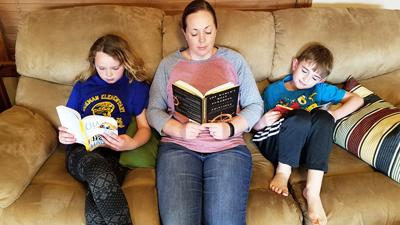
The buildings in Jefferson County’s 11 school districts will remain closed for the rest of the academic year to try to prevent the spread of the coronavirus, but that doesn’t mean school’s out for its 37,000 or so students.
Missouri Gov. Mike Parson announced on Thursday (April 9) that buildings in the state’s 555 school districts would remain off-limits to students through the end of the school year.
On the same day, the Archdiocese of St. Louis followed suit, saying that for the rest of the school year, in-person classes have been suspended in all of its schools, including St. Pius X High School in Crystal City, but that “distance learning” will continue.
Desi Kirchhofer, superintendent of the Northwest R-1 School District and president of the Jefferson County Superintendents Association, said the edict didn’t take him or his 10 counterparts by surprise.
“If there was any surprise, it was that the governor all along has been talking about local control, and then he made the announcement statewide,” he said. “But no one is surprised about the fact that the buildings would remain closed.”
Kirchhofer said he had a meeting scheduled on Tuesday (April 14) with Jefferson County Executive Dennis Gannon and Health Department Director Kelley Vollmar to discuss just that possibility on a countywide level.
“As a group, Jefferson County’s superintendents were going to discuss a possible closure for the rest of the school year,” Kirchhofer said. “That was definitely going to be the topic of discussion, and that’s the way things were looking, based on the information we are hearing.
“It didn’t make much sense that, if the peak is coming in the first week of May, and we’d have to be out for at least two weeks after that, to consider holding classes,” he said.
However, Kirchhofer said, that doesn’t mean learning will cease.
“In all of our districts, all of the alternative learning methods we’ve been putting into place for the last couple of weeks, those will continue through the end of the scheduled school year,” he said. “While a handful of districts in Missouri have ended classes for the school year, that’s not what is being considered here.”
Kirchhofer said food services, counseling and other services offered by public schools also will continue through the end of the school year.
In a sense, he said, the extension of the closure – originally to end April 6 and later extended through April 24 – will solve some issues that the superintendents were trying to wrap their heads around.
“If we would have been able to resume classroom work this year, what would that have looked like?” Kirchhofer said. “There would have been a lot of parents who wouldn’t want to send their children to school, out of understandable concern for their safety. Even if there would be only one (COVID-19) case in Jefferson County at that time, for many people – and I totally understand – that would have been one too many.”
Soon after Parson’s announcement, the Missouri State High School Activities Association announced that it was canceling all athletic, speech and music competitions that it sponsors.
With the closure extended through the rest of this school year, all other school-related activities also are off.
“I believe I speak for the rest of the superintendents, but I can tell you that Northwest R-1 students will not be participating in extracurricular activities while the schools are closed,” Kirchhofer said.
He said he and the other superintendents are continuing to discuss a number of issues, including the closure’s impact on high school seniors, whose last three months of their high school days have been wiped out.
“There are a number of senior-related activities at every school that have been affected, and we’re trying to determine what we can do about that,” he said. “Will we do things like graduation virtually, or will we be able to hold one in a different form? I know we are definitely concerned about that.”
Kirchhofer said other questions also have yet to be answered.
“What about summer school? I suppose that will depend on the circumstances. Will we be able to bring the kids back to school in July? Would we want to do that?” he said.
“One idea we’ve kicked around – definitely just a concept right now – is the idea of a two-week school boot camp before the next school year comes to get our students up to speed. But there are lots of questions about that.”
One issue is a new state law that prohibits public schools from starting earlier than 14 days before Labor Day.
“That is a question, to be sure, but that law was created to boost the tourism industry,” Kirchhofer said. “I’m thinking that that’s not necessarily going to make a difference this year.”
He said what looks like a negative can be turned into a positive.
“For the rest of the school year, learning will continue to look a little different than it has in the past, but that’s not necessarily a bad thing. I’m hearing from families that are taking different approaches to homeschooling – teaching their children how to cook and follow a recipe, for instance. Another family is planting a garden and their children are learning everything that goes into that. With the change in seasons, some families are getting outdoors and there’s a lot that can be learned there.
“We are all learning from this,” Kirchhofer said. “What I’m seeing is a high level of collaboration with our staff and our parents, and I think we will grow stronger as a result of this. Our communities will be connected even more.”