



Life is governed by the things everyone knows.
Everyone knows a mud-spattering rainstorm is bound to arrive immediately after you hit the road in your glistening, just-washed vehicle.
Everyone knows the nerdiest kid in your graduating class will have the best life statistics to report at the reunion.
And everyone knows that toast heavily slathered with butter and honey will most likely slip from your fingers, gooey-side down, onto the kitchen floor.
Doesn’t everyone know the Civil War, and the secession of states that helped cause it, were disastrous events that must not reoccur?
I fervently hope so.
Yet, two recent surveys claim that a surprisingly large number of Americans don’t necessarily hold a “never again” attitude about either event.
On the civil war question, look to the Brookings Institution, a century-old Washington, D.C., think tank that traditionally is quoted equally by the left and the right.
In September, Brookings cited a February 2021 nationwide survey by pollster John Zogby that found that 46 percent of Americans believed a future civil war is likely, while 43 percent found it unlikely and 11 percent were unsure.
Brookings pointed ominously to the deep polarization and suspicion across the nation, the high level of inequality, the prevalence of private militias and weaponry, and the myriad issues that divide us (abortion, vaccines, the outcome of the 2020 presidential election, climate change, for starters).
The article attested, however, that other factors can and should protect America from armed conflict.
Our country has a history of settling differences at the ballot box, the piece noted. And while there is an obvious political divide between rural areas and cities, that demarcation is unlike the regional North-South split that made it easier for America to slide into its 1861-1865 bloodbath.
But since we’re talking about regions now, the other survey provides some interesting talking points on that score.
According to another nationwide 2021 poll by Bright Line Watch and YouGov, 37 percent of respondents across five U.S. regions (with boundaries determined by the pollsters) said they would support secession from the U.S. as a region.
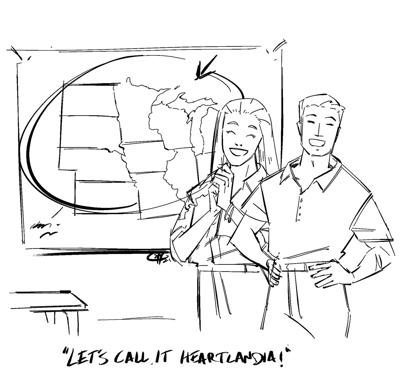
Missouri is in the survey’s “Heartland” region that also includes Michigan, Ohio, West Virginia, Illinois, Indiana, Minnesota, Wisconsin, Iowa, North Dakota, South Dakota, Kansas and Nebraska.
Give our region credit for level-headedness, because we had the lowest percentage of support for the notion – 30 percent, with the most support coming from people who identified as independents.
The highest support for secession came from the South region, 44 percent, driven by Republican respondents, and from the Pacific region, 39 percent, with Democrats leading the charge.
The Northeast region had 34 percent in favor, led by Democrats, while the Mountain region came in slightly lower at 32 percent, with Republicans most supportive.
The pollsters asked us not to worry too much, pointing out that respondents might not have thought deeply about the question and weren’t poised to take action.
OK. Well, good, I guess.
But what Americans ought to be thinking – and saying loudly – is that secession and civil war are unthinkable.
The Civil War was necessary to rid the country of slavery, but 156 years later, the wounds have still not healed.
Some 600,000 soldiers died, the southern half of the nation was largely laid waste and millions of lives and livelihoods were devastated.
My late maternal cousin Bernice Erb Finke wrote in her 1981 book on family genealogy that Missouri – a slave state that crucially never aligned with the North or South – suffered perhaps most of all, with family members, friends and communities brutally taking opposite sides in the conflict.
As a result, she wrote, lawlessness prevailed. She recounted the murder of 17-year-old Lewis Akins, my great-great-great uncle, at the hands of Civil War bushwhackers, and the terrible vengeance Lewis’ brother, Matthew Akins, exacted on the perpetrators.
My grandfather was named Lewis in honor of his ancestor, and my brother and first cousin both were given Lewis as a middle name.
The war had another interesting impact on my life, at least in legend.
My paternal relatives claimed to be descended from James Buchanan Eads, the Yankee famous for building the Eads Bridge in St. Louis, the world’s first steel arch bridge (constructed from 1867-1874).
My maiden name, however, was Eades, with an extra letter.
Easy to explain, they said. The Confederate arm of the family was so embarrassed by James, they added the extra “e” to distance themselves. Ummm… maybe?
In 2017, the Leader received a letter to the editor from a Jefferson County resident predicting a coming civil war. It was the first time I’d heard such a thing and I was appalled that even one person was going there.
Unfortunately, I came to realize, that guy was not alone, and the fracture he observed four years ago is only larger today.
We need another type of bridge – one of tolerance, respect for one another and a deep desire to preserve what we have.
To avoid the unthinkable.