
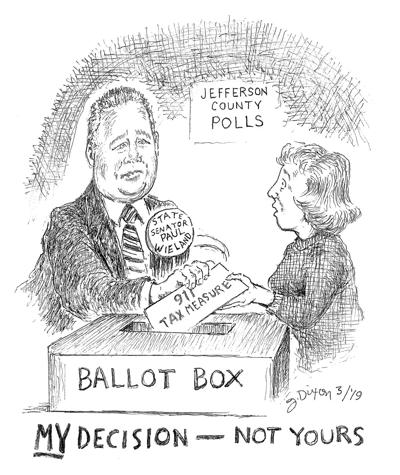
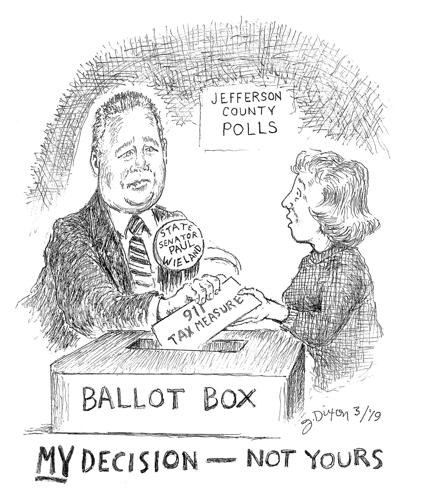
Armed with a legislative bazooka, state Sen. Paul Wieland, R-Imperial, is waging war on Jefferson County 911 Dispatch.
His efforts are causing consternation on the part of 911 officials, but depending on how it all plays out, Wieland’s real victims could end up being Jefferson County voters.
We introduced the tangled tale in Kevin Carbery’s Page 1 story in the March 21 Leader. I’m still scratching my head over it.
The agency, which dispatches calls for 31 of the county’s 36 emergency agencies, is seeking voters’ permission on April 2 to keep collecting a decade-old 1/2-cent sales tax, rather than cut the tax in half.
Using the tool of state law, Wieland is demanding the tax cut, and is apparently willing to sidestep voters to get it done. What’s up?
We asked Wieland that for our story. He said he’s playing the role of watchdog. But Jeffco 911 folks think he’s playing the role of tormentor.
For two years in a row, Wieland has tried to force the tax reduction by inserting amendments into other lawmakers’ bills aimed at extending 911 coverage to unserved areas of Missouri.
Wieland’s first try was in 2018. But Jeffco 911 said Wieland’s amendment would have no effect because he cited the wrong statute.
So, for the current session, Wieland amended his amendment and has placed it in a “cleanup” bill tied to the one that was approved last year. This year’s version reportedly has a good shot of passing, too.
Wieland’s amendment stipulates that 911 agencies matching ours to a T (serving counties with a charter form of government and with a population between 200,000 and 350,000) cannot have a sales tax greater than 1/4 cent.
And what if, say, Jefferson County voters decide next week, through a simple majority, to keep the 1/2-cent tax?
Wieland’s proposed amendment covers that possibility: “If on the effective date of this section such tax is greater than one-quarter of one percent, the board shall lower the tax rate.”
Is it just me, or does that just reek with wrong?
No matter what the voters say, Wieland’s amendment declares that he gets to decide.
And what about the future? Suppose, someday, locally elected 911 board members see a desperate need to ask voters for a sales tax increase? They couldn’t do it. Not unless a new law was created to repeal Wieland’s amendment.
In addition to his legislative maneuvering, Wieland wrote a letter to the editor. We opted for a story, instead, in order to tell both sides.
Wieland’s talking points: He said state officials (in the Attorney General’s Office and the Department of Revenue) agree with him that last year’s amendment prohibited 911 from going to the ballot on April 2, that the county’s 911 is the best funded in the state, and that the agency absolutely doesn’t need the tax extension, proven by Wieland’s examination of minutes from board meetings.
Travis Williams, 911 chief, and the agency’s board, of course, see matters far differently. Williams said our 911 has a larger mission than others in the state, and that it has been doing the job efficiently and cost effectively.
“The Sheriff’s Office alone has saved $6 million” in dispatching costs, Williams said, by moving the job to the countywide 911.
He also disputed Wieland’s claim that 911 doesn’t need the money. If the sales tax is cut in half, 911 will start seeing an annual budget deficit of $250,000 in 2020, and reserve funds will be necessary to plug the shortfall, Williams said.
That hits another of Wieland’s complaints: He thinks 911 has too much money in reserves. At present, that figure is $10 million, which is more than 911’s current budget of $9.9 million.
But Williams said $4 million of that amount is encumbered by bills that will be paid soon and the rest has been saved up, slated for projects that will enhance the system.
Times have changed dramatically since 1993, when Jeffco 911 Dispatch started operations, funded by a 15 percent surcharge on residents’ landlines.
These days, landlines are rarer than dinosaur teeth. Predicting that would happen, 911 asked voters for the 1/2-cent sales tax in 2009, and, in the midst of the Great Recession, the tax passed with 56 percent in favor, 44 percent against.
There were promises. The agency pledged to do away with the surcharge; stop charging dispatching fees to participating agencies; set up a reverse-911 system to warn residents of severe weather and other emergencies; build a backup center; and, most expensively, undertake a $30 million communications upgrade, requiring tall towers countywide and new radios for first responders.
Check, check, check, check and check. In the intervening decade, 911 has delivered on all of those pledges, with the last payment on the tower project imminent.
The tax sunset was also on the list of promises. After 10 years, the sales tax would be reduced from 1/2 cent to 1/4 cent. September 2019 seemed SO far away. But here we are.
Voters must know that entities never just accept a tax sunset. There’s no gasp of surprise that 911 is seeking an extension.
But the agency points out that call volume is up 24 percent in the last five years. The numbers for computer-aided dispatch show a 61.5 percent increase in that same time period and a 76 percent increase since the sales tax took effect. Some of that is population, Williams said, and some of it is because a few agencies that did not originally participate in countywide 911 have now signed up. Only the cities of Festus and Pevely still have their own 911 systems.
Serving more clients requires additional 911 dispatchers, Williams said. And while the tower project is nearly paid for, he pointed out that the agency faces continual maintenance costs for the system and the looming need to replace first responders’ radios, both handheld and in their vehicles. The devices are old now and will reach “end of life” in 2023, Williams said. Technology upgrades are a constant need.
“I think we’ve been good stewards of the taxpayers’ dollars,” Williams said.
If the 1/4 cent is not renewed, 911 will eventually have to return to charging agencies for dispatching and equipment, and if that happens, the costs will be paid by taxpayers.
Williams makes no threat to cut employees. Thirty-two dispatchers work at the dispatch center in eight-hour shifts, 24/7.
“We couldn’t do that (cut back on staffing),” he said. “We get 350 calls a day.”
Williams said he is perplexed by Wieland’s hostility, and he noted that 911 may have to go to court to fight the amendments – another cost to taxpayers.
“He’s trying to hamstring us. It seems like a personal vendetta with our board,” Williams said. “We went to Jefferson City to meet with Wieland, but he won’t come off his stance. He’s been reading our minutes and taking things out of context. He has never come to a meeting to see what we do.
“And it’s not just us he’s hurting. It’s every first responder.”
Wieland may be sticking by his guns out of concern for the community. But he should put that bazooka away.
Setting the tax rate is the voters’ job. Not his.