


My great-niece’s graduation party was held on a mild sunny day this past summer in rural west Jefferson County, hardly a setting to foretell tragedy.
But it struck anyway. Unfortunately, an uninvited guest did not survive the affair. A moment of silence, please.
It went down in this manner:
At about 9 p.m., with only two families remaining at Aubrey’s celebration, the 22 chickens in the “egg-laying” coop near the house (I’d met them on the way in) began to roost for the night.
Suddenly, a hungry possum was discovered inside the coop, his eye on the prize(s).
Aubrey’s dad, Tim, did what needed to be done.
Which Aubrey’s mom, my niece Mindy, said “was kind of easy,” since the possum played dead before its fantasy became its reality.
I had gone home by that time, but when I heard the tale the next day, it made me curious whether Mindy, a relative newcomer to raising chickens (for both eggs and meat) found the effort and – and the occasional drama – worth it.
Yes, she said.
She can control her family’s food supply by controlling what the chickens eat, save a little money, put a higher quality of poultry products on the table, and be more humane toward the chickens than factory farmers can afford to be. All this while making those of her seven children who love having chickens around very happy.
But raising chickens is not for the faint of heart.
Did you know?
■ Chickens stink – “No matter what,” Mindy said.
“I haven’t been able to smell normally since I had COVID in December 2021,” she said. “But I can smell those chickens. The smell gets stuck in my nose.”
In addition to the egg producers, a second coop at her home housed about 50 meat birds over the summer, until Mom and Dad and the older kiddos borrowed some equipment, applied their research and got the birds into the freezer.
■ Hens aren’t necessarily candidates for mother of the year.
I did not know that mama chickens can develop a taste for what’s inside the eggs they produce.
Mindy has discovered this the hard way.
“We have at least one egg-eater among the hens. They sometimes peck their own eggs, and then realize, ‘Oh, this is good.’ It can become a habit.”
The day we spoke, Mindy had been playing detective, hiding out near the coop, trying to discover which hen or hens were enjoying an egg breakfast meant for the family that is providing all that tasty chicken feed ($20 a bag, don’t you know). No luck.
“I’m tired of feeding hens who are eating their eggs,” Mindy declared, noting that a new crew of chicks was already incubating, in line to replace the current 3-year-old hens.
You know, those birds I spied did, indeed, look a little nervous, and that was hours before they met the possum.
The geriatric hens will go up for sale online.
“Some people don’t mind having old chickens,” Mindy said.
I hope my kids fall into that camp when they start discussing nursing homes.
■ Chickens do not have personalities.
Mindy is certain of this. Her kids disagree. They like to hold their chickens, carry them around and name them.
“Some chickens are meaner than others, but for the most part, they are going to keep distance from us,” Mindy said. “They want food; they don’t want to be petted.”
And the clincher:
“The kids have to catch the chickens they want to hold, but if you bring food, they’re at your feet.”
Maybe it’s my imagination, but I think my niece may like roosters a little more than hens.
The family has three – Rampage, Big Red and Mr. Roo (who lives in the backyard because he gets bullied in the coop).
The boy birds crow early, late and in between, but Mindy said they never wake her up. (Seven kids, remember, and she home schools). Their property is a rooster-tolerant zone.
Much of Jefferson County feels otherwise.
County government has no rules against hens or roosters (although commercial operations are monitored), but a number of subdivisions throughout the county outlaw chickens in general, or roosters in particular.
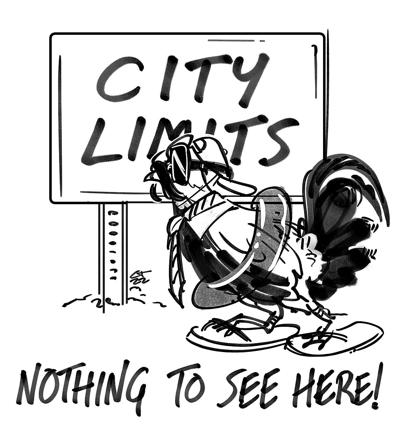
And while most municipalities in Jefferson County and the city of Eureka now allow a handful of chickens, with conditions, roosters are almost entirely forbidden.
Byrnes Mill allows (quiet) roosters up to a year old. You’ve got to wonder how rule-enforcers check for birthdays. Look for coops with party streamers?
Outlier Herculaneum says no chickens, nada.
But in De Soto, like elsewhere, you can have a few, with a kibosh on roosters. De Soto code enforcement officer Mike Kitzmiller said he has had to issue “rooster warnings” at least five times in his job, mostly to people who didn’t know one of the chicks they brought home to raise would turn out to be male.
Neighbors report the offenders. Once a rooster learns to cock-a-doodle-do, he is cock-a-doodle-done.
Although Mindy is candid about the challenges, she plans to remain in the chicken game. In for a leg, in for a thigh.
Unfortunately, daughter Norah, who got the whole thing started with her little-girl chicken obsession, is now 17 and super-busy with studies and activities. She no longer has time to spend in the coop. But her mom (and her sibs) are picking up the slack.
They’re all a bunch – er, carton? – of good eggs.