


I was 14 years old – a perfect age to be completely mortified by the behavior of my 2-year-old littlest sister.
We were out shopping with my mother when Coleen pointed at another woman in the store and started hollering, as only a 2-year-old can – “Mama, WHO is that blue woman? Why is that woman blue?”
To my adolescent horror, the child was making a big, public deal about seeing (or at least noticing) her first African-American person.
Mom and I shushed her as quickly as we could, and then tried to explain a couple of things: First, it’s never nice to point. Second, people come in all colors. (Although, not actually in blue; I swear she knows her colors now.)
These many years later, I find that episode from my life instructive.
Lots of people these days like to claim they “don’t see color,” implying that everyone is the same to them and, thus, they could never harbor prejudice or racism.
Discussions should always start with truth. Humans undoubtedly see color. We can’t help it – we have eyes, which, in almost all cases, are equipped with color-deciphering retinas, rods and cones.
Just like with my baby sister, these physiological tools teach us at a young age that other people don’t all look just like us.
Best-case scenario: Our brains say, “Oh,” and we move on.
Except, most of us can’t. Sadly, humans are like sponges in whatever culture we are raised. We align with those who are like us and absorb prejudices about the “other” along our life paths, with the degree dependent on our circumstances, upbringings, experiences and personalities.
Some of us will perceive the problem and work hard to “unlearn” negative messages. Others will make some effort, and still others won’t try.
The racial issues we face today – playing out before our often horrified eyes – are complex and multifaceted. But my take is that more people are trying today than were yesterday or the day before that.
Fewer protests are turning violent, thank the Lord, and for the first time in forever, I think there’s reason for optimism. People are talking and people are being heard.
These two elements can be a catalyst toward change.
Did you ever read the Berenstain Bears children’s books? One of my favorite lines comes from “The Bike Lesson,” in which Papa Bear tries to demonstrate to Brother Bear how to ride a bike, but keeps crashing into things. Papa says, over and over, “This is what you should not do; let this be a lesson to you.”
Near the end of their lives, three of our cats demonstrated such a lesson that speaks to me.
By the way, we’re not crazy. We did not want to own three cats who would all grow old and troublesome at the same time. It had to do with our three kids insisting on growing up and moving out, but not taking any animals.
Panda, oldest of the three, was a black-and-white long-haired beauty with bright green eyes, known for his meek and placid demeanor.
Dizzy, an orange and white tabby notable for his small head and humungous body, was a classic bully, while Gracie, all gray with silky long hair, was as prissy and coldly unaffectionate as she was pretty.
No secret as to which cat I liked.
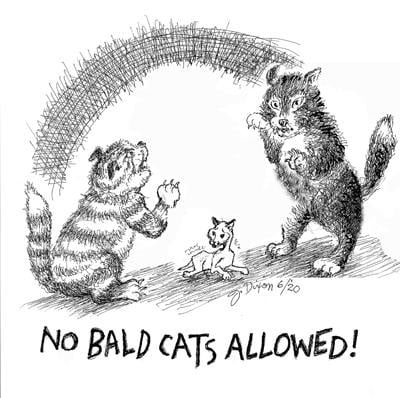
Panda had always been an excellent groomer, but at 15 years old, he could no longer keep up with his coat, and our efforts to brush him fell short. His hair became so matted we eventually had to have him sheared down to his pink skin, from head to tail tip.
You could tell the poor creature was demoralized, but it sure didn’t create empathy on the part of his feline companions of 10 years. Instead, they hissed and nipped at him, aware only that Panda was now the “other.”
He cowered under the living room couch, and stopped eating and using his litter box. Eventually, we had to separate the cats until Panda’s hair grew back and – looking once more like a cat – he became acceptable company again.
Humans are smarter than cats, right? Programmed responses can be deprogrammed. Negative messages can be overwritten. Empathy can rise and rule.
And if we stay at it, maybe one day each of us will be able to make the statement, “I don’t see color,” and have it be a truth, rather than just an aspiration.