

The tour bus emblazoned with the
candidate’s name pulled over, exactly on time, just past the intersection of Bailey Road and Truman Boulevard.
A bright morning sun, slanting in over the rooftops of Crystal City, gave me some relief to the previous day’s unending cold drizzle.
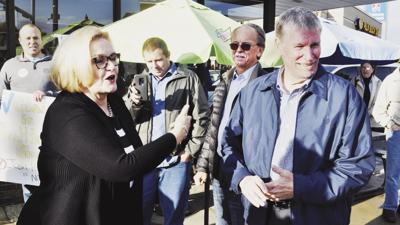
As Claire McCaskill approached the gathering citizenry at Gordon’s Stoplight diner on Nov. 2, warm applause and a few cheers broke out. The two-term U.S. Senator, in the fight of her political life, dove right into the impromptu ritual of hellos, handshakes and hugs as a couple of campaign staffers stepped away to let her work the crowd.
Thus began the campaign stop, a staple of American politics dating back – well, not as far as you’d think. For the first 150 years of our republic, it was considered unseemly for political candidates to barnstorm for votes. James Garfield (1880), William McKinley (1896) and Warren Harding (1920) won the presidency without leaving their front porches.
That all changed in the 1948 presidential campaign. President Harry S. Truman, given up for dead politically against the smugly confident Republican challenger Thomas E. Dewey, launched his “whistlestop” train tour, crisscrossing the country, stopping at little two-horse hamlets as well as the big cities. It was pure “retail” politics, winning over one voter at a time and building on the public’s natural affinity for the underdog candidate who perseveres.
It worked. Truman’s victory was even more surprising than Donald Trump’s two years ago. Campaign tours are now bread-and-butter staples at all levels of American politics.
As we put this edition to press, Missouri’s 114 county clerks were just starting to tabulate the votes cast in Tuesday’s general election. I have no idea whether McCaskill’s underdog re-election bid could pull off another Missouri miracle and defeat Josh Hawley, who like Dewey is smart, slick and sophisticated.
But if she did, surely somewhere “Give-’Em-Hell-Harry” is smiling.
And if she didn’t? She can say for the rest of her life that she went down scrapping in person for every last vote, not just in friendly places like St. Louis, Kansas City and Columbia but in hostile territory – holding 50 town hall meetings in 2017-2018 from Kennett to Maryville, Webb City to Hannibal. One of them was at Jefferson College in Hillsboro in April 2017.
Her quick stop in the Twin Cities was a nod to Jefferson County’s importance in the race. The county has turned solidly Republican since 2010, but showed an independent streak just months ago in burying Prop A, the measure to uphold Right-to-Work, by about an 80-20 margin.
On this morning, McCaskill stepped inside the diner and worked from one end to the other, posing for photos and soaking up encouragement. Jim Kasten – the Herculaneum city administrator, former county councilman and card-carrying Democrat – asked her for a photo with two Herculaneum High boys, runners who would be competing the next day in the state cross country meet.
“Oh sure!” she said, acting like this was more of a family reunion than a campaign stop. Kasten, the longtime coach who wears his Blackcat pride on his sleeve, was beaming.
A few minutes later, as McCaskill emerged from the cramped, crowded restaurant, a man gathered the veterans in attendance for a group photo. Eight of them flanked her, clearly enjoying their moment in the sun (literally) with only the second woman to represent Missouri in the U.S. Senate (the first was Jean Carnahan, after her husband, Senator Mel, died in an airplane crash in Jefferson County).
The candidate schmoozed briefly with other local Democratic veterans, such as former state senators Bill McKenna and Steve Stoll, both of whom McCaskill embraced like long-lost friends.
Then she stepped to the curb, just a few feet from the traffic rolling by, for a 5-minute interview with a reporter from a St. Louis TV station. When the interview ended, she thanked the reporter and the cameraman, who was pleasantly surprised McCaskill noticed him at all. He shifted his grip on the camera so he could shake her hand.
It was almost time to go. The candidate made her parting pitch.
“This is right at 50 percent,” she said, referring to the latest polling that showed a paper-thin gap between her and Hawley. “It’s all going to come down to who turns up (at the polls). So call your neighbors. Call your friends. Call your third cousin over in Potosi. We need every vote.”
Then she invoked the spirit of another U.S. Senator from Missouri who didn’t back down from a hard-nosed political fight.
“You know, this is Harry Truman’s Senate seat,” she said. “And he would be really P.O’d if we lost it.”
For her parting shot, she noted that Hawley favored the widely despised Prop A.
“That alone ought to help me win in Jeffco.”
Win or lose, it was nice to have one of our U.S. senators come to town. The last hand she shook before heading back to her campaign bus was mine.
“Good luck, Senator,” I said. She thanked me and kept walking. Her next stop was Fulton, then on into the whirlwind of last-ditch politics.
I went back to my car, thankful for good old-fashioned, imperfect American democracy.
No matter who won on Tuesday.