
The future is a weird place. Those of us of a certain age seem to have trouble understanding or latching onto the predictions of what we are told is to come, from driverless cars to robots doing your house cleaning and laundry to space travel for all.
The prediction that has me baffled currently is one of the oldest – that of a cashless society.
For more than half a century, we’ve been marching toward cashlessness as credit card use (and credit card debt) has zoomed. In the past 15 or 20 years, direct payments from your banking account have become common. Utility bills, those credit card payments, donations to church, you name it, they’re being paid online
Where does that leave cash? Who uses that old stuff?
Well, poor people, many of whom don’t have a bank account (“unbanked” is the politically correct term). Other cash users include people who don’t want to leave a trail of personal data snatched up by credit card companies. Then you have your basic criminal class. As a rule, drug dealers do not accept VISA.
Those are your cash spenders. The rest of us gleefully clutch our plastic and go a little bonkers, especially at this time of the year.
The pitch to ditch cash is simple – credit cards are more secure, as is your safety if you use them instead of carrying a big wad of bills. They keep a record of what you’re spending and some offer consumer protections against unsatisfactory purchases.
Unspoken in the pitch is that credit cards also encourage people to spend money they don’t have and pile up debt they can’t pay, sometimes at interest rates that would make a loan shark blush.
Recently, I had a new doctor’s appointment. The digs were large and fancy – big windows, artwork on the walls, soothing music playing at a civilized volume. Very nice.
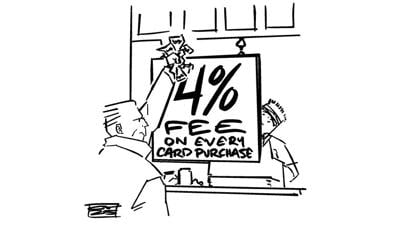
This grandeur was contrasted by a small sign posted at the check-in desk, informing patients that if they chose to pay with a credit card, there would be a 4 percent surcharge.
Is this the way to encourage a cashless society?
I was not without sympathy for the doctors’ group, which is a small business like the Leader, though with better views and art. When I was steering the ship at Leader World Headquarters, and monitoring the increasing number of our customers who paid their advertising bills with a credit card, getting paid became less profitable, to the tune of 2 to 3 percent fees taken up front by the credit card companies. Yes, friends, it costs merchants to accept credit cards.
The upside was that you got paid and didn’t have to send as many invoices, which cost considerable employee time, always-rising postage and a lot of paper.
Like most businesses, we thought that was a fair trade.
In recent years, the number of retail businesses that have begun tacking on a surcharge for credit card payments has mushroomed. Restaurants, hard businesses to run profitably, have been the front runners, in my experience. It is no longer surprising to get a restaurant check with two competing totals, one for cash and one for credit.
The trip to the doctor notched two firsts for me – a health care provider levying a surcharge, and the size of the charge. It was my first 4 percenter.
Or would have been if I’d paid it. The young woman at the desk waited patiently while I fished out my wallet, counted out enough bills to cover the co-pay and handed them over. Luckily, I had the correct amount and didn’t require this very nice young woman to make change. It would have been heartbreaking if she hadn’t been able to do it.
I predict these surcharges are going to slow down the cashless train and lead to a resurgence in purchases made with greenbacks, security be doggoned.
There would be benefits:
■ Consumers would save money, as much as 4 percent, which ain’t hay.
■ Cash-only spenders would avoid budget-wrecking credit card debt, which now averages more than $11,000 per household in the USA. Cash also imposes discipline – you can’t spend what you don’t have.
■ Numerous studies have shown shoppers to be less impulsive when they have to hand over hard cash rather than swipe a card. More thoughtful shopping and less impulsiveness are good.
■ Young people handling money at businesses would have to learn how to make change correctly. Their math grades would rise.
■ Job security for armored truck drivers and bank tellers. Somebody’s got to keep that cash moving.
So arm yourself with cash, suck in that gut and stand tall. Congratulations – you have regained a measure of control over your spending and your future.
At least until the robots take over.