


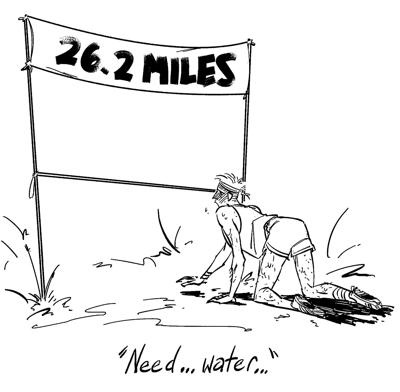
I see the oval sticker on the back of cars all the time.
It’s just a number: 26.2. Many people have no clue what that means. But runners know it instantly, instinctively. It’s the distance in miles of a marathon race, the Mount Everest of running. There’s also a 13.1 sticker for the half-marathon, for runners not quite ready for prime time.
This weekend the Tokyo Olympics conclude with the men’s and women’s marathons, held 500 miles to the north in Sapporo to avoid Tokyo’s stifling heat and humidity. The women, who didn’t have an Olympic marathon of their own until 1984 in Los Angeles, step off on Saturday while the men will compete on Sunday, the last day of the Games.
Although a U.S. athlete hasn’t won the Olympic marathon since Frank Shorter in Munich, Germany, in 1972, Americans have won more medals in the event (four gold, three silver and six bronze) than any other country. The U.S. runners this weekend will be Aliphine Tuliamuk, Molly Seidel and Sally Kipyego in the women’s race and Galen Rupp, Jacob Riley and Abdi Abdirahman in the men’s.
I was a marathoner back in the day. Running was in my bones from childhood. In the fifth grade, a teacher caught me running in the hallway and for punishment had me copy all the definitions of the word “run” from the dictionary in the school library. (It took a long time; look it up for yourself and see.)
Around that same time, I remember going out for recess and just running laps around the playing fields, for the sheer heck of it.
As a high school freshman cross country runner in suburban Chicago, I was in awe of a senior teammate who ran the North Central Marathon (Naperville, Ill.) in December 1969, the first runner from our school to even attempt the distance, let alone finish it. A year after him, I decided to run it myself.
To prepare, I ran 100 miles a week for seven weeks after the end of my sophomore season in cross country. My classmates, even my running buddies, thought I was crazy. So did my parents, who were surprised to have an athlete in the family, with my two older brothers having no desire to compete in any sports.
The morning of the race, my mom drove me out to Naperville (I wouldn’t have my driver’s license until more than a year later) and went shopping while I ran. She was there at the finish when I crossed the line in 3 hours, 19 minutes, the winner of my age group (I might have been the only one in it).
I ran four more marathons between 1971 and 1974, all under three hours, with my best being a 2:53 for fourth place in the Quincy (Ill.) Marathon in 1973.
My only bad experience came in my last one, in Whitewater, Wis., in 1974. I collapsed with heat exhaustion at the finish line; in my ignorance I didn’t drink water during the race because I was afraid I would get stomach cramps.
(Lesson No. 1 for beginning marathoners: Don’t be your own coach. Get guidance from people with plenty of experience, coaches or runners.)
At Whitewater, at least I came out better than the original marathon man, the Greek messenger Pheidippedes, who according to legend ran 25 miles from the battlefield at Marathon to Athens to proclaim victory over the Persians in 490 B.C. He shouted “Nikomen!” (We won!) and dropped dead.
By the time I graduated from Mizzou in 1977 and soon thereafter got a job, wed and had children, I didn’t have the time or energy to train for marathons anymore, although I have kept running to this day. Indeed, I’m thankful I can still grind out 15 miles a week at a slow pace.
I loved doing marathons – but actually it’s more about loving running. Anyone contemplating a marathon race should check their motivation. If you just want to say, “I did it,” like checking off an item on your bucket list, my advice is, aim lower, as many people do with the half-marathon.
The training required for the marathon, many hours pounding the pavement, is hard to do if you don’t really, inherently, enjoy running in the first place. It’s the difference between “a runner” and “somebody who runs.”
A runner looks forward to the second marathon, and the third, and so on.
Many credit Shorter’s Olympic win with launching the running “boom” in the U.S., and it was as much a triumph of mental discipline as of physical training. Just five days earlier, 11 Israeli athletes were murdered in a terrorist attack on the Olympic Village and the Games were almost canceled.
In his 2016 memoir “My Marathon,” Shorter wrote about how he approached the biggest race of his life:
“My mantra: Ride my pain, work through the finish, don’t get distracted … Don’t think about the 11 slain Israeli athletes, the air of stunned hysteria permeating Munich, or the chances of a follow-up attack. There would be time for that later. My job was to run – my trusted method for coping with chaos and managing mayhem.”
With the marathon, you have to be willing to challenge yourself and dig deep when the mental and physical reserves are tapped out. As Shorter wrote, you “work through the finish.” To finish is to win.
It’s worth it – in the long run.