


Seven or eight years ago, during my time as sports editor here at Leader World Headquarters, I was driving down to Ste. Genevieve to cover an American Legion baseball game. A battered pickup truck pulled in front of me on the road leading to Yanks Field. The truck had a bumper sticker celebrating the “International Symbol of Freedom.”
Was it Old Glory, the Stars and Stripes? Or maybe the Statue of Liberty?
Nope. It was the Confederate flag.
I thought: Really? Freedom for whom? From what?
All things Confederate, outside the historical context of a Civil War museum or battle site, face unprecedented public scrutiny as our country struggles to emerge from the long shadows of historic racism.
But no symbol or memorial of the Old South stirs up passions like the Confederate flag. Unlike the monuments to Confederate leaders (especially the revered Gen. Robert E. Lee) – static hunks of cast metal and receptacles for pigeon poop – the Confederate flag is mobile, muscular, alive and well in the hands of bigots and braggarts.
Who has not seen the stunning photograph of the man loping through the U.S. Capitol during the Jan. 6 riot, proudly hoisting the Confederate banner? The FBI identified him as Kevin Seefried of Delaware after he and his son, Hunter, were arrested Jan. 14. Of all the gut-wrenching images from that day of infamy, that one burns in the national conscience as hot as any.
As flags go, the rebel banner is strikingly effective. It uses the same red, white and blue as the American flag and even features white stars, just like Old Glory. And it employs the fabled St. Andrew’s cross, a central feature of many national, military and commercial flags around the world.
The flag grabs your attention. So does the black swastika on the flag of Nazi Germany. But unlike that ominous banner, for which public display is forbidden in Germany, France and other European countries, the Confederate flag is protected by our First Amendment’s right to free speech. As it should be.
But it’s not protected from the tides of public opinion and legislative action. Those were vividly expressed twice last year in two of the last bastions of Confederate sympathy.
The death of George Floyd, an unarmed Black man, at the hands of Minneapolis police on Memorial Day sparked protests across the nation and around the world, as did similar racially charged killings involving police in other communities. Collectively they triggered the move in June by NASCAR, the popular stock-car racing circuit, to ban the Confederate flag at all its races, most of them held across the southern U.S.
Within days of NASCAR’s move, the Mississippi Legislature passed a bill, signed into law by Republican Gov. Tate Reeves, removing the Confederate flag from the “canton” (upper left corner) of the state flag. Mississippi had been the last state still incorporating direct Confederate imagery in its flag, although several other state flags still contain echoes, like the red St. Andrew’s crosses in the Alabama and Florida flags and the “stars and bars” of Georgia’s banner.
The ironic twist to the civic mothballing of the Confederate flag is that it’s actually not the flag of the Confederate States of America. The banner Seefried paraded down the halls of the Capitol was the battle flag of Gen. Lee’s Army of Northern Virginia. It was adopted by the “Lost Cause” movement that sprang up in the 1880s, after federal Reconstruction collapsed. The flag symbolized racist Jim Crow laws, segregation and white supremacy for decades to come.
Lee’s unofficial Confederate flag wallpapered the South – and leached into northern states, too – in the heyday of lynch mobs and the dehumanization of African American citizens. It was, literally, the emblem of institutionalized, legalized hate.
It’s important to understand how this undercuts the argument made by Confederate-flag defenders that the flag represents “heritage, not hate.” Check your history, folks. In its 51 months of existence the CSA had three official flags – none of them the one we think of today.
The first, known as the “Stars and Bars” and used from March 4, 1861, to May 1, 1863, fell out of favor because it looked too much like the U.S. flag and actually confused rebel commanders in the field.
Next came the so-called “Stainless Banner,” a simple white rectangle with the familiar blue St. Andrew’s cross with stars, inside a red square canton. The white “stainless” field appealed to southerners’ belief in white supremacy. But with the tide of the war turning against them, the CSA ditched this version as too similar to the white flag of surrender. (Seems like somebody should have thought of that ahead of time.)
The last official flag, adopted only a month before Lee surrendered at Appomattox, was called the “Blood-Stained Banner.” It took the stainless version and added a red vertical bar on the right side.
So, the Confederacy was as flag-challenged as it was short-lived. However, Lee’s unofficial flag has lived on over the Confederacy’s 156-year afterlife.
Oh, one other interesting fact I learned. Every version of the rebel flag contains 13 stars. But the Confederacy included only 11 states: Alabama, Arkansas, Florida, Georgia, Louisiana, Mississippi, North Carolina, South Carolina, Tennessee, Texas and Virginia. Southern sympathizers in two of the Union’s border states asked if they could join the club – Kentucky and Missouri.
The Show-Me State has had a split personality about the Civil War and civil rights ever since.
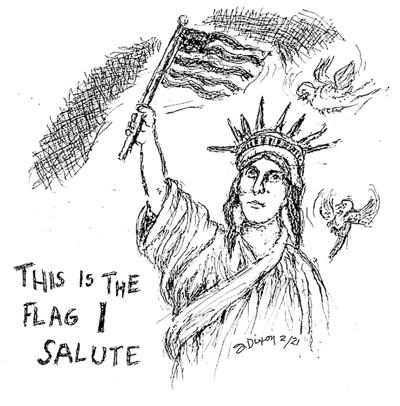
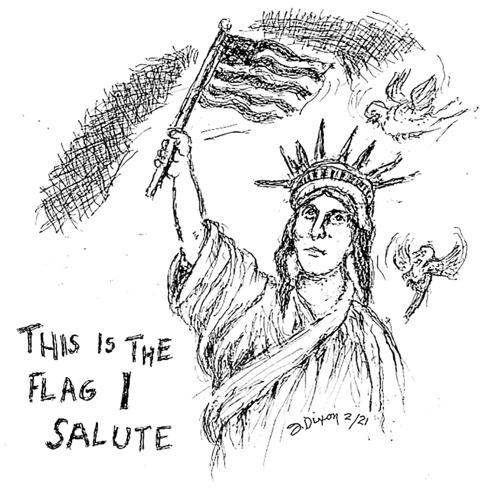
We should remember, however, that there’s only one flag we all pledge allegiance to.