


Turf battle in the NFL: Natural vs. artificial grass
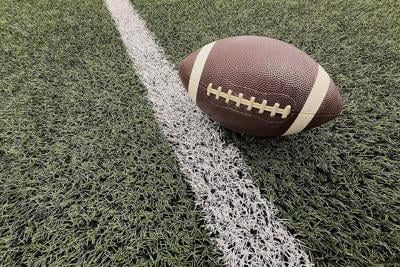
As the NFL season opens, the “grass vs. turf” debate is heated this year, especially after the World Cup required seven stadiums to replace their artificial turf with real grass for a few weeks of soccer matches this summer.
For NFL players, the issue is safety.
“The cost of doing nothing is paid for by players’ bodies,” Green Bay Packers linebacker Zaire Franklin posted on X. “Make grass mandatory. We’re #WorthTheCost.”
“If stadiums can make grass work for the World Cup, they can make it work for NFL players,” Washington Commanders tackle Laremy Tunsil posted on X.
LawnStarter has the story of how the NFL drifted to plastic, why football players are fighting to return to grass, and which stadiums use artificial turf vs. natural grass today.
Key Takeaways
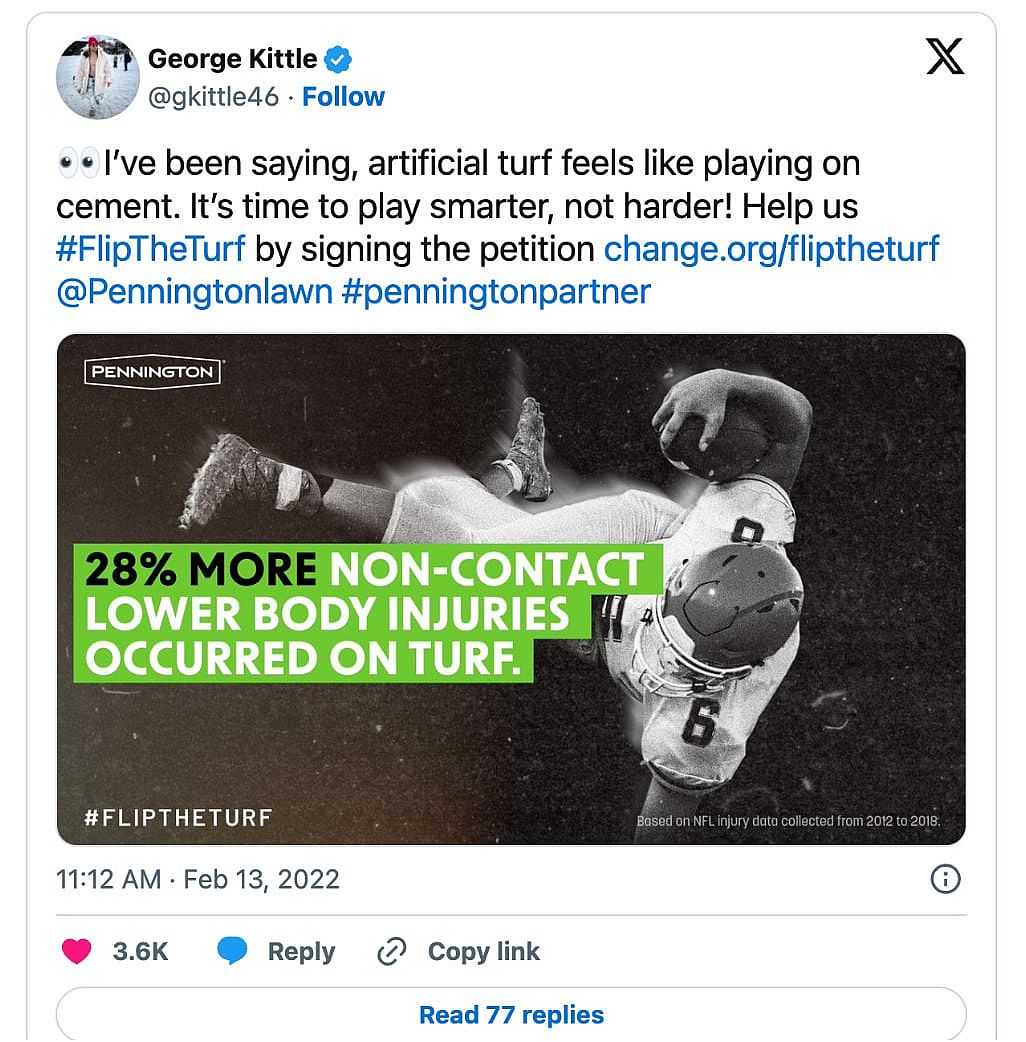
- National Football League Players Association (NFLPA) data shows players suffer 28% more non-contact lower-body injuries and 69% more foot/ankle injuries on turf than on grass.
- The 2026 World Cup forced seven NFL turf stadiums to install natural grass to meet FIFA's standards.
- The World Cup conversion renewed players’ call for permanent grass fields under the current #WorthTheCost campaign.
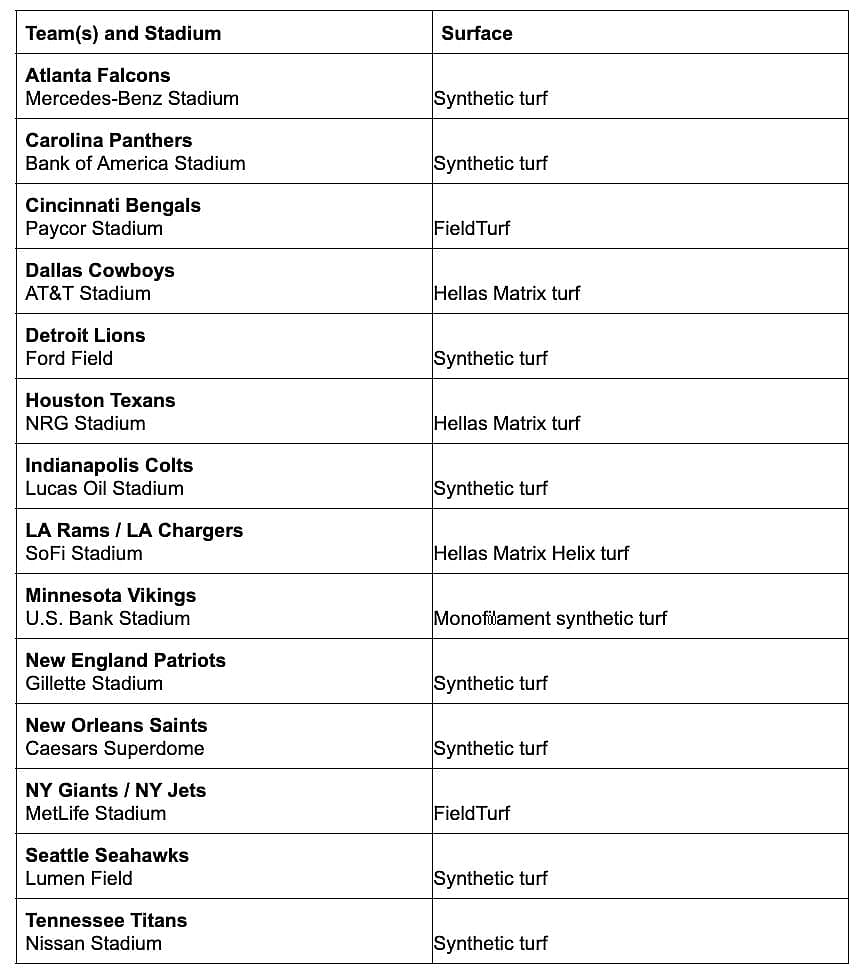
Which NFL Stadiums Use Grass vs. Turf
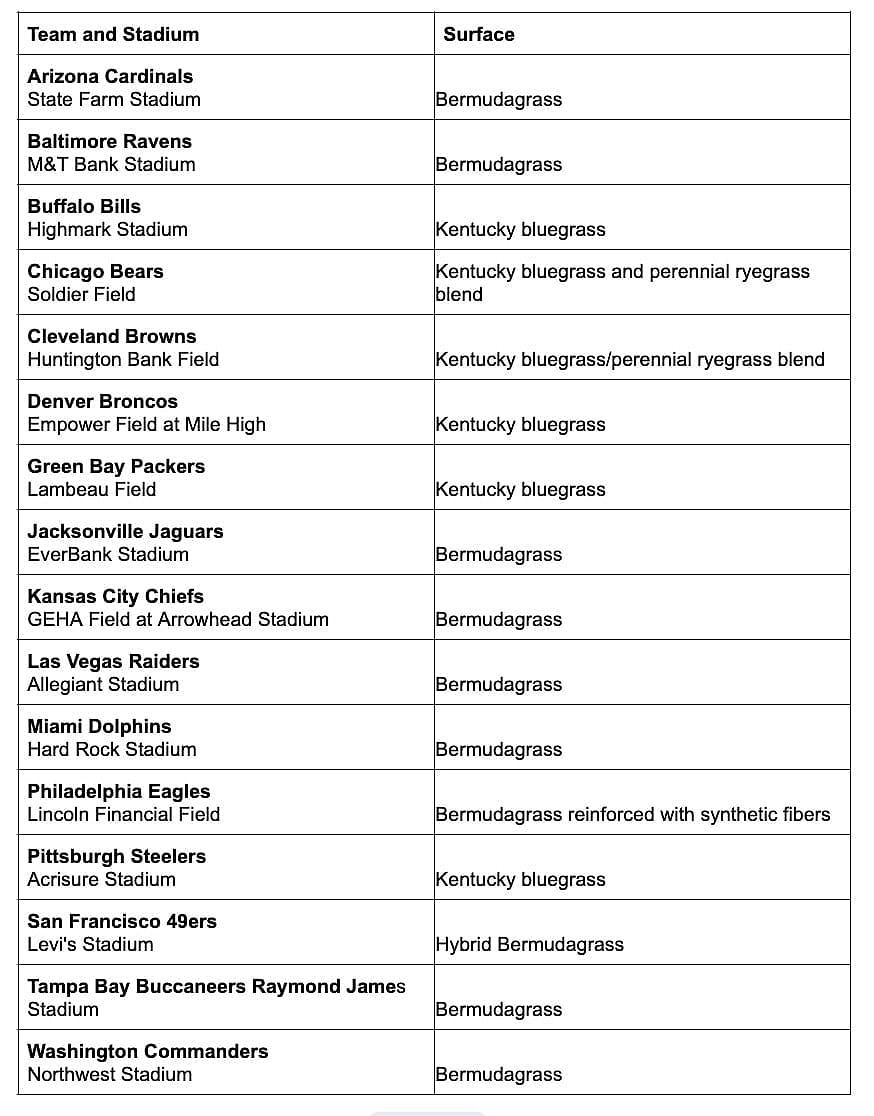
For the 2026 season, NFL stadiums are split roughly evenly between natural grass and artificial turf.
The seven World Cup stadiums that switched to grass for soccer have ripped that up, and the artificial turf is back for football. Meanwhile, the Buffalo Bills have a new stadium with natural grass, bringing to 16 the stadiums with grass vs. 14 with artificial turf.
Is that grass natural, artificial turf, or some hybrid? On your big-screen TV, they look nearly identical, and you most likely cannot tell the difference.
NFL players, though, can tell the difference. The debate over natural vs. artificial grass, and the growing pile of injury claims, has pushed players in favor of grass.
Natural grass NFL stadiums
Climate and stadium design help determine which grass species and support systems crews use:
- Warm climates: Most natural-grass NFL fields use Bermudagrass because it’s dense, durable, and heat-loving.
- Cooler-climates: Stadiums install Kentucky bluegrass or a Bermuda/ryegrass blend to survive the fall weather.
- Hybrid natural grass: A small number of fields reinforce a living grass root zone with synthetic fibers, improving stability while retaining natural grass at the surface.
Artificial turf stadiums
Concerts and other events are the main reason multi-use stadiums choose turf. It tolerates stage loads and foot traffic grass can't, but those same events compact infill, scuff fibers, and create spot repairs.
How the NFL Drifted From Grass to Turf
The first sports artificial playing surface debuted on the infield of the Astrodome in 1966 after the Houston Astros learned in 1965 that grass would not grow well indoors.
The AstroTurf infield looked green, but it had none of the forgiveness that grass did. Some players found that the artificial turf gave them more traction, but that traction came at the cost of the field’s surface being much harder.
Both in baseball and football, knee and leg injuries spiked as teams transitioned from grass to artificial turf.
Artificial turf and natural grass systems have both improved in the past half-century. FieldTurf and Helias Matrix turf are just two of the big names in artificial turf at NFL stadiums.
Today’s synthetic systems are rated by speed and firmness, and makers say they’re easier on the body than older versions.
The Injury Case Against Turf
At 2022’s Super Bowl, Los Angeles Rams wide receiver Odell Beckham Jr. suffered a torn ACL in his left knee during the second quarter. The field was artificial turf.
The injury raised concerns about the venue, the Rams’ SoFi Stadium. That’s because Beckham’s injury came when the cleats on Beckham’s left foot got caught in SoFi’s artificial turf. His ACL gave way.
Artificial turf has a troubling history at all levels of play.
Using the NFL’s own injury reports from 2012-2018, the NFL Players Association found players have a 28% higher rate of non-contact lower-extremity injuries on artificial turf, including a 69% higher rate of non-contact foot/ankle injuries.
A 2019 study out of Cleveland-based University Hospitals said that high school players — boys and girls — playing sports on turf fields suffered 58% more injuries than those playing on natural grass fields.
David Shoop, founder of Shoop, A Professional Law Corporation, in Beverly Hills, California, says that these injury discrepancies often become the center of product liability cases.
“Injury litigation involving athletic surfaces often turns on the same mechanical questions: how much the surface grips an athlete’s cleats, how much force it returns to the body, and whether the field performs as intended under real playing conditions,” Shoop says.
“Whether the product is synthetic turf, protective equipment, or another athletic surface, the legal analysis focuses on objective evidence: testing data, maintenance history, industry standards, and whether the risks were reasonably understood and addressed,” Shoop says.
Players and Execs Make the Case for Grass
In 2022, grass seed maker Pennington took to the Super Bowl ad airwaves to make its case for a return to natural turf with a #FlipTheTurf petition. The campaign brought attention to the issue.
While the company’s move would seem to be a good business ploy, the players’ motivation seems to come from self-preservation.
For years, NFL players have been openly pleading for a return to grass. San Francisco 49ers tight end George Kittle went on Twitter to write, “Artificial turf feels like playing on cement,” linking it with a #FlipTheTurf hashtag.
The NFLPA has made all-grass fields a priority. Management’s counter is practical: Artificial turf can be used more often and maintained more cheaply, especially in domes and multi-use stadiums.
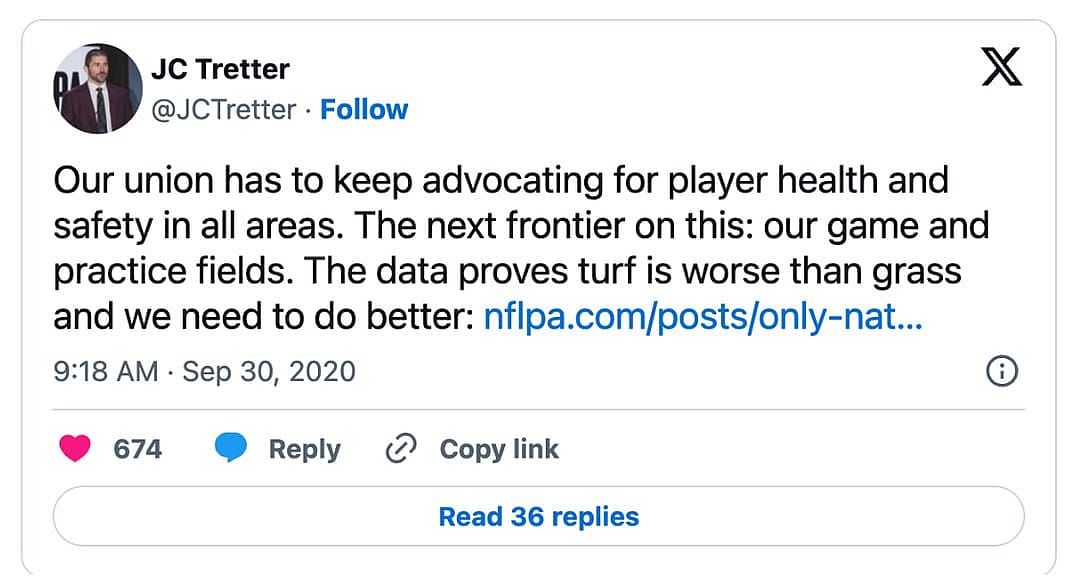
J.C. Tretter, the Cleveland Browns center who currently serves as the executive director of the NFL Players Association, plays home games on Kentucky bluegrass at Huntington Bank Field.
“Our occupation is dangerous enough,” Tretter says, adding that a move to all-grass fields is one of the players’ key issues.
Even some front offices agree with the players.
Kansas City Chiefs President Mark Donovan says the team’s new stadium is being built so it can have either a grass field or artificial turf. He says the preference is for grass, but the stadium isn’t expected to open until 2031.
“If you're asking me today to bet, I feel pretty strongly that we're going to be playing on natural grass,” Donovan told ChiefsWire in late July.
The #WorthTheCost Campaign
#WorthTheCost is the latest NFL player-led message.
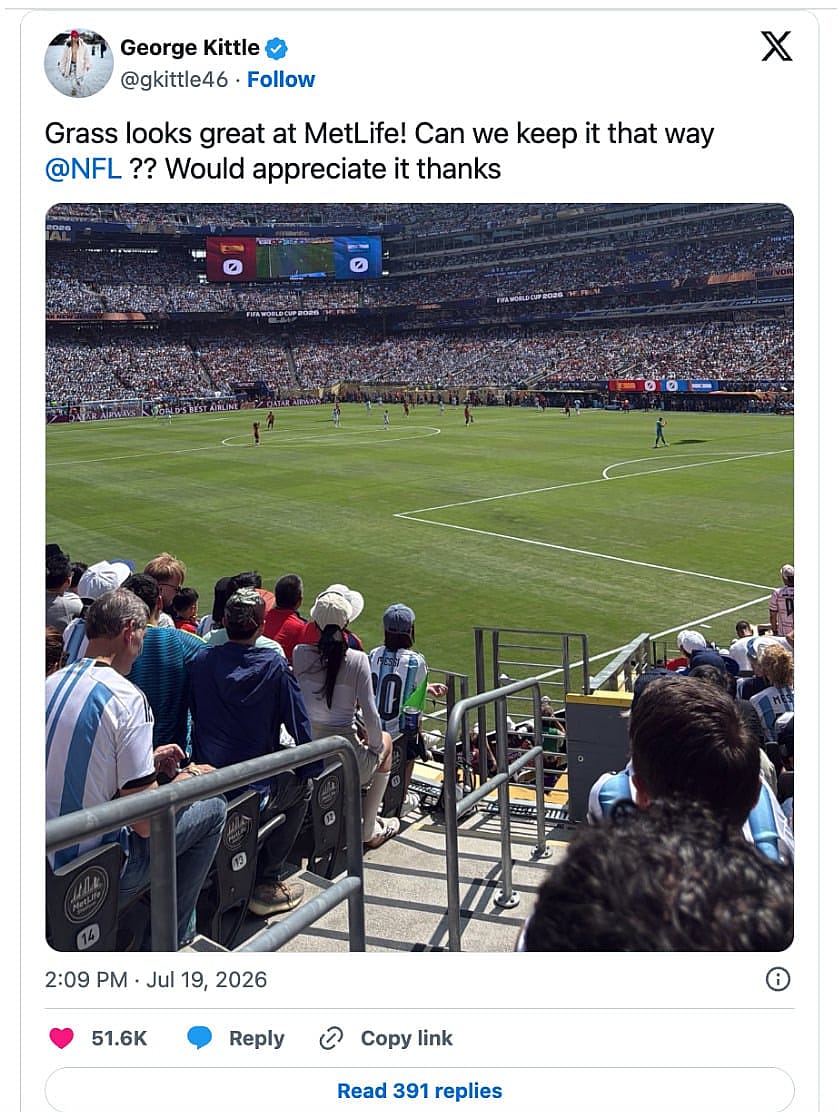
The campaign surged this summer during the World Cup, when NFL players saw stadiums that normally use artificial turf install grass for the soccer matches. The NFLPA said the temporary fields showed that owners can provide natural grass when they decide it is worth the investment.
Kittle also renewed his push during the tournament. He said the World Cup grass conversions showed the league could make grass work in any stadium, adding that players’ bodies are “their business” and that the NFL should choose to invest in them, according to ESPN.
The Cost of Artificial Turf vs. Natural Grass
For NFL owners, the hesitation to switch permanently largely comes down to cost and versatility:
- Natural grass costs: Maintaining a natural grass field runs $1 million or more annually with mid-season sod replacements adding $250,000 to $500,000 per swap.
- Artificial turf costs: Synthetic NFL fields require far less routine upkeep, running roughly $15,000 to $25,000 per year.
Here's what each surface actually requires:
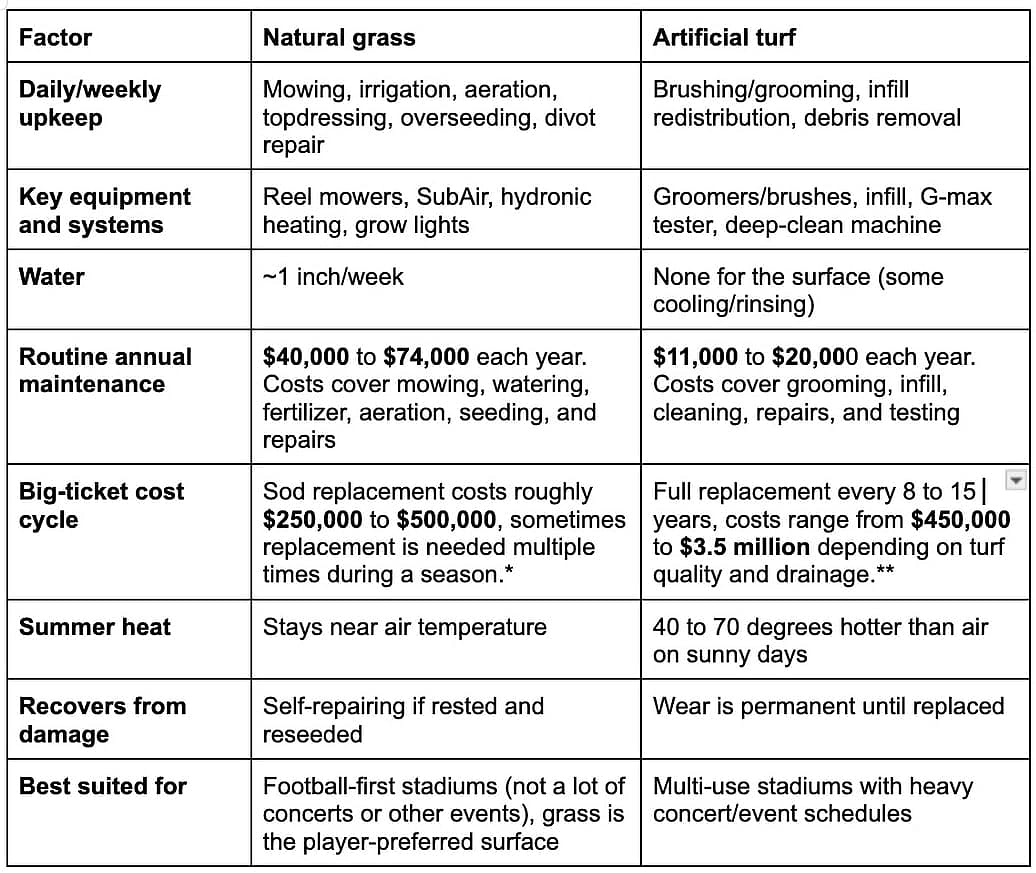
Notes:
*:NFL venues layer significant additional costs on top of this baseline including SubAir systems, hydronic heating, grow lights, and full-time grounds crew salaries.
** Range reflects two different replacement scenarios found in LawnStarter’s sources: The low end is a carpet-and-infill-only replacement over an existing base, while the high end is a full new installation including base and drainage work. Actual cost depends on whether the base/drainage system is being reused or rebuilt.
How the 2026 World Cup Changed the Playing Field
The biggest grass requirement didn’t come from the NFL. It came from FIFA.
Eleven NFL stadiums hosted matches this summer at the 2026 World Cup. FIFA required natural grass, meaning the seven host stadiums that normally use synthetic turf had to install temporary grass fields: MetLife Stadium, SoFi Stadium, Mercedes-Benz Stadium, AT&T Stadium, NRG Stadium, Gillette Stadium, and Lumen Field.
The process demonstrated that grass can be installed in domes, covered stadiums, and heavily used venues. Depending on the stadium, organizers widened the playing area, removed or covered synthetic surfaces, and brought in specially grown grass systems for the tournament.
Miami’s Hard Rock Stadium, Philadelphia’s Lincoln Financial Field, San Francisco’s Levi’s Stadium, and Kansas City’s GEHA Field at Arrowhead Stadium already used grass, so they didn’t need to convert from a regular artificial NFL surface.
The post-tournament reality was less encouraging for players. AT&T Stadium and the other six began removing the grass as soon as the World Cup matches were over.
Cowboys owner Jerry Jones said the team had “no belief that it’s any safer to play on a grass field or a turf,” adding that artificial turf improves the economics of hosting events, according to ESPN.
That decision became a powerful talking point for the NFLPA: The league’s stadiums proved they could accommodate grass, but most reverted to turf for NFL use.
Looking to the Future of Sports Fields
The NFL has said every stadium will need a league-approved playing surface by the 2028 season. The NFL is creating a list of approved options that includes natural grass, hybrid, and synthetic systems.
Teams will be free to choose any surface they want, as long as it is on that approved list.
NFL field director Nick Pappas has described the league’s goal as finding surfaces that perform more like grass, with controlled traction, firmness, and energy return. The league has used laboratory and on-field testing to evaluate those traits.
Players see the issue differently, and their position is simple: If owners can install grass temporarily for a global soccer tournament, they can install it permanently for the NFL players whose careers depend on those fields.
For the 2026 NFL season though, the stadiums that had artificial turf before the World Cup have it back, and the Buffalo Bills have already replaced their new stadium’s grass field. That shows the challenges and costs of maintaining natural grass sports fields.
This story was produced by LawnStarter and reviewed and distributed by Stacker.