
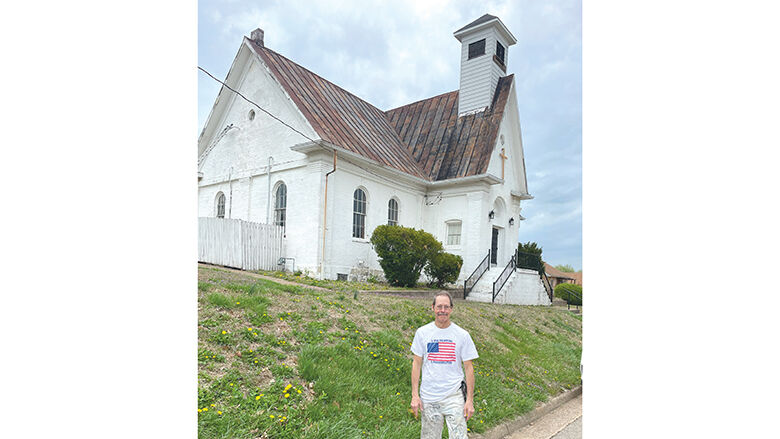
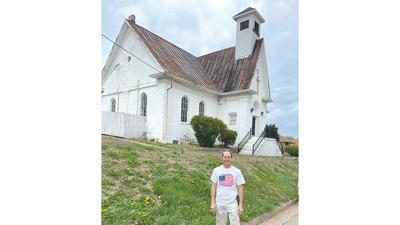
Paul Wheelhouse, a Gainesville, Fla., man who describes himself as a painter, a preservationist and a minister of Christ, recently became the proud property owner of a historic De Soto church building that dates back to 1866.
Wheelhouse has purchased what was once known as the First Christian Church of De Soto and later on, the New Apostolic Church. It’s at 400 N. Third St.
He bought the church on Jan. 31 and plans to restore part of the building to how it would have looked in the 1890s and then make it available for church services, weddings and community groups beginning this fall. He has named it Christ Chapel of De Soto.
For the past several years, Wheelhouse, who spent his childhood in Ferguson and Creve Coeur, has owned and operated A USA Painting & Preservation LLC in Florida. Prior to that, he was a minister for five years and studied for a year in Jerusalem. He’s taught world religions and archaeology courses at a community college and authored a few religious books.
In October, he was in St. Louis for the 30th anniversary of his graduation from Concordia Seminary and drove to De Soto to visit a couple of churches and Woodlawn Cemetery where ancestors are buried. When he was about to leave town, he came across this church that looked abandoned.
Wheelhouse said since 2019, he had dreamed of finding a vacant church in Missouri for sale to preserve.
“It was just a dream because I realistically figured the price would be beyond my loan qualification,” he said. “I definitely did not think I would find such a church in De Soto where I have family roots that go back a few generations.”
Wheelhouse said his late great-grandfather, Ray Kobel, and his late step great-grandmother, Alice, lived on Boyd Street, and Alice taught Sunday School at First Baptist for 28 years. Ray’s late daughter, Evelyn, was raised in De Soto, later moved to St. Louis but retired in De Soto.
A week after spotting the church, Wheelhouse said he called his real estate agent, who confirmed it was for sale and in his price range.
He said it took more than three months to close on the purchase, and the night of the closing, he wandered around the church sanctuary and realized the “stained glass windows” were just fake plastic film that was crumbling, so he removed it.
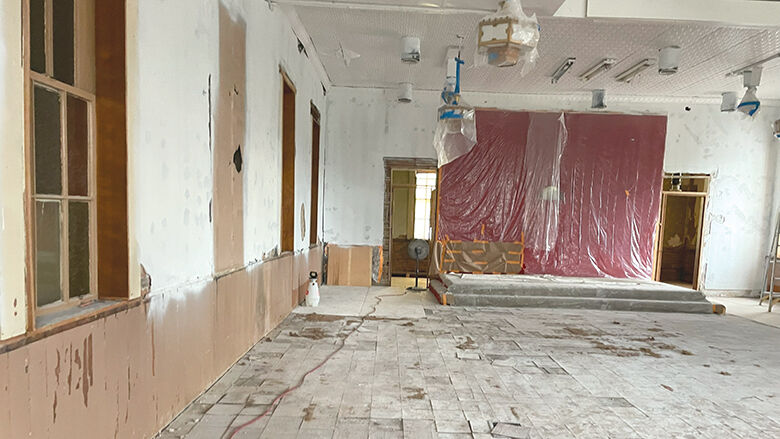
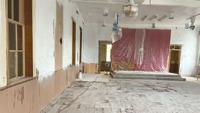
The church’s wood wall paneling, carpeting and drop ceilings have been removed.
Wheelhouse found a handyman who has helped him remove the drop ceiling, wall paneling and red carpeting, exposing what he believes to be the original stamped tin ceiling, brick walls and wooden floors.
Other discoveries included a family of squirrels living in the ceiling and a patch of what he believes is Victorian-period wallpaper at the front of the sanctuary.
“(The wallpaper) is old and not in good condition at all,” he said. “It may not survive, but I thought I’d at least try.”
The church also has unusual Eastern-looking ceiling lamps.
Wheelhouse said he found slightly newer wallpaper from the early 1900s featuring animals and alphabet blocks In the pastor’s office and it appears children had written their names on the wall.
He said 75 to 80 percent of the work he has planned for the church would be considered restoration and the rest would be refurbishing or keeping it as is, like the stage in the sanctuary and the pews, which are not original to the building.
In the next few months, Wheelhouse will wash and repaint the church’s exterior white with gold and silver accents. He plans to have the roof repainted as well. He also will finish repairing and painting the interior
His goal is to have an inaugural service/rededication ceremony for the community on a Sunday afternoon in October or November and plans to send invites to area churches and civic groups.
“It will be a service of praise and thanks to God for the whole community,” Wheelhouse said.
Piecing together history
Through preliminary research and discussions with the Jefferson County Historical Society, he believes the church building was constructed in 1866 and first served as a schoolhouse before becoming the Christian Church in 1890.
Wheelhouse believes that during the 1950s, half of the Christian Church members left and took the church bell with them to the De Soto Christian Church just down the street at Third and Boyd. He doesn’t know why. He believes the church was purchased by the New Apostolic Church in 1965.
He also believes New Apostolic Church stopped meeting at the building in the early 2000s but kept ownership of the property. He also believes New Life Church was the last church to meet there and the building was likely vacant for a couple of years.
Wheelhouse is still learning about the building’s history. He wants to know how the members worshipped and what services were like.
He hopes to register the building with the National Register of Historic Sites, which would give him access to some needed funding. He said upgrading the electric in the building will cost thousands of dollars, but he believes it is needed.
Wheelhouse said if people want to donate toward the project, they may mail donations to 400 N. Third St., De Soto, 63020. For more information about the project call 314-879-4788 or visit his blog at ausappp.com/the-historic-first-christian-church-of-desoto-and-christ-chapel-of-desoto-mo-blog/
On the blog, he said he wants to create a nonprofit organization to preserve the church, as well as other historic churches in the Midwest that have been abandoned.
Feeling at home
Wheelhouse remembers visiting his Kobel family in De Soto as a child, but he also briefly lived in the town.
He said after his grandmother, Evelyn Tuschoff, remarried and retired, she moved back to De Soto, and Wheelhouse lived with them while attending Jefferson College in Hillsboro.
“I am a 1983 grad of Jeffco,” Wheelhouse said. “So that’s my connection, and I have now lived in Gainesville, Fla., for eight years, and I’ve never felt at home (there), but as soon as I get up here to Missouri and in De Soto, I feel home.”
Wheelhouse said he plans to move to De Soto.