


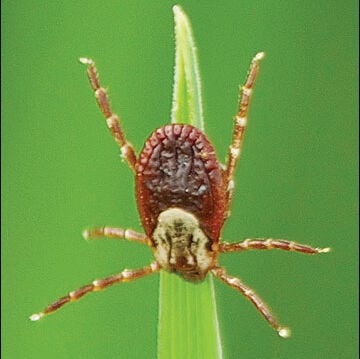
Shorter, milder winters may be leading to increasing tick survival rates, as well as allowing some species of ticks to move into areas where they previously were not able to survive.
Recent data from the Centers for Disease Control and Prevention showed blacklegged ticks, which can carry Lyme disease-causing bacteria, are now expanding their range farther north all the way to southern Canada and bringing the tick-borne illness with it.
Common tick-borne illnesses in Missouri include ehrlichiosis, Rocky Mountain spotted fever, tularemia and Alpha-gal syndrome.
Lyme disease, the most common tick-borne illness in the United States with nearly half a million cases per year, is typically less common in Missouri.
But for one former Herculaneum resident, Lyme disease has had a big impact on her life.
An active life comes to a screeching halt
Kasey Cox Wright, 40, of Union, was born and raised in Herculaneum with an active upbringing.
“I had a normal, happy childhood. I hiked. I played outside. I was a band kid. I was a three-sport athlete. I was a pretty healthy kid for the most part besides asthma and allergies. I was involved in everything when it came to high school. We were an athlete family. Every Friday was football games or track meets or volleyball games or cheerleading.”
Wright said it wasn’t uncommon to find ticks on herself after being outdoors.
“I pulled ticks off of me all the time because it’s Missouri. Of course you do.”
Wright said while she experienced asthma, allergies, occasional bronchitis and a few staph infections, there were no major signs that she might have been infected with a tick-borne illness.
It wasn’t until years later, at age 29, while living in Virginia that Wright suddenly became severely ill.
“I was working 50-hour weeks in veterinary rehabilitation. I was working with animals and having a wonderful time,” Wright said. “I was singing in a barbershop chorus and barbershop quartet. I was really really busy. I started getting joint pain, and when I say joint pain, I don’t mean regular 29-year-old aches and pains.”
Within a month, the joint pain became so severe that by the end of her workday she started needing assistance to get up the stairs to her home, Wright said.
“About a month after that started, I started getting debilitating brain fog, and for the first time in my life, having horrible ADHD symptoms, which I had never had before. I started making really weird mistakes at work, just like little things, and then it started to be bigger things. And then I started having severe panic attacks at work.”
During this time, Wright had been seeing multiple doctors to get answers. After some blood work tests came back normal, she was told the issue was in her head and she needed to seek psychiatric care.
About eight months after her joint pain began, she started experiencing extreme fatigue, feeling like she was always wearing a weighted blanket, she said. And then an even more concerning symptom emerged.
“I was standing at my car at work, and I could not remember how to get home.”
Wright said she went through more tests and doctors suggested that she possibly had multiple sclerosis, lupus or early onset dementia.
“No doctor had answers,” she said. “It was just eight months of going to doctors and them saying we don’t know. It wasn’t until I found a doctor in Washington, D.C., who asked me a bunch of random questions like, ‘Were you an outdoorsy kid? Did you have any of these symptoms growing up? Have you been tested? Where are you from? Did you hike? Have you ever been bit by a tick?”
Wright said her doctor told her she suspected she had Lyme disease and had been exposed years earlier as a child.
“I was like, ‘Wow, that’s an East Coast thing, right?’ She said, ‘No, not at all.’ And I had to take a test for that, and none of it was covered by insurance. So, $1,800 out-of-pocket later, I found out not only do I have Lyme disease, I had bartonella, babesia and Mycoplasma pneumonia. I had never heard of any of those things.”
Wright said she was put on a two-week round of antibiotics, but her symptoms did not improve.
If caught and treated in its early stages, most people who contract Lyme disease can quickly be cured with oral antibiotics like doxycycline or amoxicillin. However, if it’s left untreated, the infection can spread to joints or nerves, causing recovery to take longer and may require intravenous antibiotics. The body is unable to clear the bacteria without medical help and it will not go away on its own.
“When you find out you have bacterial tick-borne diseases, the CDC recommends 14 days of doxycycline,” Wright said. “That helps the acute symptoms if you have just been bit by a tick. But if you have been sick for 22 years, 14 days of doxycycline doesn’t do anything.”
Wright said she started seeing a Lyme-literate medical doctor after her initial treatment and has been in treatment for the last 10 years.
After treatment for Lyme, about 10 to 20 percent of people have lingering fatigue, pain or brain fog, known as post-treatment Lyme disease syndrome (PTLDS). Those residual symptoms usually fade slowly over time and are not reduced with additional antibiotics. Doctors typically treat it with symptom management and lifestyle changes.
Wright said in her case, treatment has included herbal supplements, lifestyle changes, stress management, eating an anti-inflammatory diet and taking anti-malarial drugs. She’s currently taking a chemotherapy drug to treat her nerve pain.
Wright said almost none of her treatment for Lyme has been covered by insurance.
“The average person with Lyme disease spends anywhere between $10,000 and $100,000 on treatment,” she said. “I’m about halfway there. I’ve spent about $60,000 in the past 10 years.”
She said the road to recovery has been a long one, including periods of time being bedridden, having extreme fatigue, experiencing temporary short-term memory loss, temporary dyslexia and severe depression.
Wright said her life post-Lyme looks very different than before she got sick.
“I went from being the life of the party, which I enjoyed and was never exhausting, to being very careful about how I make plans and use my energy. You will not find me out partying. I am in bed at 8 p.m.,” she said. “I have completely changed my career. I went from hands-on veterinary work to working in a public library.”
Wright is the adult outreach coordinator at a library doing programming for seniors at assisted living and memory care units as well as at adult day programs for adults with developmental disabilities.
But even with all the changes, Wright has been able to bring a little bit of her old self back.
“I sing in a band with my dad, and I still sing barbershop,” she said. “Lyme changed a lot about how I live my life, but I’m not scared. I still go outside and hike. We can’t just not go outside and enjoy what this beautiful state has to offer just because there are ticks.”
But now, Wright said she takes steps to prevent her from tick exposure, wearing full-coverage light colored permethrin-treated clothing, using DEET and doing thorough full body checks after being outside.
Wright now also uses her time to educate others about tick-borne illnesses with her “Beyond the Bite: Understanding Tick-borne diseases” education program. She said her program has had increasing interest recently.
“I had seven people in my last program with Alpha-gal,” she said. “If you would have told me 10 years ago when I first started treatment for Lyme disease and co-infections, that I would one day be educating local Missourians about ticks and inspiring people to be advocates for their own health, I wouldn’t have believed that I was capable of such a thing. Chronic illnesses can be so misunderstood and isolating, especially if you were like me and didn’t know where to start when it came to getting better.”
Wright said she is willing to bring her program to any group who is interested to learn more about tick-borne diseases. For more information, contact her at kasey.c.cox@gmail.com.
Alpha-gal syndrome on the rise
Dr. Chandra Dommaraju, a Mercy Jefferson Hospital physician who specializes in infectious diseases, said Alpha-gal syndrome (AGS) is a growing concern in Missouri, which now has the second highest concentrations of cases in the U.S.
AGS is a serious, potentially life-threatening allergy triggered by the bite of the Lone Star tick, which transmits a sugar molecule called Alpha-gal into the body. Those who contract AGS become allergic to mammal meat and mammal-derived products, such as beef, pork, lamb, venison, lard, dairy, gelatin and more. Some individuals are fume-reactive, experiencing symptoms just from the smell of cooking meat. Alpha-gal can also be found in non-food items such as makeup, soaps, lotions, laundry detergent, some medications and even certain brands of toilet paper.
Dommaraju said several hours after exposure many people with AGS will experience gastrointestinal symptoms which may include nausea, vomiting, diarrhea or abdominal discomfort. They may experience skin rashes and hives after a few hours or days. Or, most dangerously, they may go into anaphylaxis within a few minutes of exposure.
“That is when their throat swells up, and they stop breathing. That’s not that common, but it can happen,” Dommaraju said.
The process for an AGS diagnosis, Dommaraju said, can look different from person to person, but typically involves a physical exam, medical history and a blood test for Alpha-gal antibodies. In some cases, it can take months or even years to receive an accurate diagnosis because many doctors are not educated on AGS.
“It depends on how familiar their physician is with Alpha-gal syndrome. Usually, if a physician is aware of the syndrome, they know what to look for.”
Dommaraju said AGS is not able to be treated with antibiotics, unlike many tick-borne illnesses. Currently, there is no cure for AGS, although some individuals may eventually outgrow the allergy over time if they avoid further tick bites.
“Sometimes in three to four years, it can completely go away. Usually, our recommendation is to see an allergy and immunology specialist to help them with treatment,” Dommaraju said. “They can do tests to see if the antibodies to Alpha-gal are going away, and once they are completely gone, then the patient can try to be exposed again. They should do this under medical supervision. They should not try that on their own.”
Avoiding tick-borne illnesses
Dommaraju said prevention is the best method to address tick-borne illnesses.
He recommended using insect repellants, such as those with DEET or picaridin, and wearing permethrin-treated clothing.
If you plan to spend time outdoors, avoid walking through tall grass, bushes or piles of dead leaves, and walk in the middle of walking trails. If potential exposure can’t be avoided, make sure to wear clothing that protects your skin, by putting on long pants and long sleeves, tucking shirts into pants and tucking pants into socks. Wear light colors to help spot small ticks more easily.
After being outdoors, take a hot shower to wash off loose ticks. Spot check your entire body and that of any children or pets for hidden ticks. Put the clothing you wore in a dryer on high heat for 30 minutes to kill any remaining ticks.
If a tick is found, carefully remove it using tweezers to grasp the tick close to the skin to avoid squeezing the tick’s body. Pull straight up with steady, even pressure without jerking or twisting the tick. Do not use heat, petroleum jelly or nail polish to make the tick detach from the skin as this may cause the tick to force infected fluid into the skin.
You can dispose of a live tick by placing it in a sealed container; wrapping it tightly in tape; flushing it down the toilet or putting it in alcohol. Do not crush the tick with your fingers.
After the tick is removed, thoroughly clean the area with soap and water or alcohol. If a rash, fever or chills develops, quickly seek medical attention as soon as possible to get treatment, either by going to the emergency room or seeing a primary care physician.
Dommaraju said most people can avoid or recover from tick-borne illnesses with oral antibiotics like doxycycline or amoxicillin. He said recovery is fastest and most effective when the infection is caught and treated in its early stages.
“It’s better to catch it early and treat it so that you don’t get long-term complications.”