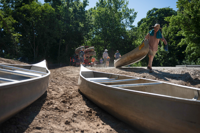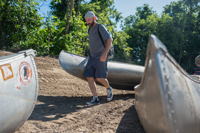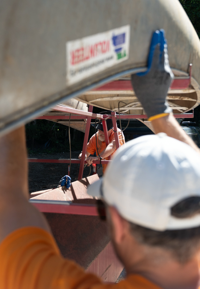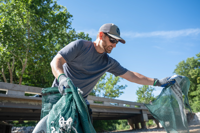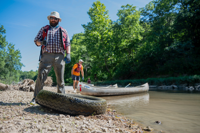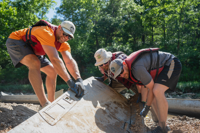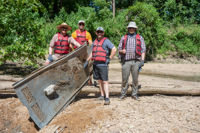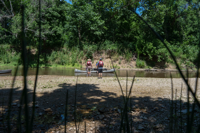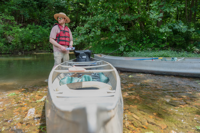


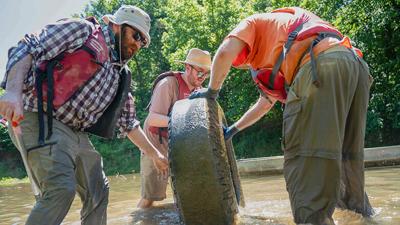
Brian Waldrop stares at two abandoned tires stacked along the bank of Plattin Creek. His orange Missouri Department of Conservation T-shirt is a beacon against the bright blue sky and lush greenery.
The creek, which lies south of Festus, is silent other than the occasional croak from a frog and the soft babble of water over rocks.
Without looking away from the tires, Waldrop sighs. “Humans suck,” he said.
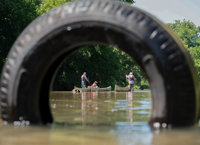
Waldrop is used to the sight of abandoned scrap tires littered along the banks of Jefferson County’s waterways; he’s spent the past 35 years digging them out of riverbeds.
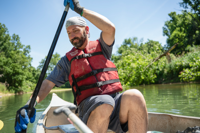
For 18 of those years, Waldrop was a volunteer with Missouri Stream Teams, a volunteer organization that’s dedicated to cleaning up and advocating for Missouri’s waterways. Since its creation in 1989, Stream Teams have removed 506 tons of trash from rivers and streams statewide with the help of 37,000 volunteers.
According to the Missouri Stream Team 2025 report, the amount of volunteer labor used since 1989 would amount to nearly $2 million.
After years volunteering, Waldrop began working with the Missouri Department of Conservation; now, he works as MDC’s volunteer engagement specialist for the St. Louis and southeast Missouri regions.
“It’s a life changer,” Waldrop said. “Stream Teams gave me a purpose in life.”
Sick and tire-d
The issue of tires in Jefferson County’s waterways is not new.
Throughout the mid-20th century, tires were used as a method of bank stabilizers, said Mike Cook, Jefferson County’s stormwater manager.
The tires most commonly pulled out of Jefferson County’s waterways date back to the 1950s and 1960s. Nearly all are fully intact; some still have rims attached.
Due to frequent river flooding, the tires have washed off the banks and into the beds, often not surfacing for decades. Some have become so embedded in the banks that they cannot be removed out of fears of erosion.
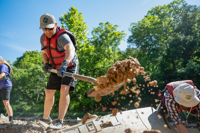
Waldrop estimated he’s pulled more than 200,000 tires out of Jefferson County’s waterways over the span of 20 years.
Since the beginning of this year, he’s pulled between 6,000-8,000 tires.
Another aspect of the tires’ pervasiveness is the lack of a disposal site.
There are currently no sites in Jefferson County that are certified to accept discarded tires; the closest sites are in St. Francois and Washington counties, Cook said.
Additionally, there are few (if any) tire shredding facilities available. Previously, local stream teams worked with a tire business in Jefferson County to shred the tires. But since the partnership ended, Jefferson County teams have not been able to easily dispose of the collected tires.
“I didn’t know how easy we had (it) before,” said Bernie Arnold, who has been volunteering with stream teams for nearly 30 years.
“It was always a pain to get rid of the tires anyway, but now it’s really a big pain,” he said.
Arnold has taken to shredding the tires himself to make the disposal process easier.
Currently, Jefferson County Public Works assists stream teams to do bulk trash pickups and sells tires for scrap metal. If the tires cannot be sold, they’re cut and taken to a certified site to dispose of them.
Many of those involved with stream teams suspect that the failed stabilization effort and the lack of a disposal site aren’t the only reasons for the frequency of trash; general littering remains a large part, and that is not exclusive to tires.
“We don’t mind cleaning up the old spots so much because it was acceptable back then,” Arnold said. “But now, you know you shouldn’t be dumping trash, and people (are) still going back there.”
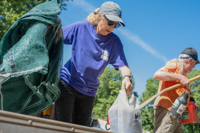
Bill and Janet McIlwee have been volunteering with a stream team for years; they estimate they’ve pulled upwards of 600 tires since they began volunteering, and both have noticed alarming amounts of single-use plastic and glass.
“The amount of trash is just unbelievable, unfathomable,” Janet said. “You just look at it, and you just think, ‘Oh my gosh, I’ve never seen anything like this.’”
Environmental and community impacts
The environmental impacts of tires and litter being left in waterways often have direct and negative effects on the health of Jefferson County residents.
Abandoned tires leach microplastics into the water; according to the National Library of Medicine, the microplastic emission from car tires is “substantially higher” than other sources.
The National Library of Medicine recently reported that microplastics have been detected in human blood, placental tissue and in gastrointestinal samples; certain studies have linked the presence of microplastics to inflammation, endocrine alterations and hormone imbalances and disruptions to gut health.
“When that stuff hits our waterways, it is an illicit discharge,” Cook said. “It becomes a pollutant, and it is harmful not only to us, but to our water resources, our drinking water, aquatic life, even to our animals in general.”
He said the cost of decontaminating the water becomes costlier the more polluted it is; most water districts and cities in Jefferson County get water from local resources.
“The more pollutants you have in the water, the more expensive it is to treat that water for consumer use,” Cook said.
Why they do it
In terms of getting involved with a stream team, no two stories are alike.
For Waldrop, his grandfather took him to his first river cleanup after the Great Flood of 1993, leading to his lifelong effort of water conservation. The great flood remains the most costly and devastating flood to “ravage” the U.S., according to the National Weather Service.
His journey with water conservation led him to leaving his job as a screen printer and earning his bachelor’s degree in biology. He is now pursuing a master’s degree in aquatic entomology.
“I wanted to do this,” Waldrop said. “I was making good money as a screen printer, but I was only doing that for myself.”
For Arnold, becoming a part of a stream team was his way of giving back to the community after spending years working as an engineer for Jefferson County’s public works department.
“I just felt like I needed to give something back, because (taxpayers) were the ones who provided me with my income,” he said. “Taxpayers were always giving me something, so I had to give something back.”
Janet McIlwee was originally opposed to the idea of volunteering with a stream team, but immediately grew to love the initiative.
“I said to my husband, ‘I work 12-hour shifts and my idea of fun is not picking up someone else’s trash,’” she said. Janet is a retired registered nurse.
“I can dust till I turn blue, but you don’t feel like you did anything worthwhile,” she said. “But you go out there and you clean these areas that wildlife live in – you leave with this really good feeling that you made a difference.”
Her husband, Bill, originally got involved in the stream team after being introduced to it by one of his students while he worked as a public school teacher. The New Mexico native fell in love with Jefferson County’s landscape and began working with stream teams to restore the area’s natural beauty.
“We live in an incredibly beautiful area. And if you could see the things that I’ve seen, it would break your heart,” he said. “It literally breaks your heart to see something so beautiful be so fouled.”
Hope on the horizon
Despite the tires and trash, Jefferson County’s waterways are becoming healthier.
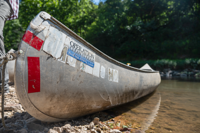
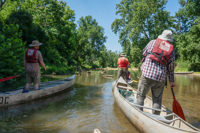
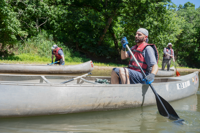
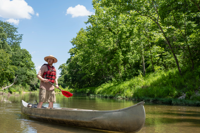
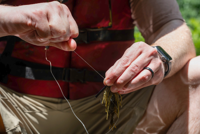
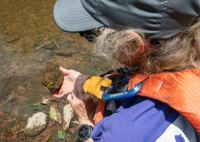
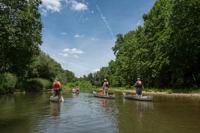
Waldrop spots damsel flies along the banks of Plattin Creek, indicating high water quality. Arnold says cleanups are better now than before, where going a mile downstream once meant completely filling a canoe with tires and trash.
While there is still work to do – whether it be tires to yank out of riverbeds or trash to pick out of bushes – the brunt of the work still falls onto the people.
“I try to make a difference. My goal after doing this for 35 years (is that) I’ve done my share,” Waldrop said. “But if I can instill a sense of hope or pride – it only takes one person to change the world.”