


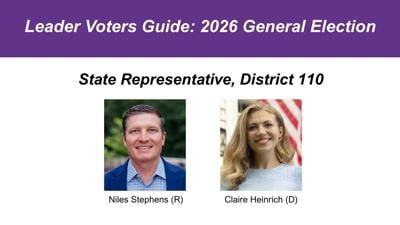
Residents of Missouri House District 110 will elect a new state representative on Nov. 3.
Republican Niles Stephens of Wildwood and Democrat Claire Heinrich of Wildwood are running for the seat. District 110 encompasses parts of western St. Louis County, covering portions of Wildwood and Eureka.
The District 110 seat is currently vacant; Republican Justin Sparks left office on Nov. 5, 2025, to accept a position with the U.S. Department of Homeland Security.
House representatives are paid an annual salary of $41,770 and serve two-year terms.
Stephens, 47, of Wildwood is a general manager of ICON Window Cleaning. He served on the Wildwood City Council from 2018-2020, and has served on the Wildwood Economic Development Committee, Wildwood Town Center Update Team and Wildwood Planning and Parks Committee. He is the managing director for MO Tax Relief Now, president of the Willow Glen Homeowner’s Association, coach for youth sports, onstage volunteer at Calvary and Pathfinder Church and neighborhood organizer for Prosper the City charity drive. His spouse is Michelle, and he has three children.
Heinrich, 28, of Wildwood is employed by the nonprofit Civitas STL. She earned her high school diploma from Washington High School, an undergraduate degree in computer science from Washington University, and a master’s degree in public management from the University of Maine. Since 2024, she has volunteered with the Circle of Concern Food Pantry in Valley Park.
Why should voters elect you, and what are your goals if elected?
Stephens: I am asking for your vote to continue building on years of service to our community. I have the experience, dedication and strong relationships to be an effective voice for House District 110 on day one. The first bills I file will be constituent-focused legislation voters have asked me to sponsor. I will be a strong advocate for our community in the budget process. I will support property tax reforms to increase transparency and stop skyrocketing bills. I will hold regular town hall meetings to keep our community informed. I will work to keep Missouri a great place to grow a business and raise a family with low-tax, low-regulation, pro-business, pro-family policies. It’s an honor to serve, and I look forward to working with residents and community leaders.
Heinrich: You’ll find me at city meetings, the farmer’s market or out talking with my neighbors – regardless of political party. I’m the only candidate in this race with an education in business and public administration, and it shows: fixing our state budget requires real solutions, not just half-baked ideas. My background in tech means I truly understand Missouri’s data center issues, not just high-level talking points on them. As the only candidate endorsed by the firefighters, I’m committed to safe communities and working across the aisle in Jeff City. My goals include bringing our state tax dollars home for public schools and infrastructure. When the state underfunds our district, we either pay the difference in higher local taxes or sacrifice community services. And I’ll fight to make sure our district’s voices are respected. Too much of our tax money is wasted revisiting the same issues because our legislature doesn’t listen.
In light of recent elections, many voters contend Missouri’s state legislators are following their own political agendas, rather than listening to the will of the people, citing Amendments 4 and 5 as the most recent examples of a seeming disconnect between legislators and residents. Do you agree or disagree with that assessment?
Stephens: Initiative petition reform has been a common topic in Jefferson City for years, and Missouri has been reducing its income tax since 2016. The amendments gave voters a chance to make their voices heard on those long-standing policy ideas. Voters rejected the specific proposals in those amendments, but lower taxes and fewer changes to the constitution are still popular with many Missouri voters. In 2027, the budget and data centers will dominate the conversation. In 2028, there will be new topics that come to light. As your state representative, I will hold town hall meetings and knock on doors to connect with voters and listen to the public. I share my personal cell phone number with voters and answer emails in detail, so constituents clearly know where I stand on an issue.
Heinrich: I absolutely agree with this assessment, and it’s one of the core reasons I’m running for office. District 110 needs representation that votes like District 110. Our last representative voted against his constituents, and my opponent has promised to follow with the same agenda. Missourians are tired of being ignored in Jefferson City. Amendment 4 was meant to end the initiative petition process because Jeff City has no desire to be accountable to the people. Amendment 5, which my opponent also heavily supported, was meant to end citizens’ right to decide what they are taxed on and how high that tax is. Both amendments are classic examples of government overreach. Your question highlights a key difference in this race – I am the only candidate who agreed with the voters of District 110 to reject Amendments 4 and 5. I will represent the people of this district.
A common topic of legislative reform concerns tightening the requirements for citizen-led initiative petitions. Would you support reforming IP? What sort of reforms would you support?
Stephens: The Missouri Constitution is bloated with statutory laws. Marijuana monopolies, gambling rules and bingo locations should not be in a state constitution. They have made their way into the Missouri Constitution by collecting signatures in the parking lots of high-density urban areas. Changing the United States Constitution requires broad support; changing our state’s constitution can be accomplished by driving up the numbers in four counties. I would support initiative petition reforms that require higher vote thresholds and/or statewide support. I would support shrinking the state constitution by moving some of the constitutional amendments to the statutes where they belong.
Heinrich: This is a common topic of discussion in Jeff City because they don’t want to represent the people, and their record proves it. The IP process is the last resort of voters to intervene in the legislative process. The recent battle to keep Amendment 6 off the ballot was so hard-fought by Jeff City, our secretary of state and my opponent because it will close the door on Jeff City’s proud tradition of ignoring the voters. If Jeff City would like fewer IP ballot items, perhaps they could represent the people instead of their own interests. Any limits placed on changes to the constitution should exist on both the citizen IP process as well as changes initiated by the legislature. The attempts to “reform” the IP process are really just attempts to limit the power of Missouri voters. The IP process certainly needs less reform than Jeff City does.