
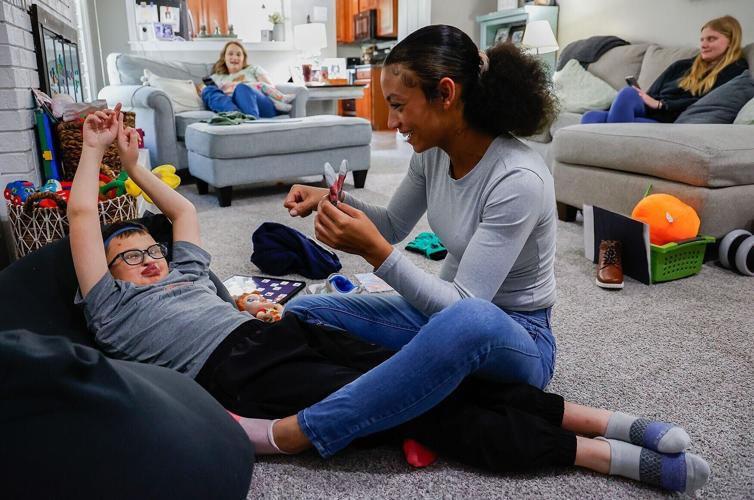

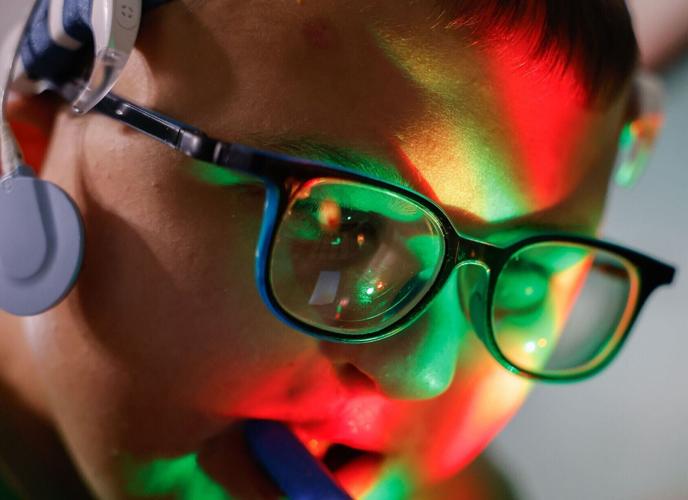





Sitting on his living room carpet, 11-year-old Carter McKee intently hovers over a colorful, light-up sensory toy. Vibrant yellow, red and blue dots reflect in Carter’s glasses as his fingers carefully press plastic buttons to form his desired pattern of colors on the board.

Carter McKee, 11, changes the colors of the lights from a DJ mixer toy while chewing on an oral motor chew tool on May 3 at his home in Jefferson City. Carter has CHARGE syndrome, which causes cranial nerve abnormalities that cause swallowing difficulties. He uses the chew tool as a safe, sensory-rich alternative to satisfy the urge to chew.
The activity comes to an end once Mya Shorley-Gierer, Carter’s personal care assistant, crouches down in front of Carter and uses American Sign Language to sign “First stars, then play.” Carter hands over the light-up toy to begin his applied behavior analysis therapy, a type of behavioral therapy for people with developmental disorders.
Carter’s registered behavior technician, Elena Parr, holds up a brown leather boot and asks, “What this?” Clenching both hands into fists, Carter emphatically taps them together to answer with the sign for “boots.”
Shorley-Gierer smiles as Carter earns another star during his ABA therapy.

Registered behavior technician Jaukyasha Robinson, center, uses American Sign Language to sign “yes” as Carter McKee correctly answers with the sign for “socks” during his applied behavior analysis therapy session while his mom Amanda, back left, and one of his personal care assistants, Mya Shorley-Gierer, back right, watch on April 19 at the McKee’s home in Jefferson City. Carter meets with a registered behavior technician regularly to learn new skills, increase positive behaviors and improve social interactions.
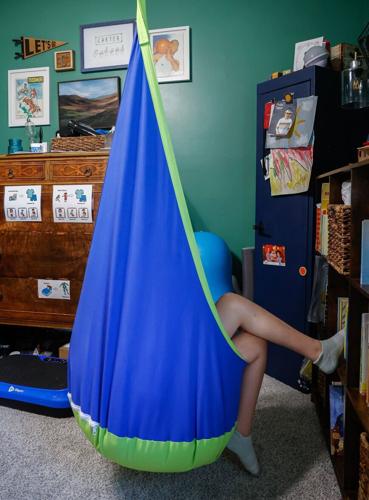
As a personal care assistant for Carter, Shorley-Gierer knows Carter’s likes and dislikes. She knows he likes playing adaptive sports outside, spinning in his indoor swing and chewing on buttery popcorn at the movies.
Carter was born with CHARGE syndrome, a complex, genetic syndrome that requires intensive care for various physical and developmental challenges. Throughout his life, Carter has had 18 surgeries and regularly visits with 11 specialists. CHARGE syndrome, which also can cause deaf-blindness, presents challenges for Carter’s mobility and learning. A total of five caregivers work with Carter for a combined 35 hours each week.
Their presence in Carter’s life is made possible through a Medicaid waiver program called self-directed supports. Managed by the Missouri Department of Mental Health, self-directed supports is a delivery model through Medicaid’s Home and Community-Based Services. The state program allows Carter’s parents, Tom and Amanda, to hire, train and manage their own care staff. Without self-directed supports, beneficiaries like Carter could require institutional care.

Carter McKee, 11, watches videos on his iPad while sitting in an indoor swing hanging from his bedroom ceiling on April 20 at his home in Jefferson City. Carter has CHARGE syndrome, which affects Carter’s vestibular system to the point where he cannot get dizzy, Amanda McKee said.
State budget pressure threatens disability care
Recent budget proposals put the program’s future at risk. In February, Gov. Mike Kehoe’s proposed budget for fiscal year 2027 included $80.7 million in cuts for the Department of Mental Health, which encompassed $6.2 million in cuts for self-directed supports. Care staff would have seen a 21% to 29% decrease in pay rates under the proposed cuts.
On Feb. 11, families and advocates spoke out against the cuts at the Capitol, arguing that a decrease in caregivers’ pay rates would force them to find work elsewhere.
Amanda McKee, who manages the hiring and scheduling of Carter’s care staff, said self-directed supports benefit Carter because his caretakers are in tune with his needs. Through the support of his care staff, Carter has found independence at home and in his community.

Carter McKee, 11, and Aubrey Sandbothe, one of his personal care assistants, walk across a ropes course during the CHARGE Walk and Roll event April 25 at the Missouri School for the Blind in St. Louis. Carter and his family socialized with friends and other families in attendance before making their way to the school's track.
“We want to build those trusting close relationships with them, since they’re caring for our son so much,” Amanda said. “They’ll see Carter kind of as, not only their boss, their little bestie sometimes.”
While there are numerous people supporting Carter throughout the day, nobody has more control over his life than Carter himself.
Whether it is choosing what sensory toy he wants or using sign language to communicate his preferred book to flip through, Carter forges his own path in life — his care staff by his side every step of the way. From helping Carter get dressed in the morning to setting up the medical equipment, Carter and his caregivers tackle the day as a team.

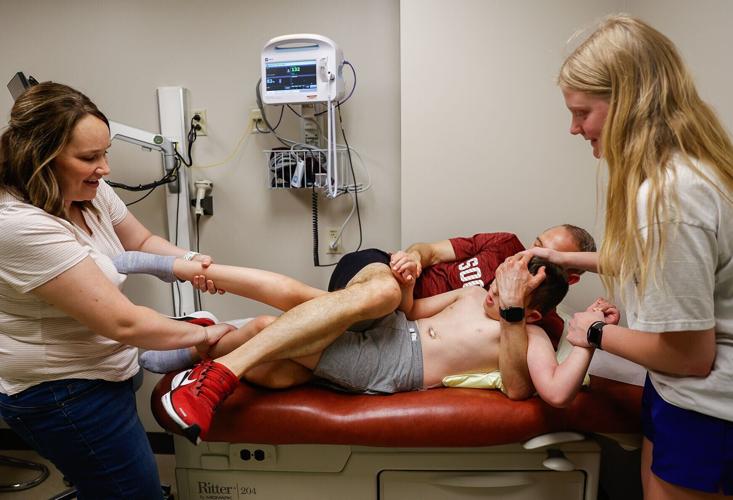
From left, Carter McKee’s parents, Amanda and Tom, and Mya Shorley-Gierer, one of Carter’s personal care assistants, hold Carter on the exam table before an appointment to change his gastrostomy tube with Tara Kempker, his pediatric nurse practitioner, on April 14 at the Hitt Street Medical Building in Columbia. Carter goes to this appointment every three months to get his G-tube changed.
The McKee family was approved for the Medicaid waiver for self-directed supports in 2018 and has since managed Carter’s care staff. Amanda said the approval came after being placed on the waitlist for three years.
Prior to the approval for the self-directed supports, Tom said he and Amanda were stretched thin with meeting Carter’s needs and work. After Carter’s CHARGE diagnosis, Amanda quit her job as an elementary school teacher to take care of him at home. The staff hired through the program has allowed Carter more opportunities in his community through activities that his younger sisters Julia and Lena can also participate in, such as family swim lessons.
“They spend so much time with us. They are just part of our family,” Tom said. “It’s really sad when they go because ... we’ve had some really good helpers come and go, grow up and move on to other jobs and their careers.”

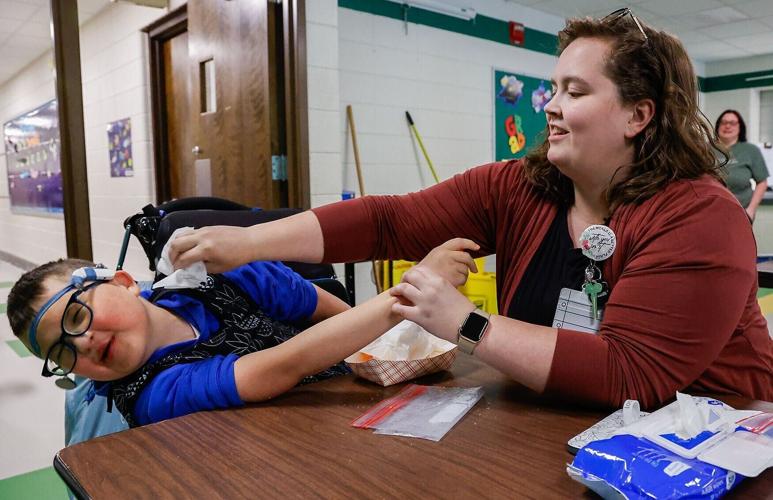
Carter McKee, 11, turns his head away as Allison Peak, Carter’s deaf-blind intervener, attempts to wipe his face clean during lunch on May 1 at Cedar Hill Elementary School in Jefferson City. As Carter’s deaf-blind intervener, Peak works with Carter to facilitate environmental access and encourage his independence at school.
Inclusion in the classroom and community
At his elementary school, Carter has indirectly become a teacher of inclusive education. Amanda said his presence in the classroom helps his teachers learn new strategies that all students can benefit from.

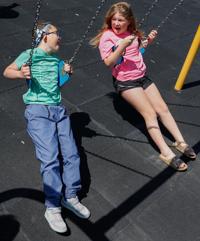
Carter McKee, 11, and Peighton Wright, Carter’s best friend, 11, sit on the swings during recess on April 20 at Cedar Hill Elementary in Jefferson City. The two have been friends since kindergarten.
“You’re going to come across people with special needs or people that are just different than you in your own community,” Tom said. “When Carter’s in school, those kids are exposed to that, and they can see he can do things ... then those kids grow up with the comfortability to be able to see he is just a person, that he’s just different, and we’re all different.”

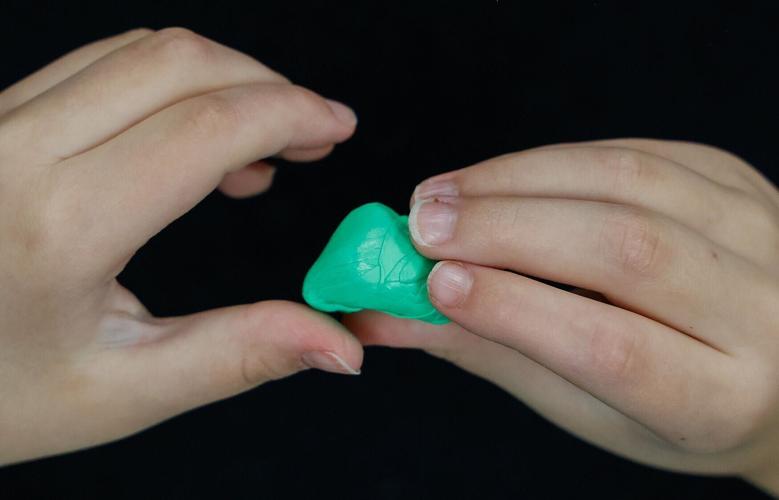
Carter McKee rolls green putty while working with a deaf educator at school on April 20 at Cedar Hill Elementary in Jefferson City. Rolling objects is a sensory regulation activity for Carter.
Carter always looks forward to hanging out with his “self-proclaimed” bestie, Peighton, at school. Peighton and Carter have been friends since kindergarten. Amanda said the bond between them would not have been possible without inclusion in the classroom.
The benefits of inclusion are also a priority for the CHARGE Syndrome Foundation. The foundation originated from a Deaf-Blind Project in the Division of Genetics Department of Child Health at the University of Missouri. Since its foundation 33 years ago, the organization now serves over 3,600 families and individuals with CHARGE syndrome.

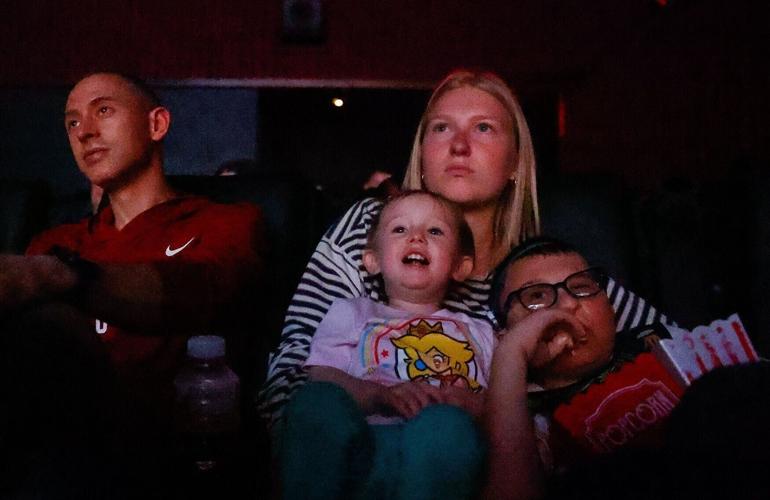
Tom McKee, Carter McKee’s dad, left, Aubrey Sandbothe, one of Carter’s caregivers, back center, Lena McKee, Carter’s younger sister, 2, and Carter, bottom right, watch The Super Mario Galaxy Movie on May 1 at the GQT Capital 8 movie theater in Jefferson City. Carter sometimes takes a sensory break during a movie with his caregiver, but stayed during this movie.
Students at his elementary school took the initiative to raise money for the CHARGE Syndrome Foundation through a bake sale that they organized themselves, Amanda said.
“The foundation overall has been a ... lifeline thread throughout Carter’s life,” Amanda said.
Shorley-Gierer, who is also a Mizzou student studying policy in health care, joined Carter and his family at the CHARGE Syndrome Foundation conference in July 2025 in Phoenix. The event provides a space for families to connect with other people with CHARGE Syndrome.

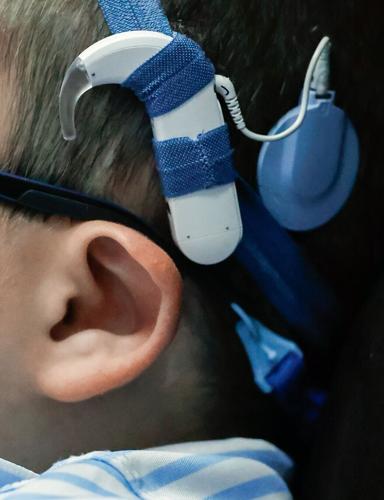
Carter McKee uses his cochlear implants while taking a break in a multi-sensory environment on May 3 at Capital City Christian Church in Jefferson City. Carter’s implants use a sound processor to send sounds from outside the ear to a receiver that is located under the skin behind the ear.
Amanda said that the school district has worked hard to collaborate with the family as they advocate for his educational and support needs. She added that resources from the foundation have helped the family know how to advocate for Carter in school.
“I don’t think we would have advocated for the school setup without having all the sessions and training and things you see at the conference and hearing other parents talk about their (individualized education program) process,” Tom said.

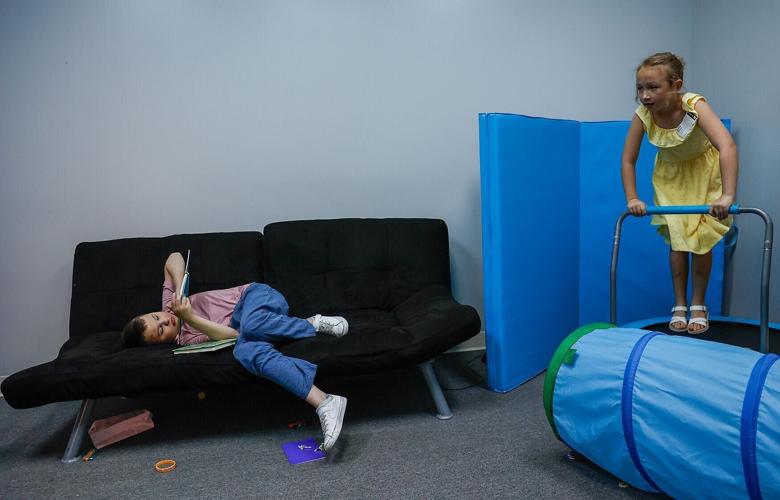
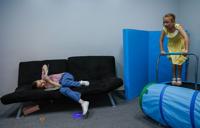
Carter McKee, left, 11, flips through a book while his sister Julia McKee, 7, jumps on a trampoline on April 19 at Capital City Christian Church in Jefferson City. During the service, one of Carter’s personal care attendants Mya Shorley-Gierer took Carter to the church’s child care center so he could relax in the multi-sensory environment.
Where things stand
In April, the Missouri House Budget Committee restored $28.1 million of the $28.6 million in proposed general revenue cuts to services for people with developmental disabilities. Amendments can still be made as the House and Senate remain in budget conference, leaving the status of funding unclear until the budget is finalized before the deadline Friday.
Some families seeking support for at-home care will likely find themselves on a waitlist as the proposed House budget allocates no additional money toward home and community-based services for newly qualified Missouri families.

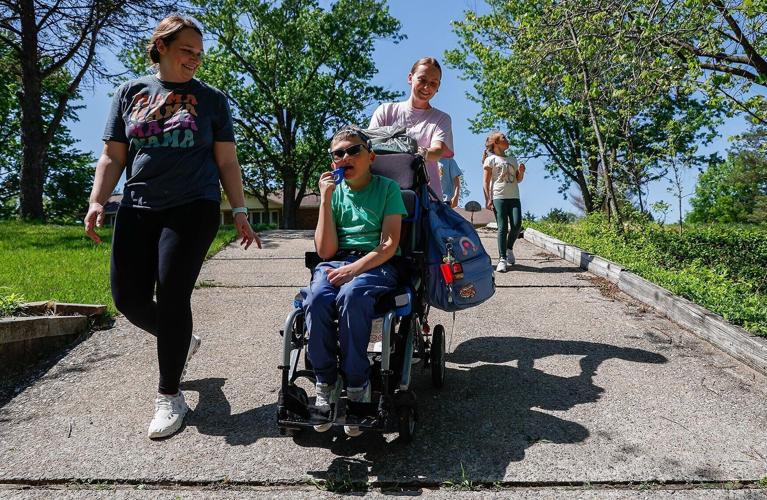
Shannon Ruckman, one of Carter McKee’s caregivers, pushes Carter down the driveway on the way home from school with Amanda McKee, Carter’s mom, left, and Julia McKee, right, on April 20 at the McKee’s home in Jefferson City. The self-directed supports program allows Carter’s care staff to work 35 hours a week.
The scrutiny surrounding the budget comes while Missouri faces sweeping cuts in federal health care spending via the 2025 reconciliation law, also known as the “One Big Beautiful Bill Act.” The reconciliation package would reduce federal Medicaid spending by $911 billion for a decade, according to a Congressional Budget Office estimate. The new law means 14% of Missouri’s federal Medicaid funding is at risk for the next 10 years, ranging from $11 billion to $18 billion, according to research from KFF.
Since self-directed supports are an optional program offered under the state’s Medicaid plan benefits, the program may be more vulnerable to budget cuts, Amanda said.

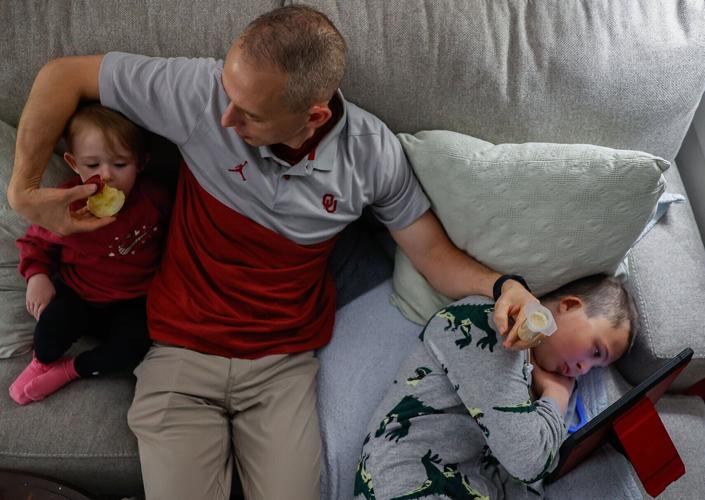
Tom McKee, Carter McKee’s dad, center, shares his apple with Lena McKee, Carter’s sister, 2, while monitoring Carter’s gastrostomy tube before school on April 29 at the McKee’s home in Jefferson City. Carter likes to watch videos in the morning while getting ready for school.
“(Self-directed supports) is not a luxury, it’s a necessity,” Amanda said. “If we didn’t have it, it would greatly impact our family.”
For the McKee family, self-directed supports is not the only disability program at risk.
On April 3, President Donald Trump released his outline for the administration’s discretionary funding recommendations for the upcoming fiscal year. The budget proposal seeks to cut federal funding to several Individuals with Disabilities Education Act programs.
The Missouri DeafBlind Project receives federal grants to cover the cost of professional development materials for Carter’s deaf-blind intervener at school, Allison Peak. This service, called technical assistance, could be one of the IDEA programs affected by the proposed cuts. Amanda said technical assistance plays a crucial role in making school more accessible to Carter.

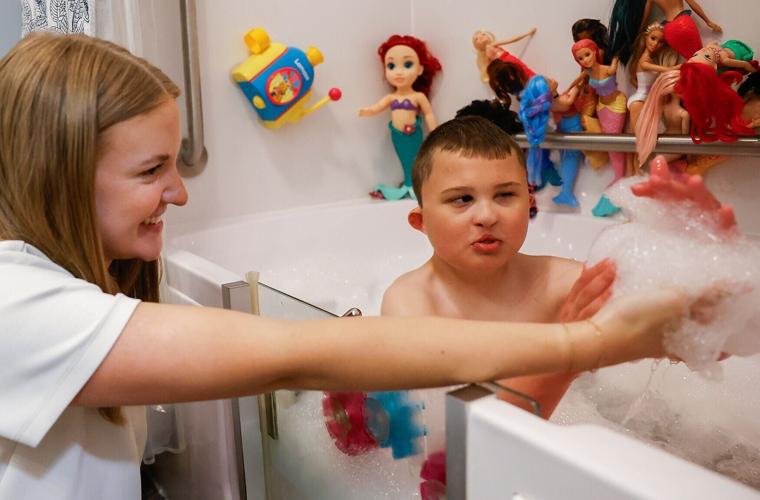
Emma Stockstill, left, one of Carter McKee’s caregivers, holds up bubbles to Carter while he sits in the tub after school on April 29 at the McKee’s home in Jefferson City. Stockstill has been working with the family since September 2022 and had Carter as her ring bearer at her wedding.
“The reason he is making progress at school is largely, in fact, thanks to the professional development provided to all the people working with him,” Amanda said. “The fact that they are willing to support schools and professionals for children with such a low-incidence disability is really important.”
These various programs in school, in the community and in the home can be crucial for people with CHARGE syndrome.
When he was 3 years old, Carter learned how to walk on his own — not on the ground but in the water. CHARGE syndrome affects Carter’s proprioception, which is the ability to understand where one’s arms and legs are in space. Water therapy helped Carter’s arms and legs have the sensory input to help him learn to walk.

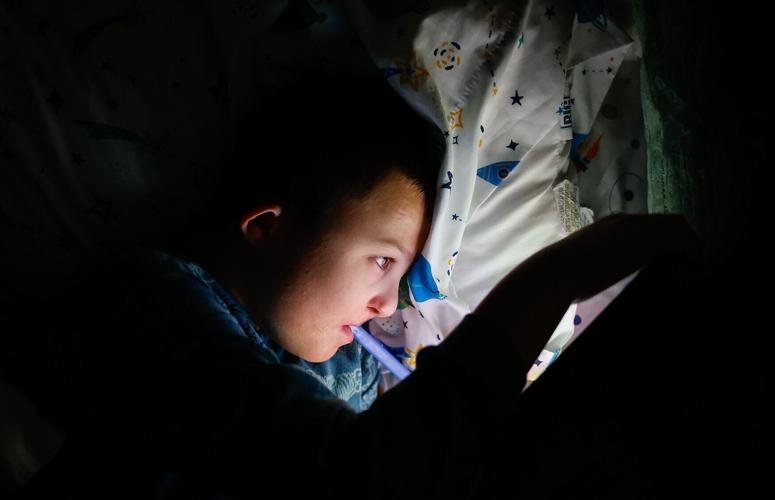
Carter McKee lies in bed watching videos on his iPad before going to sleep on May 3 at his home in Jefferson City. Through the support of his care staff, Carter has found independence at home and in his community.
“He’s got everything working against him to walk,” Tom said. “But he could walk in the water. ... He did that for a few years, and it was super helpful and fun. He just loves being in the water, and it made huge progress for us.”
Carter’s sensory experience of the world may differ from others, but with the needed resources, he has taken steps towards future growth.