


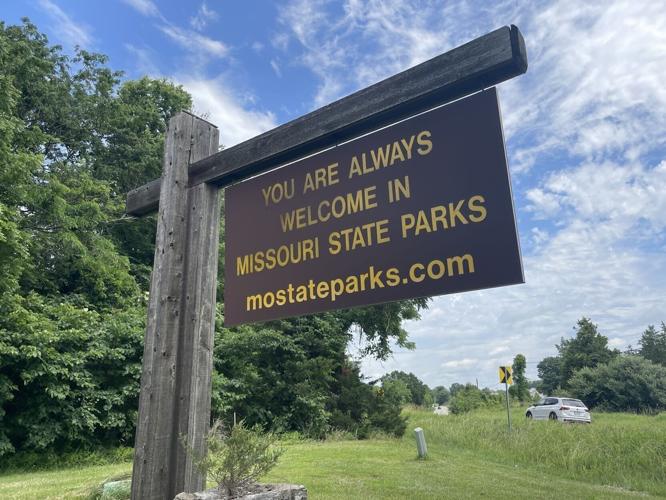
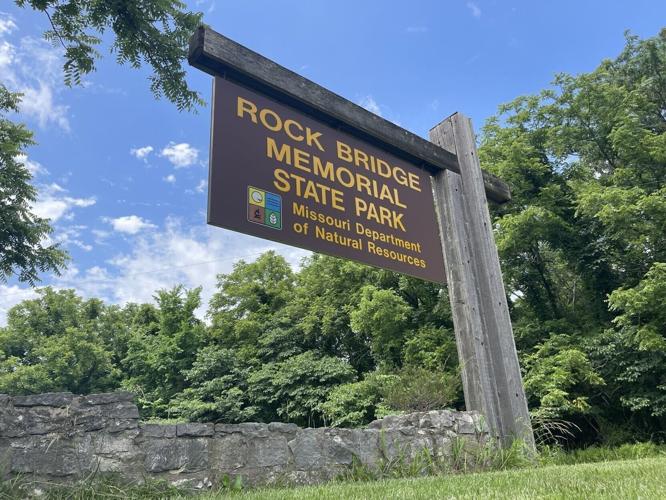

Visitors leaving Columbia’s Rock Bridge State Park are bid farewell by the park’s entrance sign. Missouri is one of eight states without state park entrance fees for both in-state and out-of-state guests. | Trevor Grandin/Missouri Business Alert
If an out-of-state visitor wants to take a hike in any of Nebraska’s state parks, it’ll cost them $14, while an annual pass to Kansas’s state parks costs $25. But walking into one of Missouri’s 93 state parks doesn’t cost a dime.
That isn’t the norm across the country. Though some states advertise free entry into its parks, like Hawaii and Connecticut, visitors without an in-state license plate can expect a fee for entry. In fact, Missouri is one of only eight states in the country that offer free entry into all its parks, regardless of residential status.
That’s thanks to the Parks, Soil, and Water Tax, an over 40-year-old sales tax Missourians have supported time and again. Last time the tax was on the ballot in 2016, it found overwhelming success and passed with an 80% approval rating. This year, voters will once again decide the tax’s fate, but with an expected nine constitutional amendments spread between the August and November ballots, advocates worry whether their message can rise above the noise.
Missouri’s state parks have been funded a handful of ways throughout the years. In 1972, a tax that funded Missouri’s state parks ran out, and the department started selling annual passes to make up for the lost revenue. A column called “The Outdoor Beat” described a way to get around the required fees in a 1972 edition of the St. Joseph Gazette. It suggested travelers simply walk in.
“Only motor vehicles — and you can pack ‘em as full as you want with riders — will require a permit,” the author wrote.
Every motor vehicle that entered a Missouri state park required a permit. It cost $1 for day-use passes, $3 for year-round individual park passes and $10 for annual passes. Melanie Smith is the current deputy director of resources at Missouri’s Parks Department, and she said the annual fee system didn’t last long.
“We looked at annual passes, which is what many states do, but that was not well received by the citizens or the legislature,” Smith said. “They didn't want to see us move to that, and so they actually did a special appropriation to pay back the passes that had been sold.”
The annual passes lasted less than two months until refunds were issued and the entry fee was scrapped. Then in 1984, Missourians passed a constitutional amendment that included the current tax. Section 47(a) of the Missouri Constitution lays out the details: a one-tenth of a percent sales tax on all purchases in the state. That means for every $100 purchased, 10 cents is given to the parks, soil, and water tax.
Hear more: State parks tax on the Business Brief podcast
From there, those 10 cents are split further. Half the tax funds soil and water conservation programs while the other half funds the parks system. Smith said, in 2025 the department earned $69.9 million from the tax, about 75% of the department's budget. The other 25% comes from camping and tour fees, grants and donations.
The tax money pays for a lot of park operations. Kendra Varns Wallis is the executive director of the Missouri Parks Association, a nonprofit that helped lead the amendment's original petition process in the 80s. She said tax money pays for everything, from trail maintenance and wastewater systems down to making sure bathrooms are stocked with hand soap and toilet paper.
“When you think about it, state parks are kind of like a little town, and so they have all these layers that they have to take care of,” Wallis said, “like pump stations and things you don't think about.”
Why are Missourians voting on the tax again this year? The amendment says voters will reconsider the levy every ten years, and if it should fail to pass, the tax would terminate at the end of the second fiscal year after the last election. The tax has passed four times since 1984, and in her personal opinion, Wallis said voting on the tax every decade keeps everyone involved accountable.
“It makes the employees, the visitors, the people who contract with state parks, everyone's accountable to be the best that they can be,” Wallis said. “And then every 10 years, you're graded on it for people to renew.”

Columbia’s Rock Bridge State Park is one of 93 parks throughout the Missouri parks system. Half of the Park, Soil, and Water Tax funds water and soil conservation while the other funds operations in state parks like Rock Bridge. | Trevor Grandin/Missouri Business Alert
Two other states in the country fund their parks departments through statewide sales taxes, and neither need to worry about renewing them anytime soon. Arkansas enacted a permanent sales tax to fund their state parks in 1996, and though Minnesota’s sales tax passed more recently in 2008, it doesn’t expire for eight years.
Other states have tried and failed to implement similar revenue streams. Iowa voters passed a constitutional amendment in 2010 establishing a natural resource trust fund they hoped would act as a sustainable funding source for the parks department. Since its creation, Iowa legislators have failed to pass a corresponding sales tax, and the fund has remained unfunded ever since.
However, this year’s voting season in Missouri is expected to be dominated by taxes. Voters will decide on the Parks, Soil, and Water Tax during the August primary election. The measure will be listed as Amendment 1. Alongside it will be Amendment 5, one of Missouri Governor Mike Kehoe’s top priorities from the previous legislative session.
Amendment 5 would allow lawmakers to expand sales taxes in an effort to replace the personal income tax. Millions of dollars have already poured in from either side of the fight, and advocates of the parks sales tax like Jonathan Ratliff hope their message won’t be misheard in the larger conversation. Ratliff is the campaign manager for Citizens for State Parks, Soil, and Water, a coalition of nonprofits in favor of the parks tax.
“You can tell from my hairline I have a lot of fear at any given time, right?” Ratliff said. “You know, the rumors out there, from what the campaign on Amendment 5 could be, you're talking $30 million or more. That's a loud conversation, and that's a lot of noise”
Organizations that may not normally find themselves on the same side of an issue have come together for over 40 years in support of the Parks, Soil, and Water Tax. That includes groups like the Sierra Club, the Nature Conservancy, Missouri Soybean Association and Missouri Farm Bureau. In an era of hyper-partisan politics, Ratliff finds this amendment gratifyingly nonpartisan. For him, the tax is evidence that people can still come together to benefit the common good.
“There are plenty of times, in I'm sure your daily life [and] in my daily life, that I wonder, can we as Missourians, or as Americans, actually agree on things anymore?” Ratliff said. “And I think it's refreshing to see on this issue — yes, we can.”