


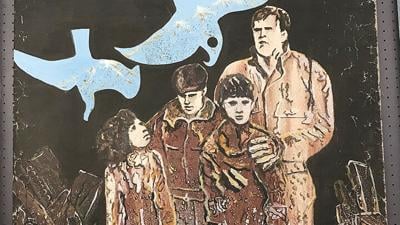
It’s been a long, strange trip indeed for a group of paintings on special exhibit at the Tanglefoot Art Gallery in Festus.
The 50-odd canvases that make up “The Discovered Paintings of Viktor Minkin” were created by a political exile in the former Soviet Union and went through Latvia on their way to Festus. They were headed for the dumpster when they were rescued for the free exhibit, which lasts through Jan. 28 at the gallery at 109 E. Main St.
Gallery owner Rick Bayers said he hung the paintings close together, hoping to give visitors a sense of the way he first encountered them.
“When I came across these, just stacks and stacks of wonderful paintings, it was like peeling an onion,” he said. “I loaded them close in here because I want the viewer to get the same feeling I did of being just overwhelmed with this man’s art.”
Artist in exile
The late Viktor Minkin was born in 1938 and grew up in a rural area near Moscow. He earned a master’s degree in civil aviation management and went to work for Aeroflot, the Soviet airline, as director of its Tokyo branch.
“In Soviet Union, you could not get a good position unless you joined the Communist Party, so he joined,” said his youngest son, Alex Minkin, 49, of New Jersey, who still speaks with a pronounced Russian accent. “He grew to have some political clout. Then, when he started speaking up against the system, he got classified as a dissident.”
Viktor Minkin’s doctoral dissertation was confiscated by the KGB in 1978 and he and his wife, art teacher Stalina, and their children were exiled to Magadan, a city 3,600 miles away in Siberia. He was assigned a job gutting fish in a processing plant.
“I was 6, my sister, Renata, was 8 and my brother, Erik, was 12,” Alex said. “My father was only allowed to come home to us a couple of times a year for a month. The rest of the time he was on an island off the coast where the plant was located.”
In 1985, Viktor Minkin was reassigned to teaching basic engineering at a local community college and allowed to live with his family again. That’s when he started painting, learning technique from his wife.
“My mother spent hours and hours with him, training him, correcting him, explaining perspective and things like that,” their son said. “Our home library primarily consisted of art books, and she introduced him to a lot of different artists and styles and techniques. He tried everything under the sun.”
His paintings reflect that variety. Some are sketch-like, others fully finished, and reflect styles ranging from Impressionist to abstract. He painted on a variety of surfaces, using whatever pigments were available. He sometimes painted over canvases, and at least one of his works is painted on both sides.
“You can definitely see he was largely self-taught as an artist,” Bayers said. “You can tell he was searching for his voice, his own style.”
Bayers said he didn’t do any cleaning or retouching on the paintings before mounting them for exhibit.
“I wanted to show the journey these have been on, all the way from Siberia,” he said.
Coming to America
Minkin’s family was allowed to emigrate to the U.S. in 1991, bringing along Viktor’s easel and more than 100 of his and his wife’s paintings. The logistics of that journey were “staggering.”
“When Soviet Union fell apart, the KGB was still active,” Alex said. “Magadan was a ‘closed’ city, and it was impossible for my father to fly; that was controlled. You don’t go by ship because the ocean is frozen; there is no train because of permafrost.”
The only other option was the 3,000-mile road connecting Magadan to Irkutsk, mostly used by big trucks.
“It was insane if you did it in a regular vehicle,” Alex said. “It took my father 52 days to drive from Magadan to Latvia, where we had some distant relatives. It was quite an ordeal.”
In Latvia, the Minkins worked with the CIA and American missionaries to effect their emigration to the U.S.
Alex said his parents originally were relocated to St. Louis and then moved to Festus.
“The whole family was considered political refugees, and we were given green cards immediately,” Alex said. “After a while, we were allowed to become citizens.”
The Minkins’ experiences in their homeland influenced their lives in their new home.
“My parents, because they were dissidents, were considered to be enemies of the state in Soviet Union,” Alex said. “While in Magadan, you have no personal rights. KGB can come in and rip up the floor, throw things around, confiscate possessions.
“My parents were extremely private, very protective of everything; and that didn’t go away when they came to the U.S.”
Chain of custody
After Viktor’s death in 2014 and Stalina’s in 2020, the Minkin children sold their parents’ Festus house.
“We took as many (of their paintings) as we could,” Alex said. “We didn’t have the resources to take all of them.”
Local businessman Jeff Crisel was contacted by a local realtor to clean out the house and dispose of the remaining contents.
“I sent one of my crews, and they were loading everything up to go to the dump when I came and saw these paintings,” Crisel said. “I said, ‘Wait a minute!’ For some reason I just didn’t feel good about getting rid of them.
“My daughter looked at them and felt the same way. She said, ‘Dad, even if they’re not worth a dollar they shouldn’t be thrown in the trash.’”
Crisel had the paintings taken to a vacant building he was rehabbing in Festus, where they caught the eye of Paul Wagner from Village Electric Heating and Cooling in Herculaneum.
“Paul came down to do some furnace work, and he saw them and asked me what they were,” Crisel said.
Wagner called his daughter, Michelle Griffaw of Festus, to come investigate.
“I went down and there were just piles and piles of pictures,” she said.
Griffaw had the paintings hauled off to her basement and spent time researching them before turning them over to Bayers.
“I’m a little ‘art ignorant,’” she said. “But I knew I didn’t want them to go to waste. A lot of emotion and effort went into those.”
Alex is glad his father’s work is getting the recognition he was denied during his lifetime.
“Because they were so private, my parents didn’t display and didn’t sell,” he said. “My mom was the better painter. All her works are in private hands. Some of my father’s works were donated. I think he sold maybe two paintings in his lifetime. I’m glad these paintings are out there for people to see.”
Griffaw is grateful she played a role in getting the art in front of the public.
“I’m so glad Rick took them,” she said. “Now they can be appreciated the way they should be.”