


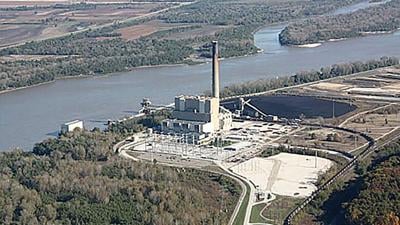
A recent court ruling has opened the door for Ameren Missouri to shut down operations for good at its Rush Island generating plant south of Festus. The facility will be officially retired from service on Oct. 15.
“Although Rush Island is set for retirement, Ameren isn’t simply closing its doors and walking away. We are committed to this community,” said Marco Tipton, manager of community relations for the utility company.
Ameren officials announced in 2022 that the Rush Island plant, previously scheduled to operate through at least 2039, would be closed in 2024.
The Missouri Public Service Commission in late June issued an order authorizing Ameren Missouri to refinance its remaining debt plus the costs associated with decommissioning the coal-fired Rush Island Energy Center. The ruling allows Ameren to issue just more than $461 million in bonds to be repaid over a 15-year period.
Officials estimate customers would have paid an additional $120 million over that period under the original repayment schedule.
Ameren is taking advantage of a process called securitization, signed into state law in 2021, which allows utility companies to bundle together any remaining debt from building coal plants with the cost of closing those facilities ahead of schedule, then refinancing the new amount. A third party issues bonds to pay back the utility’s investments and then customers repay the bonds through their bills.
Utility officials say the goal of the process is for companies to reinvest the money saved into increasing reliability, upgrading the existing grid and developing renewable energy projects like solar and wind.
Tipton said phasing out coal plants is a long-range goal for Ameren, as directed by the Environmental Protection Agency. The Meramec plant in Oakville closed in 2022; the Sioux Energy Center in West Alton is slated for retirement in 2030; the Labadie Energy Center in Franklin County is scheduled to be retired in phases over the next 20 years.
“There are two generating units at Labadie,” Tipton said. “One is scheduled for closure in 2036 and the other in 2042, although that could change.”
According to its website, Ameren has committed to a net-zero carbon emissions goal by 2050.
The company plans to add 3,100 megawatts of wind and solar generation by 2030.
Shutdown ordered
The Rush Island Energy Center was put into operation in 1976, just before the 1977 update to the Clean Air Act that began requiring new power plants to install pollution control measures. Under that law, older plants were grandfathered in, exempt from the rule unless they made upgrades that went beyond routine maintenance in a way that increased emissions.
Ameren overhauled the two-unit Rush Island plant in 2007 and 2010, but contended the changes were not substantial enough to meet the criteria for requiring pollution control.
But in 2019, a U.S. District Court ordered the company to install scrubbers to meet current standards for sulfur dioxide emissions at both the Festus and Labadie plants.
In 2021, the 8th Circuit U.S. Court of Appeals upheld that ruling for Rush Island but struck down the requirement for the Labadie plant.
Officials estimate the cost of scrubbers at about $800 million for one unit and $1.2 billion for both.
At its peak, the plant employed more than 200 workers and generated just under 1,200 megawatts of power. It also contributed about $1.9 million each year in taxes to the Jefferson R-7 School District.
“It came as quite a shock to us when they announced the closing had been moved from 2039 to 2025,” R-7 Superintendent David Haug said. “We want Ameren as a partner in this community. We just don’t want them to close the doors and walk away.”
The district is taking a wait-and-see approach.
“With the current political situation, you don’t know what might happen after November,” Haug said. “Things could look very different in terms of energy decisions being made in this country.”
Tipton said the Rush Island plant still has about 90 employees on the payroll.
“It has been a support resource since 2022,” he said. “It was called on when power needs surged.”
Ameren officials say those power needs will now be handled by SSR (System Support Resource) units that have been recently upgraded.
Tipton said the full closure at Rush Island will not be an immediate, ‘switch-off and walk away” sort of thing.
“The shutdown procedures will take approximately six months,” he said. “All usable assets will be transferred to other locations; all employees will be offered full-time positions at other plants.
The whole thing should take 18-24 months.”
The future of the site
Long-term plans are yet to be developed for the site once its life as a coal-fired plant is over.
“The site is still very attractive to us,” Tipton said. “We’re in no hurry to get rid of it.”
Haug said the 500-acre property represents about $40 million in assessed valuation to the school district – about 15 percent of the district’s total.
“The property holds significant value, and the school and the county don’t want it to just sit there,” he said. “We’d love to see it repurposed, maybe as a gas-generated plant. We want Ameren as a partner in this community. It helps keep small business strong and ultimately benefits us and the kids.”
Tipton said discussions about whether and how to repurpose the plant are in the very early stages.
“There is nothing we can confirm; we’re in the very preliminary discussions of possibilities,” he said. “But Rush Island has provided reliable energy for nearly 50 years and been an important fixture in the community.
“Ameren Missouri is deeply committed to Jefferson County. It’s not just a business; some of us live here. We are still exploring options and potential uses as we navigate the transition toward cleaner energy sources. We are still committed to providing reliable and affordable energy.”