




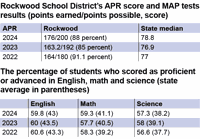

Rockwood School District students are performing well above state averages, according to the Annual Performance Report (APR) and Missouri Assessment Program (MAP) tests scores released by the Missouri Department of Elementary and Secondary Education (DESE).

The district earned 176 of a possible 200 points (88 percent) in the 2024 APR, which is nearly 10 points better than the state median score of 78.8.
Rockwood students scoring as proficient or advanced on MAP tests were more than 10 percent higher than state averages.
In English, district students scoring as proficient or advanced were 59.8 percent compared to the state average of 43. In math, Rockwood students scoring as proficient or advanced were 59.3, and the state average was 41.1. In science, district students scoring as proficient or advanced were 57.3 compared to the state average of 38.2.
“We have been working on identifying areas that we need to show growth in and working on those through curriculum development, resource development, teacher instruction and student intervention,” said Shelley Willott, assistant superintendent for learning and support services. “We look at all of those things on a consistent basis, and that seems to be paying off. We really look at knowing our students as learners and knowing what they need to raise their scores to the next step. That is what we focus on in the classrooms, knowing our kids, knowing what they need and giving them what they need, so they can grow as learners.”
Rockwood also produced a strong composite APR score in the first year DESE has calculated that number, which is the average of the last three APR scores. DESE will eventually use that score to determine accreditation for public schools.
The district had a composite score of 87.5. The state median score was 78.8.
“When you look at it, (the composite APR) makes a lot of sense in terms of how it is computed,” said Glenn Hancock, director of research, evaluation and assessment. “The first year of this, we had a really high average of getting over 90 percent of the points. The APR changed over the next years to include more areas and points. It gives us an understanding of all the things we currently watch on a regular basis. The score helps us understand how they are measuring things right now.”
Each year, Missouri school districts receive an APR score based on graduation and attendance rates; advanced coursework; career preparation experiences; MAP scores in reading and math; scores on the ACT and other national exams; and the number of graduates entering college, the workforce or military service, according to DESE.
DESE officials said during a conference call with reporters on Nov. 21 that composite APR scores will be used to determine accreditation in 2026.
“Originally, we had anticipated that as early as the 2024 APR we would have enough data to use (for accreditation),” said Lisa Sireno, assistant commissioner in DESE’s Office of Quality Schools. “However, as we started to look at data and considering the importance of the stability of measures and using multiple years of data to make decisions, it was determined it would be important to use two consecutive (composite) APRs.”
If the composite scores were being used for accreditation now, a district would be accredited if its composite APR score were between 70 and 94.9. Those scoring at 95 or above would be considered accredited with distinction, those scoring between 50-69 would be provisionally accredited and those below 50 percent would be unaccredited.
DESE released the latest APR and MAP tests scores for public schools across the state on Nov. 25.
The data and test scores are from the 2023-2024 school year. DESE uses that information to measure schools’ performance as part of the Missouri School Improvement Program, which is in its sixth iteration and is called MSIP 6.
This is the third time the APR has been produced under the new criteria, which scores districts based on performance and continuous improvement.
Rockwood, which scored an 85 on last year’s APR, followed a statewide trend of improving its score.
DESE reported more than 60 percent of the state’s more than 550 school districts and charter schools improved their APR scores. DESE also reported that more than 86 percent of the state’s school districts and charter schools met or exceeded MSIP 6 expectations.
“It’s something that we’ve been waiting for,” DESE Commissioner Karla Eslinger told reporters on Nov. 21. “Ever since the pandemic, we have looked at scores (and seen declines). We’re starting to see the fruits of our labor. We’re starting to see where we are making progress.”
Hancock said while Rockwood’s scores are good, the APR and MAP tests do not produce the complete picture for how district students are performing academically.
“It is a snapshot in time,” he said. “There is learning happening and there is growth with each student that isn’t always captured (in state scores). There are a lot of positive experiences that students gets that they can add to a job resume or job application. We include that with our sharing of the APR total points. There is a fuller story that is happening in the district.”