
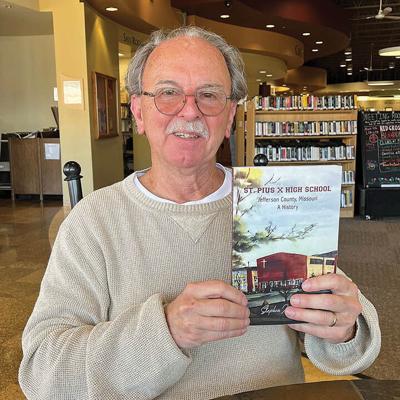
What started off as a small project to put together some history about St. Pius X High School turned into a thorough, comprehensive book about the Catholic school in Crystal City.
Steve Stoll, who had been both a student and a teacher at St. Pius, spent more than three years researching and writing the book.
“I have a bad habit of saying I will do something, then pouring myself into it,” Stoll said. “Some people asked if I would be interested in getting some of this (St. Pius X history) down, and I said, ‘Sure!’”
The end result was a book published in October and now available on Amazon for $20.
Stoll, 76, will sign copies of the book at the Festus Public Library on March 23.
He served in the U.S. Army and earned a bachelor’s degree from the University of Missouri in Columbia before embarking on a 20-plus-year teaching career. (He later got a master’s degree as well).
His political career got off the ground in 1983 when he was elected to serve on the Crystal City Council.
He ran successfully for the Missouri House of Representatives in 1992 and served three terms and went on to serve two terms in the Missouri State Senate. In 2005, he returned to Jefferson County to serve four years as Festus city administrator and then was named the county’s first-ever director of administration in 2009. He served on the Missouri Public Service Commission through the end of 2017.
He and his wife, Kathy, a retired Hillsboro R-3 School District band director, live in Festus and have four children and five grandchildren.
“I joke that I’ve been an educator, a legislator, an administrator and a regulator,” he said. “I guess now I have to add a writer.”
Rick Overberg, a St. Pius X graduate and longtime teacher there, said the school’s alumni association approached Stoll about the project in early 2020.
“We had set up like six categories we wanted, and one of them was the history and the social background of the school,” Overberg said. “Steve was an obvious one to get involved; he’s got such a love for history. He said he would like to do it.
“So we kind of hammered out a direction, and he pretty much buried himself in the information.”
All involved agreed that time was of the essence if they wanted to get firsthand information and personal memories from some of the principal players in the school’s history.
“A lot of people had already passed away – like Father Dalton, Ralph Boyer, Sister Margarita, Bill Schmidt – and the memories they had were lost forever,” Stoll said. “So I said, ‘Yeah, I’ll talk to a couple of folks.’
“I didn’t really expect to write a book, but it just…well, it just kept blossoming.”
Digging in
Stoll said the onset of the COVID-19 pandemic came just as he began work on the project, and he and his wife were largely confined to their Festus home.
“I’d go downstairs to my office, and Kathy might not see me the rest of the day,” he said. “It kind of kept growing as I kept adding things. I would think, ‘Well, if I’m going to write about this, I need to know how it got started,’ and I started making calls, talking to people to find the real story behind it all.”
St. Pius X President Jim Lehn said school officials were happy to cooperate.
“We provided access to whatever documents we had,” he said. “We gave him a storage area on the lower level of the annex building.”
Stoll confessed that research was more interesting than the actual writing of the book.
“For example, in the early days there was a lake in back of the school,” he said. “Ralph Boyer used to go out there and get samples for biology class. It was called Portell’s Lake, and the nuns used to ice skate on it. (The school) had a chance to buy it, but Father Deutschmann decided they didn’t need it. They eventually drained it into the VFW lake, and today, what sits back there is an industrial park.”
Stoll began with the philosophy behind the school’s founding.
“The closest Catholic high school was in Ste. Genevieve,” he said. “Once the kids here left grade school, they didn’t have close access to a Catholic high school.”
His book covers early fundraising efforts.
“They had these pledge cards and they would go around and people would pledge money for the construction,” he said. “We found a box of them in a closet behind a door.”
St. Pius X began as a regional school, supported by the local parishes according to the number of students each sent. In 1965, it became an Archdiocesan-funded school.
All kinds of assistance
Stoll had plenty of help from the far-seeing nuns from the school’s early days.
“The nuns kept very good records of things that happened back in the early days, and they put them in booklets,” he said. “I’ve got most of them from 1959, when the first class started, to about 1970. One of the nuns, I think maybe Sister Margarita, said, ‘This may be good for the future.’ and kept a whole listing of firsts – first football game, first ring ceremony, that kind of thing.
“I also relied on a lot of old newspaper articles, alumni news, the Lancer Legend school newspaper, yearbooks, even some brochures the Archdiocese produced. Fortunately, there had also been some interviews. I went through a lot of publications to gather information.”
“The alumni area was kind of a mess,” Kathy said. “He basically went through and organized it all.”
Stoll personally interviewed a number of administrators and teachers, both lay and religious.
“We went to Illinois to visit sister Gabrielle Rowe, an English teacher back in the early days,” he recalled. “She checked on things and would email me.”
The book includes sections on the school’s influential early leaders, notes its first Black students, and gives a nod to those who currently work to carry on the mission.
“The appendix has every teacher who taught there and what they taught and how long,” Stoll said.
He began the editing process in October 2023.
“Amazon did the formatting,” he said. “They did a good job. It took a while. It was edited twice for content, then again for grammar and that kind of thing.”
Copies will be available for purchase at the March 23 signing event, beginning at 10 a.m.
“I’d like to recover my expenses, but that’s about it at this time,” he said. “I didn’t realize that, once I wrote it, I’d have to sell it. But, you know, it has gotten us out of the house a lot, and that’s good.”
Stoll said he isn’t sure if he’ll ever tackle another book project.
“But you know, sometimes when I look at this, I can’t believe I actually did it.”
Overberg said Stoll was a perfect fit for the task.
“He has stayed so connected to different parts of the community, and he was looking at the broader picture,” Overberg said of his longtime friend. “When we saw (the book) in its first edited form, we were struck with the different social and political fiber of that time. The community was very interested in having a Catholic school, and the nuns were very tenacious. They were pushing education.
“He did a good job. Had he not done this, we’d have lost so much information.”
Lehn said it’s tough to downplay the importance of Stoll’s accomplishment.
“It’s so important to remember where we came from and how we got to where we are today,” he said. “We can’t afford an archivist, so what he did is very beneficial.
“I can’t thank Steve enough for the effort. This was a labor of love.”