
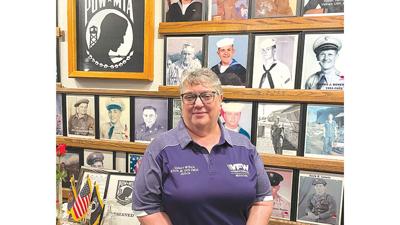
Service has become a way of life for 66-year-old Quincy Myrick – first serving the country as an Army soldier and later volunteering with the VFW in her quest to make veterans’ lives better.
Myrick, who grew up in Florissant and lives in House Springs, wasn’t sure what she wanted to do with her life or what she might want to study after high school, so she enlisted in the Women’s Army Corps – the women’s branch of the U.S. Army that was created during World War II.
“Shortly after I joined, they phased out the Women’s Army Corps (and became one Army),” she said.
Myrick, who previously lived in De Soto, served in the military from 1976 to 1980, spending a year in Korea.
“It was peace time when I joined,” said Myrick, who left the Army as an E5.
Decades passed before she had a chance encounter with a VFW member and found out she qualified to be a member of the VFW. After all, VFW stands for Veterans of Foreign Wars and she didn’t serve during conflict.
Myrick said she qualified because the 1953 Korean Armistice Agreement ended the Korean War, so a treaty was never signed.
The VFW states veterans are eligible if they have served in war, campaign or expedition on foreign soil in hostile waters including service in Korea for 30 consecutive or 60 non-consecutive days.
Myrick joined the De Soto VFW Post 1831 around 2010 and has served various leadership roles at the post, district and state levels.
“It became a way to continue my service beyond the service,” she said. “I really carry it in my heart that I want to serve veterans – current veterans and the ones who are going to come after me because that’s what the ones before us did.
“So it really became this badge that I wear, to support our veterans and fight for veterans’ rights, especially legislatively. That’s the huge way we fight for their rights.”
Myrick said the VFW started after the Spanish American War in 1899 because soldiers were coming back from war with injuries and illnesses and they had no way to get care.
She said the VFW was the leader among other veterans service organizations in getting the GI Bill passed in 1944 and then in making it the Forever GI Bill in 2017.
Myrick said the VFW also was instrumental in the Pact Act, which provides benefits to veterans who have been exposed to toxic substances.
“You can file for a disability percentage, and it’s all based on how severe your illnesses are/what your illnesses are,” she said. “The service organizations – the VA, the VFW, Amvets, American Legion – all of these organizations – will file your claim and represent you at no cost because that’s what we do. We service veterans. You don’t have to be a member of the VFW.”
One of the VFW’s current fights is to outlaw what they call “claim sharks” who advertise they will help veterans with their claims.
“(Claim sharks) are keeping up to 50 percent of the awards that veterans or the survivors are getting because (veterans and their families) don’t know any better,” Myrick said. “They see the ads and they believe it.”
The VFW cautions veterans to work only with a VA-accredited representative. It cautions veterans to avoid businesses that promise an increased disability rating or percentage increase and expedited claims decisions or those who encourage the use of their own network of doctors rather than a VA exam.
She said fighting for veterans’ rights is an ongoing battle.
VFW
Like any organization, the post was eager to put Myrick into many roles when she joined in 2010.
“My second meeting I became the post adjutant, which I love, and I’m still the post adjutant,” said Myrick, who went on to serve as post commander a few times.
After a couple of years in the VFW, she was asked if she wanted to be the district adjutant. Missouri has 12 VFW districts.
“And then from there, I thought I want to keep going forward because that’s how we make a difference, moving up,” Myrick said. “And I am a huge proponent of mentoring. I just think you can’t expect someone to be able to move into a job and do the job without being mentored. Because that’s how we’re going to help our veterans and help the organization. That’s what keeps us going. So I went through – they call it going through the chairs – for the district level: junior vice, senior vice and then district commander. So I’ve been all three of those.”
She said she has attended every state and national VFW convention since 2014.
Her involvement in the VFW increased in 2020 when she retired from USDA Rural Development.
Myrick has served in state-level roles in the VFW, too, beginning as surgeon and now the junior vice commander. She anticipates being named senior vice commander in June and commander – the second ever female commander in Missouri – in June 2025.
She met her husband, Bill, an Army veteran, through the VFW. He was involved in the VFW through another post. They married in 2014.
She said Bill and her mentor, Earl Boyer, a Vietnam veteran who recently died, are the reasons she is so involved in the organization.
Myrick is one of thousands of veterans nationwide to share her story in the VFW’s #StillServing campaign which began in 2020 to “showcase and honor the men and women who bravely defended our freedom and continue to serve the community after the military.”
According to the VFW, #StillServing represents the heart of the VFW and its members and conveys what today’s VFW embodies.
The VFW encourages all veterans to share stories on social media using #StillServing to show how they continue to answer the call to serve in ways big and small. In addition, family or friends are asked to use #StillServing in social media posts to honor a veteran in their lives who believes the spirit of service transcends military life.
The VFW urges Americans to visit vfw.org/stillserving to learn more about the campaign, make a shareable image honoring veterans in their lives, watch videos of VFW members making a difference and see a collection of user-generated content.
According to the 2021 Veterans Civic Health Index, veterans volunteer more, donate more and are more likely to be involved in community issues and vote.
Myrick said it is important to her that she carries on the service that began when she was in the military.
“You just carry on that service,” she said. “It becomes part of you. You see the sign ‘Once a soldier, always a soldier.’ It’s true. It becomes a way of life.”