


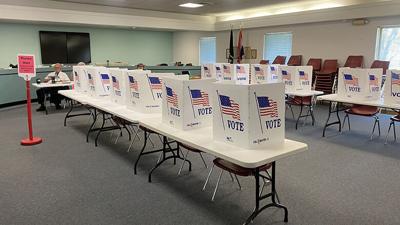

Jefferson County ballots will feature four statewide amendments in the Aug. 4 election.
Two of the four – Amendment 4, which would have the power to change how citizen-initiated constitutional amendments are handled, and Amendment 5, which would eliminate the state income tax -- have drawn the most attention among voters due to the contentious advertising campaigns being waged over them.
Here’s what you need to know about the four amendments:
Amendment 1
Amendment 1 would continue the existing sales and use tax for Missouri’s conservation efforts and state parks.
If passed, the 0.1 percent sales and use tax would be used to fund soil and water conservation, state parks and historic sites.
Proponents say the tax allows state parks and historic sites to be free to both State Park in Cedar Hill, Mastodon State Historic Site in Imperial, Sandy Creek Covered Bridge Historic Site in Hillsboro and Gov. Daniel Dunklin’s Grave State Historic Site in Herculaneum.
If approved this year, the tax issue would appear on the ballot again in 2036; if the tax issue is rejected, the tax would expire in 2028.
Amendment 2
Amendment 2, if passed, would require Jackson County to elect its county assessor rather than appoint one.
Jackson County is a charter county, meaning it has a localized constitution and structures its own local government. Jefferson County is also a charter county.
A county assessor is in charge of classifying property and determining value of personal property for tax purposes.
In 2010, Missouri voters approved an amendment that required counties with charter governments to elect, rather than appoint, county assessors.
Despite Jackson County being a charter county, it was made an exception due to its population – the original amendment exempted charter counties with populations between 600,000-700,000. St. Louis County was also exempted because of its population but chose and continues to elect assessors rather than appoint.
In November 2025, Jackson County voters approved making the county assessor an elected position like other charter counties, with 90.3 percent voting in favor. Changing the position to an elected seat also requires a statewide majority vote for approval. If passed, the amendment would have no impact on taxes.
Amendment 4
Amendment 4, if passed, would change how citizen-initiated constitutional amendments would be approved.
Currently, passage of a citizen-initiated constitutional amendment requires a statewide majority vote. Under Amendment 4, passage would require a majority of votes in each of Missouri’s eight congressional districts.
Meaning, if seven of the eight districts passed a constitutional amendment, but one district did not, the amendment would not pass.
Rep. Bill Lucas, (R-De Soto), said Amendment 4 will benefit rural counties by giving those who live there the same power as those in larger cities, such as St. Louis, Kansas City and Columbia.
“Right now, you’ve got districts and counties all over Missouri that don’t have a voice in amending our constitution because they can just be overrun by those three big population areas,” he said. “The people in the outlying areas, the rural communities, their voices are not being heard.”
Each of Missouri’s eight congressional districts has a population range of 714,982-804,392 inhabitants. Six of the districts are represented by Republicans, and two are represented by Democrats.
The Missouri Chamber of Commerce and Industry, the largest business association in the state, also endorsed the amendment, calling it “common-sense reform” in a news release.
But critics of the amendment say it is “hypocritical” and “unfair.”
Opposing the amendment is Missouri REALTORS, formerly known as the Missouri Real Estate Association. The association is leading the campaign Missourians for Fair Governance.
Scott Charton, the spokesman for the campaign, says Amendment 4 is a power grab by politicians, as the majority rule standard would still apply to legislative-initiated amendments.
“It is hypocritical, it’s unfair, (and) it’s a power grab by politicians,” he said.
And he noted that it would be significantly harder to pass a citizen-led initiative.
“If the people tried to propose something that they wanted that the politicians wouldn’t give them, all the special interests and politicians would have to do is focus all their advertising and fire on one district,” he said. “The people proposing it would have to campaign statewide. All (opponents would) have to do is aim all their fire at one district to kill it. How is that representing the people?”
Amendment 4 also adds penalties for foreign nationals (who are defined as someone who is not an American citizen or lawful permanent resident) or foreign adversaries from showing support or opposition and funding ballot measures.
Amendment 5
Amendment 5 would give Missourians the opportunity to eliminate income tax and entrust the Legislature to handle the loss of an estimated $8.5 billion in general revenue.
If passed, income taxes would be gradually reduced until fully eliminated, and sales and use taxes would be expanded to make up for lost revenue.
The Show-Me State collected $10,889,046,499 in fiduciary and income taxes in fiscal year 2025; the Missouri Budget Project, a nonprofit analysis organization, estimates an $8.5 billion hole in the general revenue budget if the amendment passes.
That budget hole would account for 64 percent of the general revenue budget.
Only eight other states do not have income taxes. Tennessee, the closest geographically and in population compared to Missouri, has a state sales tax of 7 percent and a combined state and local sales tax rate of 9.61 percent.
In comparison, Missouri’s state sales tax rate is 4.225 percent.
Jefferson County’s local sales tax rate is 1.625 percent, but towns within the county are able to add an additional tax. For example, the city of Festus tacks on an additional 3 percent sales tax and the Joachim-Plattin Ambulance District adds another 0.5 percent sales tax.
Gov. Mike Kehoe addressed phasing out income tax in his State of the State address in January, saying he wanted to modernize the state’s tax code and make Missouri more economically competitive.
“If we are serious about building a foundation for growth, to compete rather than be complacent, then we must begin the work now to phase-out and eliminate Missouri’s individual income tax,” he said in his address.
Proponents of the amendment say that passing the amendment will put more money in working Missourians’ pockets and attract more investment opportunities for the state.
But some have raised concerns about how Missouri will make up for the loss of revenue generated by income taxes and a potential increase in cost of living.
“You’d have to spend a lot of money to cost yourself in (sales) taxes as you’d be saving on income tax,” Lucas said. “Now, retired people, people on fixed income, it’s not going to work that way for them.”
Last month, the American Association of Retired Persons said passing Amendment 5 would expose retired Missourians without income to a potentially higher sales tax rate.
Lucas maintains he is “up in the air” on Amendment 5 and wants his constituents to have the chance to vote first.
Missouri REALTORS also sponsor Missourians for Fair Taxation, a campaign opposing Amendment 5. The campaign concerns itself with an increase in cost-of-living expenses and how the amendment would give Missouri politicians free rein over taxing everyday expenses.
“There are current citizen-led, voter-approved, constitutional taxpayer protections that they (legislators) want to set aside, and those prohibit them from raising new taxes without getting your vote,” Charton said. “This is a license for lawmakers to ignore the current constitutional taxpayer protections that Missouri voters have already approved.”
Charton refers to the Hancock Amendment, which was passed in 1980 and gave Missourians the right to vote on major tax increases. If Amendment 5 passes, state legislators are allowed five years where they could bypass the Hancock Amendment.


Follow races for local and statewide offices as well as ballot measures.