

This is the fifth and final installment in a series about the Jefferson County Sheriff’s Office and the nine major police departments in the area. This week’s installment provides information about equipment each of the law enforcement agencies must buy. It also includes a story about the Jefferson County Sheriff’s Office Crime Lab and its director, as well as one about the Jefferson County Jail and another about the Sheriff’s Office’s new police dogs.
Click here to view other stories in this series.
The Jefferson County Sheriff’s Office and the nine other major law enforcement agencies in the area invest a significant amount of money to equip their officers with uniforms, weapons and protective gear and to provide other equipment intended to keep both the officers and the community safe.
Those costs range from about $2,500 to $10,000 per new officer, with the Herculaneum and Eureka police departments spending the most, at about $10,000, and the Hillsboro Police Department spending the least, at about $2,500.
The Sheriff’s Office – the largest law enforcement agency in the area – spends about $4,150 to equip its new officers with uniforms, weapons and protective gear. However, Sheriff Dave Marshak pointed out that his agency, like many of the other local police departments, incur other costs to provide officers with the equipment they need, like radios, laptop computers and software licensing.
In addition, the Sheriff’s Office, as well as some of the other area law enforcement agencies, provide at least some of its officers with vehicles to take home for work, Marshak said.
“The Sheriff’s Office has operated a take-home vehicle program for as long as I’ve been with the department,” said Marshak, who has worked for the Sheriff’s Office since 1994. “Most deputies are assigned a vehicle, and as long as they meet policy requirements, they take those vehicles home. Many of our personnel serve in on-call roles—including SWAT, detectives, narcotics and mental health/crisis response (personnel) – which makes take-home vehicles a necessary part of our operations. We also have a few civilian positions with on-call responsibilities that are issued vehicles for the same reason.
“In recent years, more law enforcement agencies have expanded or introduced take-home car programs as a recruitment and retention incentive. I believe most area agencies do (provide take-home cars), although the positions that qualify can vary. Some limit them to supervisors, K-9 handlers or specialized units.”
Most of the law enforcement agencies in the county also allocate funds for dashboard cameras for their vehicles, as well as body cameras for their officers to wear. However, neither the Sheriff’s Office nor the Crystal City Police Department has body cameras. The Sheriff’s Office doesn’t have dashboard cameras either, but the Crystal City Police Department does.
Both the Sheriff’s Office and the Arnold Police Department have police dogs, or K-9 officers.
Arnold Police Department
- Police dogs: Two
- Equipment cost covered by city: Approximately $3,000 per officer for uniforms, duty gear, load-bearing vest and bullet-proof vest
- Total vehicles: 39
- Vehicle inventory: 35 Chevrolet Tahoes, three Harley-Davidson motorcycles, one Ford Mustang
- Cameras: 46 body cameras, nine Flock license-plate reading cameras, no dashboard cameras
Byrnes Mill Police Department
- Police dogs: None
- Equipment cost covered by city: Approximately $3,000 to fully equip one officer with equipment, including uniforms, ballistic vests and pistols
- Vehicle inventory: Eight – six marked and two unmarked assigned to the chief and captain
- Cameras: Six body cameras, four Flock license-plate reading cameras, three dashboard cameras
Crystal City Police Department
- Police dogs: None
- Equipment cost covered by city: About $4,000 per officer, including uniforms, duty belt, ballistic vest, vest carrier, firearms and stun gun for more than $4,000
- Total vehicles: 15
- Vehicle inventory: Marked and unmarked patrol cars
- Cameras: No body cameras, dashboard cameras in most vehicles, four Flock license-plate reading cameras
De Soto Police Department
- Police dogs: None
- Equipment cost covered by city: Approximately $4,300, including weapons that cost about $2,300 per officer; vests that cost about $800 per officer; and uniforms and other dress items that total about $1,200 per officer
- Total vehicles: 14
- Vehicle inventory: 10 patrol vehicles, two administrative vehicles, one investigative vehicle, one code enforcement vehicle
- Cameras: body cameras for each officer and code enforcement officer; four Flock license-plate reading cameras through private partnerships; no dashboard cameras
Eureka Police Department
- Police dogs: None
- Equipment cost covered by city: Average about $10,000 per officer, including firearms, uniform and radio; officers are issued a 9mm Glock 17 pistol, and all officers are trained and equipped with a patrol rifle, less-lethal shotgun and tasers
- Total vehicles: 25
- Vehicle inventory: 17 patrol vehicles, three detective bureau vehicles, three command staff vehicles, two UTVs
- Cameras: 22 body cameras, with 20 in the patrol division and two with the school resource officers; 15 in-car cameras
Festus Police Department
- Police dogs: None
- Equipment cost covered by city: About $5,000 per officer, including handgun; patrol rifle; shotgun; taser; bullet-proof vest; rifle-rated outer vest and ballistic helmet
- Total vehicles: 33
- Vehicle inventory: 20 patrol vehicles, two traffic unit vehicles, one DWI enforcement vehicle, four SRO vehicles, three detective bureau vehicles, two administration vehicles and one pickup truck for miscellaneous details
- Cameras: 27 dash cameras, 27 body cameras and 10 Flock license plate reading cameras
Herculaneum Police Department
- Police dogs: None
- Equipment cost covered by city: Approximately $10,000 per officer, including uniform items and weapons
- Total vehicles: 11
- Vehicle inventory: 11 patrol vehicles
- Cameras: 12 body cameras, 11 dashboard cameras, two Flock license-plate reading cameras
Hillsboro Police Department
- Police dogs: None
- Equipment cost covered by city: The police department covers all costs for outfitting officers, and officers are given an annual uniform allowance, with an approximate cost of $2,500 to fully equip a new officer with a pistol, rifle, protective vest, heavy-duty ballistic plates and a medical trauma kit
- Vehicle inventory: 12, plus three unmarked vehicles assigned to administrative staff and one Polaris UTV
- Cameras: 12 body cameras, four Flock license plate-recognition cameras, eight dashboard cameras
Jefferson County Sheriff’s Office
- Police dogs: Five
- Equipment cost covered by county: Approximately $4,150 per officer for uniforms; handgun; rifle; shotgun; taser; OC spray; baton; radio; take-home vehicles and licenses for equipment; computer and software
- Total vehicles: 190
- Vehicle inventory: Patrol vehicles, four crime scene vans, two armored SWAT vehicles, equipment truck, Special Operations Mobile Command Post, Crisis Response Team utility truck and narcotics vehicles
- Cameras: no body cameras, no dashboard cameras, 17 Flock license-plate reading cameras
Pevely Police Department
- Police dogs: None
- Equipment cost covered by city: The city pays for a gun, a Taser and pepper spray for each officer
- Total vehicles: 13
- Vehicle inventory: 12 vehicles and one Humvee, which is used as a display car only
- Cameras: Pevely has some cameras, but no specifics were given about how many or what kind

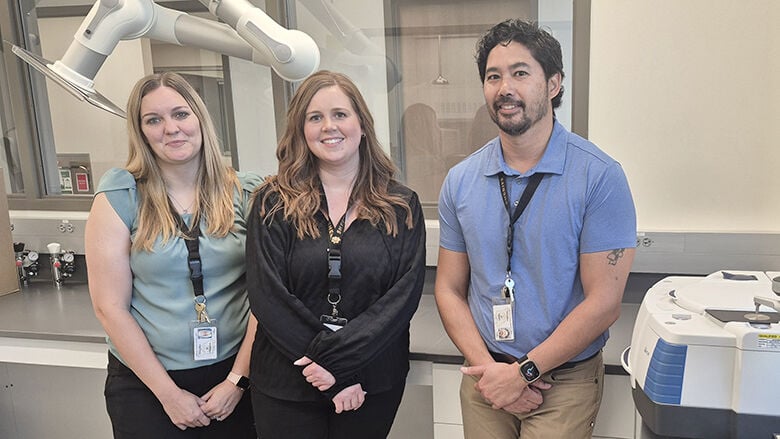
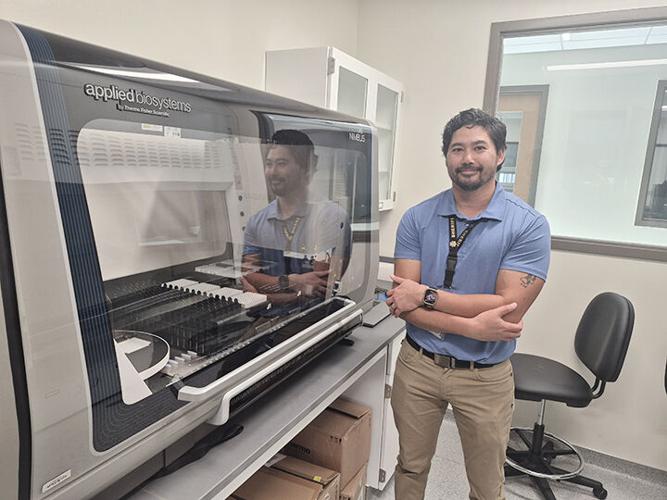
Jefferson County Sheriff’s Office Crime Lab Director Kevin Kellogg said the Nimbus Pro, at left, extracts and analyzes DNA samples.
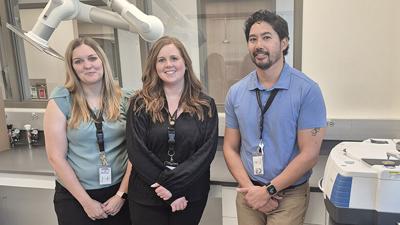
Crime lab director relocates for new challenge
By Tony Krausz
Kevin Kellogg has been busy since moving from California to Missouri to oversee the recently built Jefferson County Sheriff’s Office Crime Lab.
Kellogg, 47, left his position with the Santa Clara County District Attorney’s Office in June to take the crime lab director job here. His annual salary with the Sheriff’s Office is $137,500.
Since assuming the director role, he has hired three drug chemists and two DNA specialists; overseen the ordering of equipment and supplies and the installation of the equipment; and started the processes necessary to receive accreditations for chemical and DNA testing by creating manuals and safety and quality assurance programs.
“It is not like coming in as a director of an existing lab, where you may need to hire someone or improve one instrument,” Kellogg said. “You have to start everything from the ground up. It is quite a challenge.”
The nearly 11,000-square-foot crime lab, 1177 Mason Circle, in Pevely was built next to the Sheriff’s Office’s evidence storage building.
According to Jefferson County documents, it cost $7,892,242.76 to build the lab. The county used $7.1 million of its allotment from the American Rescue Plan Act of 2021 (ARPA) stimulus plan to cover most of the cost.
Sheriff Dave Marshak said as of Nov. 20, the department was still purchasing equipment for the lab, but the project is expected to be completed under the $9.6 million that was budgeted for it.
“We have several grants we are waiting for approval on,” Marshak added.
He said computer forensic investigators moved into their portion of the lab in July, and members of the crime scene and latent prints units started working in the building in August.
Kellogg will oversee the forensic scientists, who, once the lab is fully accredited, will be able to process DNA evidence and test substances submitted by Sheriff’s Office investigators.
Marshak said the lab is expected to start testing substances in May and be accredited for DNA testing by December 2026.
“Building a crime lab is a lot like starting a farm,” he said. “Just because you’ve bought the land and built the barn doesn’t mean you’re ready to harvest crops. The soil must be prepared, the seeds planted and the fields nurtured before you can expect a yield.
“The same is true in forensic science. Before results can be ‘harvested,’ the lab must cultivate the right environment, validate its instruments and ensure every process meets rigorous scientific standards. Only then can we produce evidence that is reliable and trusted in court.”
Marshak said Jefferson County needed its own crime lab because his office now sends evidence to the Missouri State Highway Patrol’s lab in Jefferson City. That lab processes evidence from county and city law enforcement agencies around the state, and it can take up to a year to get results, and that’s if the lab even accepts the evidence that needs testing because of the overload.
“The ability to prioritize our own cases and determine which evidence is tested first is an enormous advantage,” he said.
Marshak said the Jefferson County crime lab currently examines latent prints photography and crime scene work and performs computer forensics for the Sheriff’s Office and area municipal police departments.
“For established disciplines like photography, crime scene work and latent fingerprint analysis, we can now use advanced technology that identifies more suspects and processes evidence more efficiently, something we couldn’t do before because of space limitations,” he said.
Marshak said the lab provides the space that computer forensic investigators need to perform their duties. As a result, a Eureka Police officer recently was added to the computer forensic unit, joining a deputy and Arnold Police officer, after they moved into the lab.
“Technology now plays a central role in nearly every criminal case,” Marshak said. “From smartphones and watches to vehicles, digital evidence often determines whether a suspect can be identified and prosecuted. With the new lab, we can now expand into vehicle forensics, which has become increasingly important as modern cars store critical investigative data.”
Marshak said after completing accreditation processes, the Sheriff’s Office’s drug and DNA evidence will be tested at the Jefferson County lab.
Kellogg said he expects to start off handling just the Sheriff’s Office investigations when the drug and DNA labs begin operating, but the plan is to accept and test evidence from other departments in the future.
“We will see what our capacity is and go from there,” he said.
Coming to Jefferson County
Kellogg, who now lives in Fenton with his wife, Alicia, and their two daughters – Kaitlyn, 11, and Hannah, 8, previously worked for the Santa Clara County District Attorney’s Office since 2010 and started managing cold cases for Santa Clara County in 2013.
“I prioritized what cold cases should be worked and what test methods should be used on test samples,” he said. “Also, for about two years, I supervised one of the DNA units. I think our DNA unit was about 23 people, and there were three supervisors. I was managing one third (of the unit).”
Kellogg started his DNA forensics career with the California Department of Justice in 2005 and then went to work for the San Francisco Police Department in 2006.
He has a bachelor’s degree in cellular and developmental biology from the University of California-Santa Barbara and a master’s degree in cellular and molecular biology from California State University-Sacramento.
“Kevin is a DNA expert with supervisory experience in a forensic crime lab,” Marshak said. “He’s also an accomplished national presenter and has taught at the university level. Beyond those credentials, Kevin was genuinely excited about the challenge and professional growth that comes from building a lab from the ground up. He brings the energy, motivation and leadership skills needed to make that vision succeed.”
Kellogg said he was not looking for a new job when he saw the Jefferson County Crime Lab director position posted on the American Academy of Forensic Sciences website. However, he was intrigued by the opportunity to start a new lab, even though the location made him pause.
“I was like, ‘OK, this looks like something I really want to do,’” he said. “Then I looked at the location. I was like, ‘OK, this is in Missouri.’ It would be a big change for me and my family. Is this something we would want to do? Is it worth moving here?
“Looking at everything holistically, I liked what I was doing in California, but I was commuting a lot, everything was expensive and I could be doing this for X amount of years, but would I be content? Then there is this other opportunity that I could dive into and take the challenge, and that is something I found exciting.”
Kellogg said when he first visited Jefferson County, it reminded him of where he grew up in Loomis, Calif., which is part of the Sacramento metropolitan area.
He said the biggest challenge of relocating to Missouri is getting used to the weather, but the objective of the crime lab has been worth moving nearly halfway across the country.
“It is a national problem having forensic evidence being conducted,” he said. “There is a backlog in Missouri, California and other states. There are not enough labs or resources to examine all the evidence that you want and to examine the evidence in a timely manner. Having the ability for the county to have its own lab and triage its own evidence on how it gets worked is a luxury.
“Coming from Santa Clara, their county has their own lab. Their DA’s office calls their lab the crown jewel. They have the luxury of dictating how they want their evidence prioritized.”
Kellogg said he feels he has the right people in place after hiring the new drug chemists and DNA analysts, and he is looking forward to the lab working on its first cases.
“I am really glad that I took this job. I like the community,” he said. “The Sheriff’s Office has been really great. I feel like I have been handed keys to a Corvette, and I just have to make sure it is running smoothly.”

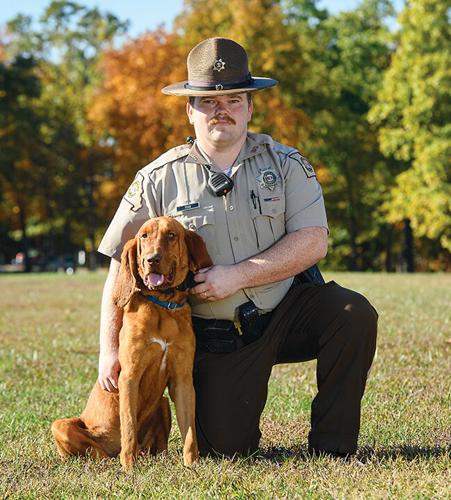
Deputy Josiah Tegg with his canine, Scout.
Jefferson County Sheriff’s Office adds two dogs
By Tony Krausz
The Jefferson County Sheriff’s Office recently added two more canines to its roster.
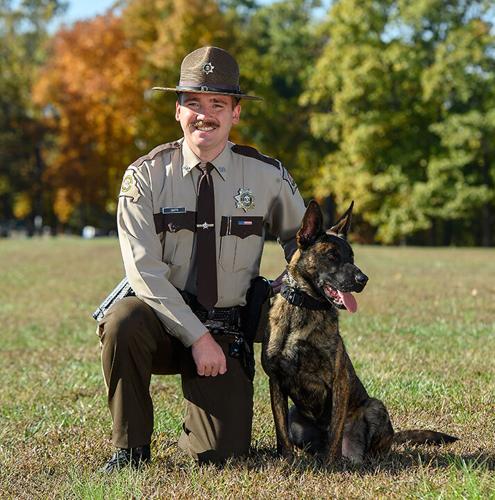
Scout, a 1-year-old bloodhound, started working with Deputy Josiah Tegg on Aug. 26, and Tedi, a 15-month-old Dutch shepherd, started working with Deputy Logan Smith on Oct. 27.
Scout specializes in tracking and locating people, and Teddi is trained in explosive detection and also may be used to track missing people.
“I think the K-9 unit is really important to a police department or sheriff’s office,” Smith said. “We have narcotic dogs. We have bloodhounds. Now, we have an explosive dog. All of that brings a lot to the table.”
The Sheriff’s Office has three other canines.
Bert, an 18-month-old Belgian Malinois shepherd mix, has been partnered with Deputy Josh Oesterreich since March. Zeus, a bloodhound, is partners with Deputy Derek Richard, and Murphy, a Belgian Malinois, is partners with Deputy Brad O’Donnell.
The Sheriff’s Office lost two dogs earlier this year.
Kane, a 12-year-old German shepherd, retired in May after partially tearing an ACL while trying to locate men who allegedly stole telecommunications wire in Imperial. Kane had been partnered with Deputy Marc Gibson, who also is the school resource officer for Seckman High School, and the dog died in October.
Maro, a 12-year-old Dutch Shepherd, unexpectedly died Sept. 15 from an apparent stroke. Maro had been partnered with Deputy Scott Burkard.
Tegg said having canines is beneficial.
“Canines like Scout, who is able to smell somebody who walked through an area a week prior, to other canines, like Murphy and Bert whose sheer presence can get somebody to give themself up because they don’t want to get bit, are extremely beneficial,” he said.
The Sheriff’s Office paid a total of $13,500 to acquire Scout and to get training for Tegg and the bloodhound at Scent Evidence K9 in Tallahassee, Fla., spokesman Grant Bissell said.
The H-J Family of Companies, a manufacturing business in High Ridge, donated Tedi to the Sheriff’s Office, Bissell said. He said H-J paid $22,634 to acquire Tedi, cover the cost of training at F.M. K-9 in Berrien, Mich., and for additional equipment to be installed in a Sheriff’s Office cruiser needed for the dog.
Scout
Tegg, 29, of the De Soto area said Scout has an impressive lineage.
He said the bloodhound’s aunt, Stella, received a national accreditation for being one of the best tracking dogs in the nation. She is owned by the Scent Evidence K-9, where Tegg and Scout trained before going on active duty in August.
“When we bought Scout, we were not just buying a bloodhound. We were buying the legacy that came with the bloodline,” Tegg said.
Scout has proven to be a chip off the family block with the Sheriff’s Office. Tegg said he and Scout were called upon to track a person or an object six times between Aug. 26 and Sept. 13.
Tegg also said Scout was part of the team that looked for Stacy Jay-Malcom after her husband, Robert Malcom, 60, was found dead on Aug. 30 in their Dittmer home.
Stacy Jay-Malcom was found on Sept. 7 on private property in a wooded area in the 8900 block of Hwy. WW in Dittmer. On Nov. 20, Sheriff Dave Marshak said investigators believe Stacy Jay-Malcom shot and killed her husband, but the department was still awaiting lab confirmation.
“He found firearms and other items dropped by (Stacy Jay-Malcom),” Tegg said. “I went a different day, and he took us up the road, basically a mile from where she was found before he tired out.
“He has had confirmed directions of travel, firearms located, a confirmed missing location. I don’t think I have been on a single track with him that we did not locate something.”
Tegg, who started working at the Jefferson County Jail in October 2021 and became a deputy in July 2022, said it was one of his career goals to become a canine officer.
He said he set that goal after watching a demonstration while attending the Police Academy. He said an officer threw a bullet in a room, brought a dog in, had the dog smell the gun, and the dog found the discarded bullet in less than two minutes.
“It was really neat to see the dog work. I wanted to be part of that kind of training,” Tegg said.
He said he completed training sessions with the Sheriff’s Office canine officers before being assigned to the unit. He also was thrilled when Marshak told him he would be paired with Scout.
“I was sitting down typing a report one day, and the sheriff asked me into his office. I am like, ‘Oh dear, I’m in trouble.’ When I get in there, he is like, ‘You applied to be a canine officer, right?’ I was like, ‘Yes sir.’ He asked, ‘What have you done to do that?’ I told him how I gave up some of my own time to go to canine training sessions. He was like, ‘How would you feel about getting a bloodhound?’
“I was ecstatic then.”

Deputy Logan Smith with his canine, Tedi.
Tedi
Smith, 27, of De Soto said he and Tedi trained at F.M. K-9 from Sept. 22 to Oct. 22. He said Tedi can detect black powder, C-4, TNT, dynamite and other explosive materials.
He also said Tedi can find discarded firearms and fired bullets.
“It was challenging at first to get to know his tell-tale signs when he knows there is an explosive in a locker or there is an explosive hidden in a room or vehicle,” Smith said. “After the first couple of weeks, the tell-tale signs were pretty easy to catch on to with the help of the trainers. They gave me a whole bunch of clues about what to look for when he goes to work.”
Smith said he joined the Sheriff’s Office less than two years ago after working for the St. Louis County Police Department for about three years.
He said he wanted to be partnered with a dog to help him with his road patrol duties.
“Having an extra partner who is trained in a specialized field can help in different situations while on road patrol,” he said. “I was luckily chosen through the selection process.”
Smith said he and Tedi have been deployed once since they started working together, but the dog was unable to find anything.
However, Smith said Tedi’s skills are valuable to the Sheriff’s Office.
“If we had a shooting, Tedi is able to detect the black powder residue,” he said. “He can search for a weapon that has been discharged and thrown from the scene and gun shell casings that have been spent that are not visible to a patrol officer.”
Connecting
Along with police work, the dogs are a great way to connect with the community, both Smith and Tegg said.
Smith said he and Tedi went to H-J after returning from training, and he found people are more likely to approach him when he is with the dog.
“Everybody at H-J got to meet him, and we have been to a couple of (public relations) events,” he said. “People are more likely to come up to me and ask questions.”
Tegg and Scout attended the open house for the Sheriff’s Office and Rock Township Ambulance District’s shared facility in Imperial on Oct. 29, and the two have also been at other public relation events.
“When I bring him out for PR events or someone wants to see the dog, he goes wild when people show him love,” Tegg said. “The moment they find out he is a bloodhound, everybody wants to pet him. It is really good for doing PR and showing a different side of the Sheriff’s Office.”
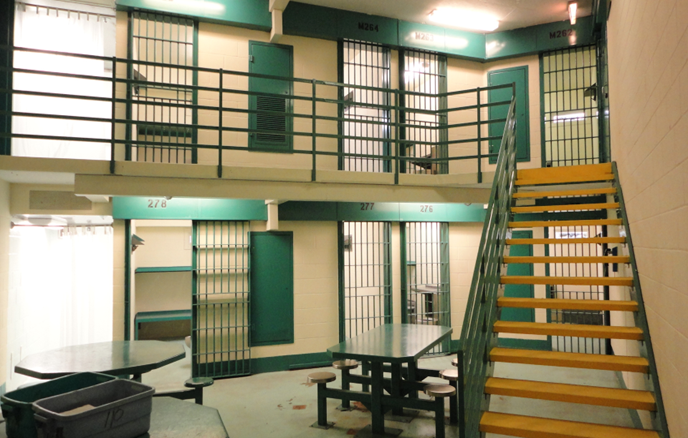
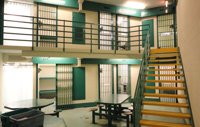
Interior of the Jefferson County Jail in Hillsboro.
County jail faces overcrowding, structural issues
By Abby Stetina
The Jefferson County Jail in Hillsboro operates like a small city, with a kitchen, laundry room, transportation service, mail room, visitation area and dorms, Jefferson County Sheriff Dave Marshak says.
When the Law Enforcement Center was built in 1991 for $6.5 million, the jail also housed the Sheriff’s Office headquarters. In 2008, though, the county built the current Justice Center next door to the jail for $4.9 million. At that time, the Sheriff’s Office relocated from the third floor of the jail to the center, and the former office space was converted to dorm-style, minimum-security beds.
Even with the expansion, overcrowding remains an issue at the jail, and the building has some structural issues, Marshak said.
The entire jail infrastructure, he said, including the kitchen, medical areas, recreation, religious space, plumbing and electrical, was designed to handle 80 inmates. Today, the jail serves more than four times that amount, he said.
The jail had 116 beds when it was first built. Another 152 permanent beds were added during the 2008 expansion, for a total of 268 beds. The jail has a maximum capacity of 334 beds, but with daily population fluctuations, the actual number of inmates in the jail has been recorded as high as 370 and as low as 180, Marshak said. Stackable sleds, sometimes called EZ bunks or “sled beds,” are used when the jail runs out of permanent beds for inmates.
“When we run out of space, we have two options: pay other counties to house our inmates, which is extremely expensive, (or) reduce our own population, which often means releasing individuals earlier than victims or the public would expect,” Marshak said. “These pressures exist while the current building is showing signs of structural strain, including stress fractures that formed after the third-floor expansion. Any partial collapse would be financially devastating for the county.
“The second floor contains six holdover cells, but because they lack showers and proper medical space, these cells are temporary and are often used by necessity for inmates on medical or suicide watch,” Marshak said. “This is not ideal or best practice.”
A brief history
The county’s first jail was constructed in Herculaneum in 1820, the county’s seat of government at the time. When the county’s seat switched to Hillsboro in 1839, a new courthouse with a jail was constructed in 1841 for about $1,500.
A new courthouse and jail complex was built in 1863 due to population growth in the county. That courthouse is still in operation today, with many officials deeming it inadequate for its current uses. The building houses the 23rd Circuit Court, including courtrooms, the Prosecuting Attorney’s Office and the Circuit Clerk’s Office.
Expanding roles
The Sheriff’s Office employs 60 correctional employees at the jail. Capt. Brian Taylor serves as the jail’s support services commander, and Brenda Short, a civilian, is the jail administrator.
Correctional employees are often asked to handle situations outside their purview, Marshak said, including caring for inmates who are detoxing from alcohol or drugs and monitoring inmates with mental illnesses. He said the facility is not equipped to handle that level of need, adding that the jail may have 30 people detoxing on a given day.
The jail is currently also understaffed and has eight correctional officer positions open.
“Lt. Col. Tim Whitney (the undersheriff) often says our jail staff are superheroes, and I agree,” Marshak said. “They do the work of a modern mental-health center, detox unit, transportation hub and housing facility every day inside a 1991 structure designed for a very different era.”
Future of the jail
The Capital Improvement Plan for County Buildings, provided by County Executive Dennis Gannon and approved by the County Council, recommends that a total of $1,525,000 be spent over the next five years for exterior, interior and special projects at the jail.
Any improvements would have to be allocated in the county’s annual budget and approved by the council. The county’s fiscal year runs from Jan. 1 to Dec. 31, and the 2026 budget must be approved by the end of this year.
The county’s newly adopted master plan, called the Visualize Jefferson County Master Plan, makes one mention of the jail.
“One of the agency’s significant obligations is the jail, which houses pre-trial detainees and convicted offenders,” the plan states. “The jail has become the largest de facto mental health provider in the county and the best place to invest in services for drug addiction to reduce recidivism. The county should prioritize investments in the jail, which will yield public safety benefits for the entire community.”
The county purchased a 15.24-acre piece of vacant land at Business 21 and Goldfinch Lane south of Hwy. A in Hillsboro in 2021 for $425,000. That property could be used to build a replacement jail, but no money has been allocated to build a new facility.
Regardless of the future of the jail, either at a brand-new facility or in its current place, Marshak said the Sheriff’s Office will strive to provide compliant room and board for inmates.
“A jail is meant for short-term incarceration, but in practice, lengths of stay vary dramatically,” Marshak said. “The legal system often moves slowly, especially when mental health evaluations or competency concerns are involved. Some individuals have remained in our custody for three years awaiting resolution.
“A large percentage of our detainees are legally presumed innocent,” he said. “A small number will ultimately be found not guilty. Yet jails must provide constitutionally compliant housing, health care and safety regardless of conviction status.”